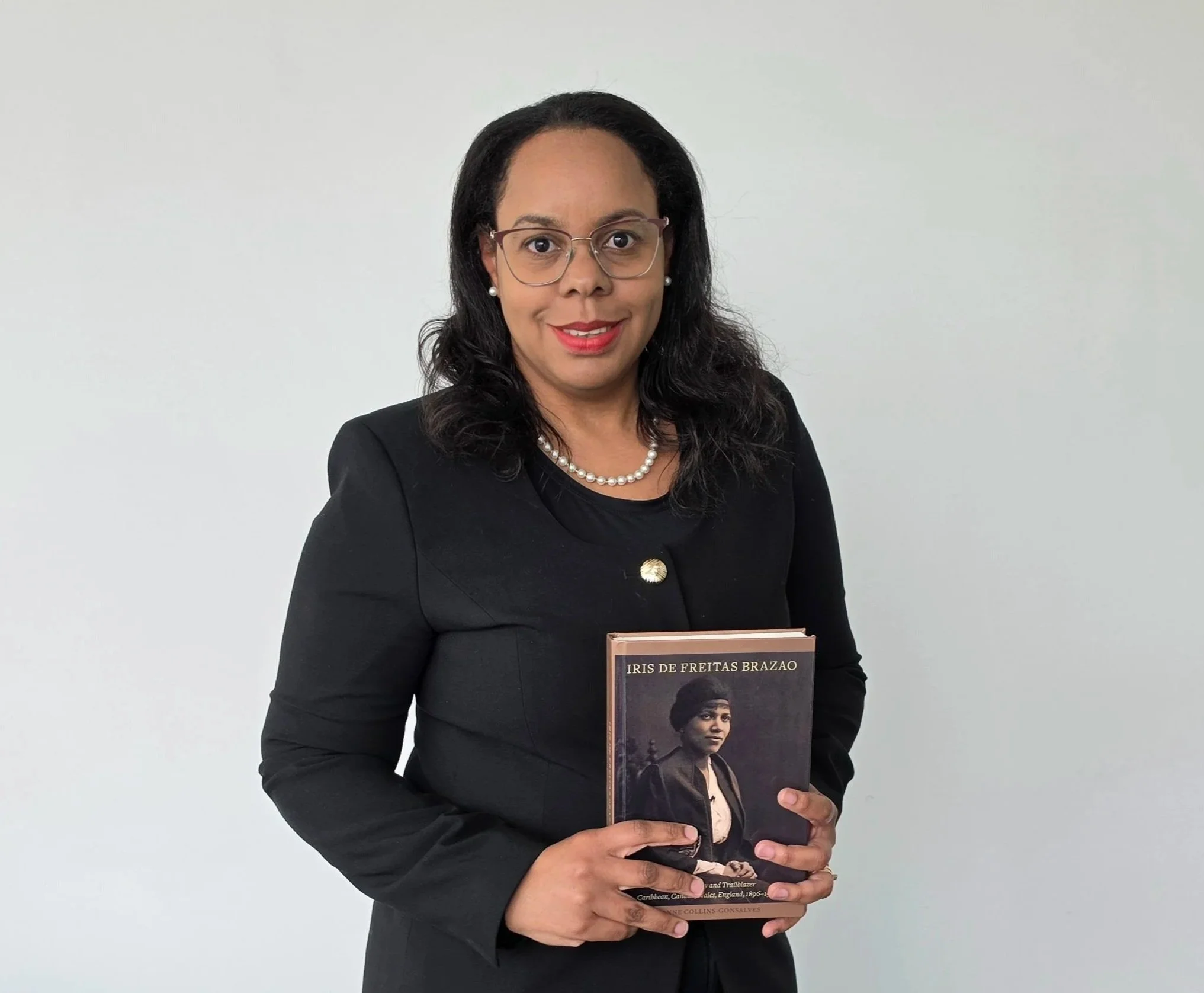
A father’s revelation leads Joanne Collins-Gonsalves to a Caribbean legal pioneer
October 29, 2026
When Dr. Joanne Collins-Gonsalves learned in 2012 from her father about their family’s connection to Iris de Freitas Brazao, her research into the pioneering Caribbean lawyer took on a deeply personal meaning.
Her paternal grandmother, Muriel Collins, née Graves, had attended St. Ursula’s School in British Guiana with de Freitas Brazao. Their friendship continued into adulthood, and Collins offered comfort during a period of profound loss.
“After her husband passed, she actually stayed with my grandmother for a time because she was in such grief,” Collins-Gonsalves said. “My father grew up knowing her as Aunt Iris.”
Discovering that bond added another dimension to her efforts to document a woman whose accomplishments had received far less attention than they deserved.
On October 15, Collins-Gonsalves shared de Freitas Brazao’s story at the University of Toronto Scarborough during a Women’s History Month lecture facilitated by historian Dr. Afua Cooper.
The event also highlighted the legal pioneer’s connection to the university where she spent a semester in 1918 before continuing her education in Wales and England.
More than a century later, the historian whose family had welcomed de Freitas Brazao into their home was helping students understand the significance of her journey.
Cooper’s involvement reflected her own longstanding commitment to bringing overlooked Black experiences into public knowledge.
A distinguished professor at U of T Scarborough, she founded the Black Canadian Studies Association and established Dalhousie University’s Black Studies program, helping create the academic foundations through which this history can be researched, taught and preserved.
Her book, The Hanging of Angélique: The Untold Story of Canadian Slavery and the Burning of Old Montréal, challenged popular understandings of Canada’s past through the story of an enslaved Black woman executed in 1734.
Cooper’s leadership of A Black People’s History of Canada has also helped make historical research accessible through educational resources for teachers and students.
Facilitating the lecture extended that work by creating space for another Black woman’s life to be examined and understood.
“I am so very pleased that Professor Cooper asked me to do this lecture on Iris and be able to share her incredible journey and her contributions, not only academically, but the woman that she was in the legal profession,” Collins-Gonsalves said. “It has opened doors in Guyana and throughout the Caribbean.”
For young Caribbean Canadians, particularly those born or raised here, she believes learning this history can deepen their understanding of the communities from which they come.
“It is to know that they have a proud heritage,” Collins-Gonsalves said. “This Caribbean woman, this woman of African heritage, this woman also of Portuguese heritage is a true Caribbean woman.”
de Freitas Brazao’s educational and professional achievements also connect Caribbean history with Canadian and British institutions, allowing students to recognize a shared past that extends beyond national boundaries.
“She is a wonderful example of a Caribbean woman who excelled despite opposition and adversity,” said Collins-Gonsalves. “Whether she faced barriers in her university studies, as a woman entering the legal profession or as a woman of colour, she prevailed. There is so much to admire about Iris.”
Her own introduction to the subject emerged through research into Portuguese business history in Guyana.
de Freitas Brazao’s father, Manuel Gregor de Freitas, was a wealthy Portuguese businessman whose activities fell within the scope of that investigation.
When Collins-Gonsalves asked her father, Aubrey Collins, whether there were other people she should consider, he mentioned de Freitas Brazao and added a detail about his daughter almost in passing.
“He said, ‘And his daughter was the first female lawyer in the Caribbean’,” she recounted. “I had no idea. I was like, ‘Really, Daddy?’ I was so surprised.”
Collins-Gonsalves's research, begun in 2010, eventually produced the 2023 biography, Iris de Freitas Brazao, Legal Luminary and Trailblazer: Caribbean, Canada, Wales, England 1896–1989.
“My original area of research is economic history,” she said. “During my research on the Portuguese, I found out her father was a wealthy Portuguese businessman. And then I found out about her. In my PhD dissertation, I wrote a small chapter on her and I said, ‘I must come back to this’.”
Returning to the subject required piecing together a life from evidence scattered across countries and institutions.
There was no substantial collection of personal papers to guide Collins-Gonsalves. University documents, newspapers, archival records and interviews became essential to reconstructing de Freitas Brazao’s experiences.
“There are no known surviving diaries or personal records of hers,” she pointed out. “This research draws on public sources, including university records, archival material and newspapers.”
The limited attention previously given to de Freitas Brazao help explain why her name remains unfamiliar outside certain historical and legal circles.
“References to her are scattered across records, newspapers and books,” Collins-Gonsalves said. “Often, they amount to just one or two lines.”
Those brief references recorded accomplishments but offered little opportunity to understand the support, ambition and determination behind them.
Born in Barbados and raised in British Guiana, now Guyana, de Freitas Brazao benefited from a father who had both the resources and the willingness to support his children’s education.
Overseas study was expensive, but his encouragement helped make a legal career imaginable at a time when few women could pursue that path.
“He not only had the wealth, but he was the one who pushed her to do it,” Collins-Gonsalves said. “He was the one who suggested, ‘You need to go and become a lawyer’. He was a remarkable man because he did not do it for her only. He did it for all of his children.”
Her mother, siblings and teachers also formed part of that support network.
After her brief period at U of T, de Freitas Brazao studied at Aberystwyth University, the University of Oxford and the Honourable Society of the Inner Temple.
In 1929, she was called to the Bar, becoming the first woman barrister-at-law in the Commonwealth Caribbean.
Collins-Gonsalves was particularly struck by the demands of de Freitas Brazao's overlapping academic and professional studies.
“She was between Wales, Oxford and the Inner Temple during the 1920s,” she said. “This is at a time when women had just been allowed to graduate from the University of Oxford.”
de Freitas Brazao qualifications did not shield her from discrimination when she returned to the Caribbean.
“She faced arguments that employment opportunities should be left for men,” said Collins-Gonsalves. “Her use of her maiden name after marriage also attracted opposition that reached the legislative assembly.”
Understanding those experiences, the historian believes, is essential to appreciating the significance of her career.
“Iris faced a lot of opposition,” she said. “The fact that she was able to persevere, the fact that she was able to prevail and the fact that she was able to excel are really great qualities that I found about her. She had an exceptional life.”
Recovering such experiences forms part of a broader commitment Collins-Gonsalves brings to her professional work.
She is managing director of Historical Research International Inc., a Canadian company that researches and documents the histories of businesses, organizations and individuals. Its work includes business histories and biographies, helping turn dispersed records and personal recollections into documented accounts.
“We do historical research for companies, organizations, businesses,” Collins-Gonsalves, who is based in Edmonton, said. “We are focusing a lot on business history as well. We ensure that businesses have their history written.”
That work can preserve the knowledge of founders and employees, establish an accurate account of an organization’s development and help later generations understand the circumstances in which it operated.
“As companies grow, their history needs to be told,” Collins-Gonsalves said. “And that history can then be used in a myriad of ways around the company for communication, to ensure that the information is correct.”
de Freitas Brazao’s biography demonstrates the value of sustained historical investigation. Without it, a distinguished career might have remained a collection of brief references, with little explanation of the woman behind its milestones.
For Collins-Gonsalves, the instinct to ask questions about the past began at home.
Her father, a former president of the Guyana Heritage Society, took her to historical lectures. She pursued history at school and university and later researched Caribbean integration at the CARICOM Secretariat.
Collins died not long after their conversations about de Freitas Brazao, making the memories he shared especially valuable.
His contribution also illustrates what younger people can discover by asking parents, grandparents and other elders about their lives. Family recollections can provide leads, relationships and perspectives that formal records alone may never reveal.
Collins-Gonsalves, who served on the Edmonton Heritage Council, hopes universities and legal institutions will find more tangible ways to honour de Freitas Brazao. She sees 2029, the centenary of the legal pioneer’s call to the Bar, as an opportunity to build on the growing recognition of her life and achievements.
“I would like to see much more done to honour Iris,” she said. “I’m humbled to have played a small part in bringing attention to her story, and I will continue that work. She is someone to look up to and someone whose contributions deserve recognition.”