The helping hand behind Karl Hale’s rise in tennis and service to Jamaica
August 19, 2026
Karl Hale was not born with a golden spoon in his mouth or a racquet in his hand.
Raised by a single mother, now 92, he grew up in low-income housing near Peanut Plaza in North York. His family did not own a car, and he watched television in black and white until he was 20.
Tennis, with its club fees, court costs and expensive equipment, might as well have belonged to another world.
Yet the sport became the thread connecting almost every chapter of Hale’s life from representing Jamaica in Davis Cup competition and coaching in Japan to directing one of the world’s leading professional tournaments, expanding access to racquet sports in the Greater Toronto Area and building schools for children in Jamaica.
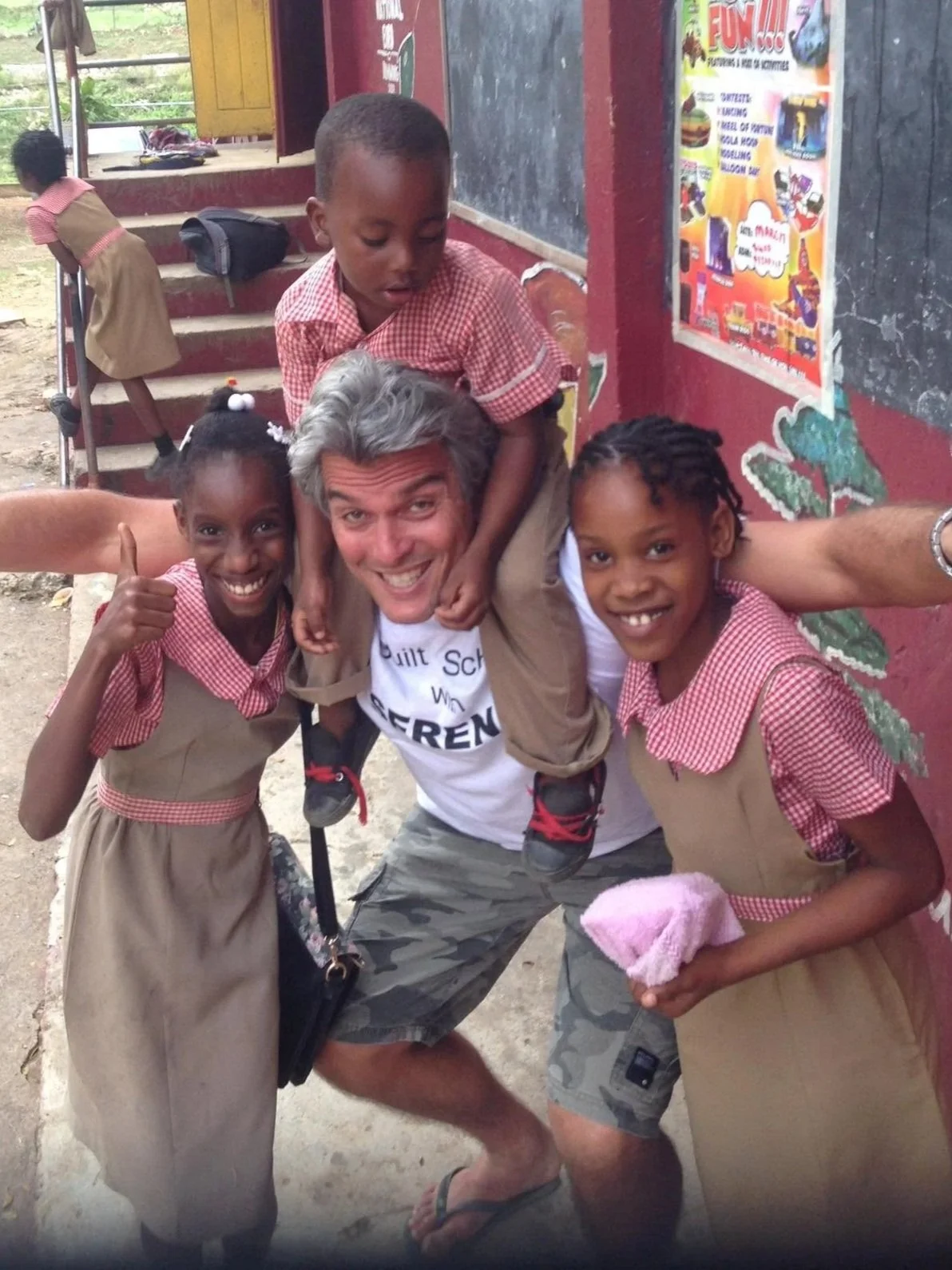
Karl Hale during a school build in Jamaica in 2015 (Photo contributed)
None of it would have happened, he said, without people who opened a door when he could not afford the key.
At 13, Hale began playing at the North York Winter Tennis Club’s indoor facility near Peanut Plaza where George Fowler and Dave Duguay recognized his enthusiasm for the sport and allowed him to use courts that would otherwise have sat empty early in the morning or late at night.
“I definitely couldn’t afford to play tennis,” he pointed out. “They let me play for free at seven in the morning or 10 at night. It allowed me the opportunity to really improve and develop my passion for tennis.”
Hale played outdoors in the summer and searched for any opportunity he could find in the winter before a scholarship at age 18 to the University of New Mexico gave him regular access to the game and accelerated his development.
The experience taught him that while talent is widely distributed, opportunity is not.
“People just need one person to help them, and they can do amazing things,” Hale said. “I have done amazing things in my life, and if I can help one person through these channels, I would do it.”
By the 1980s, Peanut Plaza had become more than a shopping centre for him. It was a gathering place for the area’s growing Jamaican community, with businesses, food and familiar personalities that helped many newcomers feel at home.
Hale remembers Bev Chin’s travel kiosk, Allan’s Pastry, Linstead Market and Mr. Jerk, which opened in 1986. Snow, the North York-raised artist who achieved international success with his 1993 hit Informer, was among the young people who frequented the plaza and surrounding neighbourhood.
“My community was Peanut Plaza,” he noted. “I grew up in definitely a much different environment than people perceive.”
That perception is understandable.
Hale is a prominent racquet sports executive and entrepreneur whose work encompasses tennis, pickleball, and padel. He has served as tournament director of the National Bank Open in Toronto since 2006 and is the founder of court-construction company Premium Court and founder and chief executive officer of Premier Racquet Clubs which operates facilities in Mississauga, Markham, Brampton and Toronto.
He has also held senior international leadership positions in coach education, including chairing the Professional Tennis Registry and Professional Pickleball Registry and serving with the Padel Coaches Registry.
Hale’s accomplishments can look inevitable from a distance, but they were anything but.
When he became tournament director of the Toronto event in 2006 at age 38, Canadian tennis held a much smaller place in the country’s sports culture. The men’s and women’s competitions were staged in separate weeks, the tournament had only recently been renamed the Rogers Cup and Canada had few homegrown stars capable of attracting casual fans.
Nearly two decades later, Canada had won its first Davis Cup title in 2022 and its first Billie Jean King Cup championship the following year. Canadian players had also captured Grand Slam titles and emerged as internationally recognized stars.
The National Bank Open expanded to a 12-day format in 2025, and attendance in Toronto grew from approximately 100,000 to more than 200,000.
Hale sees the tournament’s growth as both a product and a driver of the sport’s rise. A longer schedule gives fans more chances to attend, while Canadian success has helped move tennis beyond its traditional audience.
“We all like to be involved with champions and winners,” he said. “Right now, our sport is a winner.”
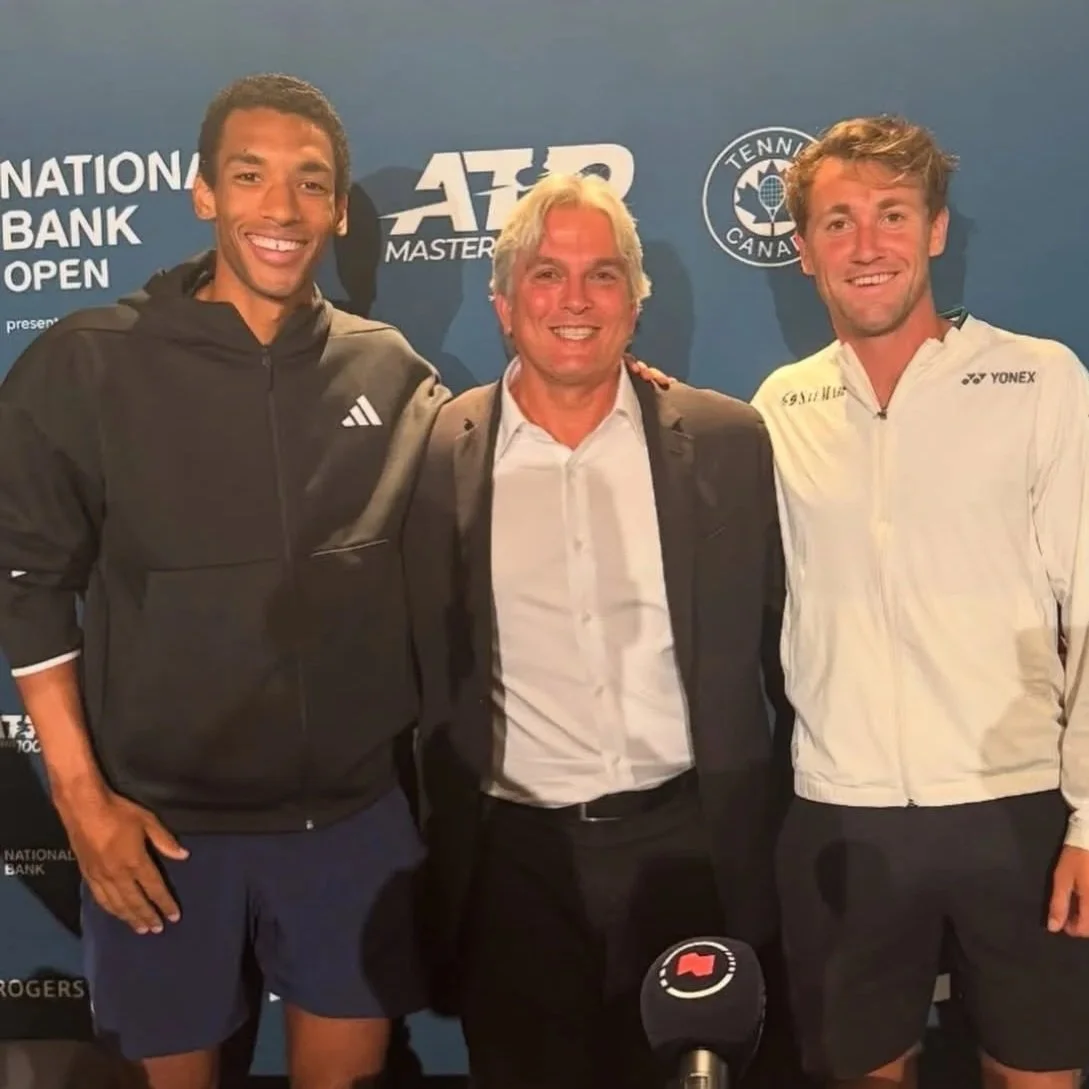
Karl Hale with Canada’s top two men’s singles tennis players Felix Auger-Aliasssime & Denis Shapovalov (Photo contributed)
The job begins again almost as soon as the final ball is struck.
Hale contacts players and their representatives for the following year, works with sponsors and helps shape an experience that must satisfy athletes, spectators, broadcasters and an international audience.
Because the men’s and women’s competitions are top-tier, mandatory events on their respective tours, the leading players automatically include Canada on their calendars. The tournament will also offer equal prize money to men and women beginning in 2027, another sign of its evolution.
Hale’s rise to the upper ranks of Canadian tennis did not distance him from the teenager whose opportunity to play depended on someone providing free court time. Instead, it strengthened his determination to make racquet sports more accessible to others.
That commitment inspired Premier Racquet Clubs, a network that is expanding to six GTA locations. Through its tennis, pickleball and padel programs, PRC aims to create more affordable entry points for families and communities historically underrepresented in racquet sports.
Rather than viewing pickleball as a competitor to tennis, Hale embraces it as an accessible sport that beginners can learn relatively quickly and that can encourage otherwise inactive people to exercise. He has also introduced padel through PRC as the internationally popular sport begins establishing a foothold in Canada.
He believes that rapid participation growth must be accompanied by qualified instruction. Through his leadership roles with international coaching organizations, he has promoted education and certification so instructors can teach proper technique and safe play, particularly in pickleball, where inadequate preparation can increase the risk of injury.
Hale’s business model and philanthropic mission are rooted in the same conviction that access changed his life and widening it can change someone else’s.
His first tennis inspiration was his brother Robert, who is 10 years his senior. Robert played at Munro College in Jamaica before walking on at Seminole Junior College in the United States without a scholarship and eventually becoming the team’s top-ranked player. He later represented Jamaica and served as the country’s Davis Cup captain.
Karl watched and admired his older brother while constantly challenging himself to reach Robert’s level.
“I was always very competitive,” Hale said. “I thought I could beat him, though I never did. I believed I was good, but he was my role model and the person who inspired me to take up the sport.”
The brothers still play whenever Karl visits Robert in the Cayman Islands. With age beginning to take its toll on his older brother, Karl now has the upper hand.
“I can beat him now because he’s 10 years older,” he said with a laugh. “And I don’t let him forget. It’s not how you start. It’s how you finish.”
Hale went on to represent Jamaica in Davis Cup competition, an experience that raised his international profile and helped shape his approach to leadership. Jamaica entered the tournament as an independent nation in 1988 after players from the region had previously competed for a combined Caribbean/West Indies team.
He developed a successful partnership with fellow Jamaican Doug Burke, the president of ACE Tennis in Canada. The pair won eight Davis Cup doubles matches together, a Jamaican record.
Their most memorable victory came in 1993 against Allan Lopez and Miguel Merz of El Salvador. Hale and Burke prevailed in a marathon doubles match, with the deciding set ending 23–21.
Hale recalled that the match stretched over two days because the facility lacked adequate lighting. With the fast court and powerful serving making breaks difficult, the Jamaicans agreed when play resumed that they would have to take greater risks on their returns.
“We said to each other, ‘To break serve, we’re just going to have to go for it and hope you connect a few times,’” Hale recalled. “We got lucky to break and then held serve.”
The 23–21 deciding set established a Davis Cup record for the longest final set in a doubles match, measured by games. Because deciding-set tiebreaks are now used in the competition, the mark is unlikely to be surpassed.
For Hale, however, representing Jamaica meant more than possessing a record.
“It is the highest honour in sport, representing your country,” he said. “It made me really proud, and it actually helped me get more recognized in the tennis community. It was an integral part of my development as a leader.”
Hale tested himself on the professional circuit and proved capable of pushing elite opponents. He also had the honesty to recognize the difference between producing one excellent tournament and sustaining excellence week after week.
“I was a good player, but not a great one,” he said. “I had beaten some very good players, but I recognized the difference in consistency. I could play well for one tournament, while the top players performed at that level for an entire month. I knew I couldn’t sustain that.”
That realization opened another door.
After nearly defeating a top-50 opponent at the Japan Open, Hale accepted an opportunity to coach in Japan. What he initially imagined as a one-year assignment became a five-year education in culture, discipline and human relationships.
He worked with leading juniors and professional players while learning to navigate homesickness, language barriers, earthquakes and a social structure far removed from North America. The experience taught him to listen before imposing his own assumptions.
“You really see how different ethnicities, communities and socioeconomic groups operate,” he said. “They all have their own uniqueness, and they all work in their own way. You learn, working with people, to listen more and understand where they are coming from.”
Hale was particularly struck by the respect accorded older people and the belief that experience should be valued rather than pushed aside. Japan’s famous punctuality and collective discipline also influenced how he approached business and leadership.
The club owner who recruited Hale, Munehiro ‘Hiro’ Yoshida, became one of the most influential male figures in his life. Yoshida and his wife, former Japanese tennis star Kazuko Sawamatsu Yoshida, share a deep commitment to the sport.
She made history in 1975, teaming up with Ann Kiyomura to capture the Wimbledon women’s doubles championship. The couple later established the Yoshida Memorial Tennis Training Center in Kashiwa where Hale coached for five years.
Yoshida’s faith in Hale continued a pattern that began at Peanut Plaza, where someone recognized his potential, opened a door and trusted him to make the most of the opportunity.
That belief is most visible in Helping Hands Jamaica Foundation, the charity he founded two decades ago. The organization has now built 28 schools in Jamaica and mobilized thousands of volunteers, while partnering with public figures including Serena Williams, Shaggy and Sean Paul.

Karl Hale (r) with Jamaica Vacations executive director Lionel Reid (l), Jamaica’s Consul in Toronto Nigel Smith, Jamaica Tourism Minister Edmund Bartlett and Jamaica Tourist Board regional manager Sandra Scott at the 2010 Helping Hands Jamaica Foundation charity ball (Photo by Ron Fanfair)
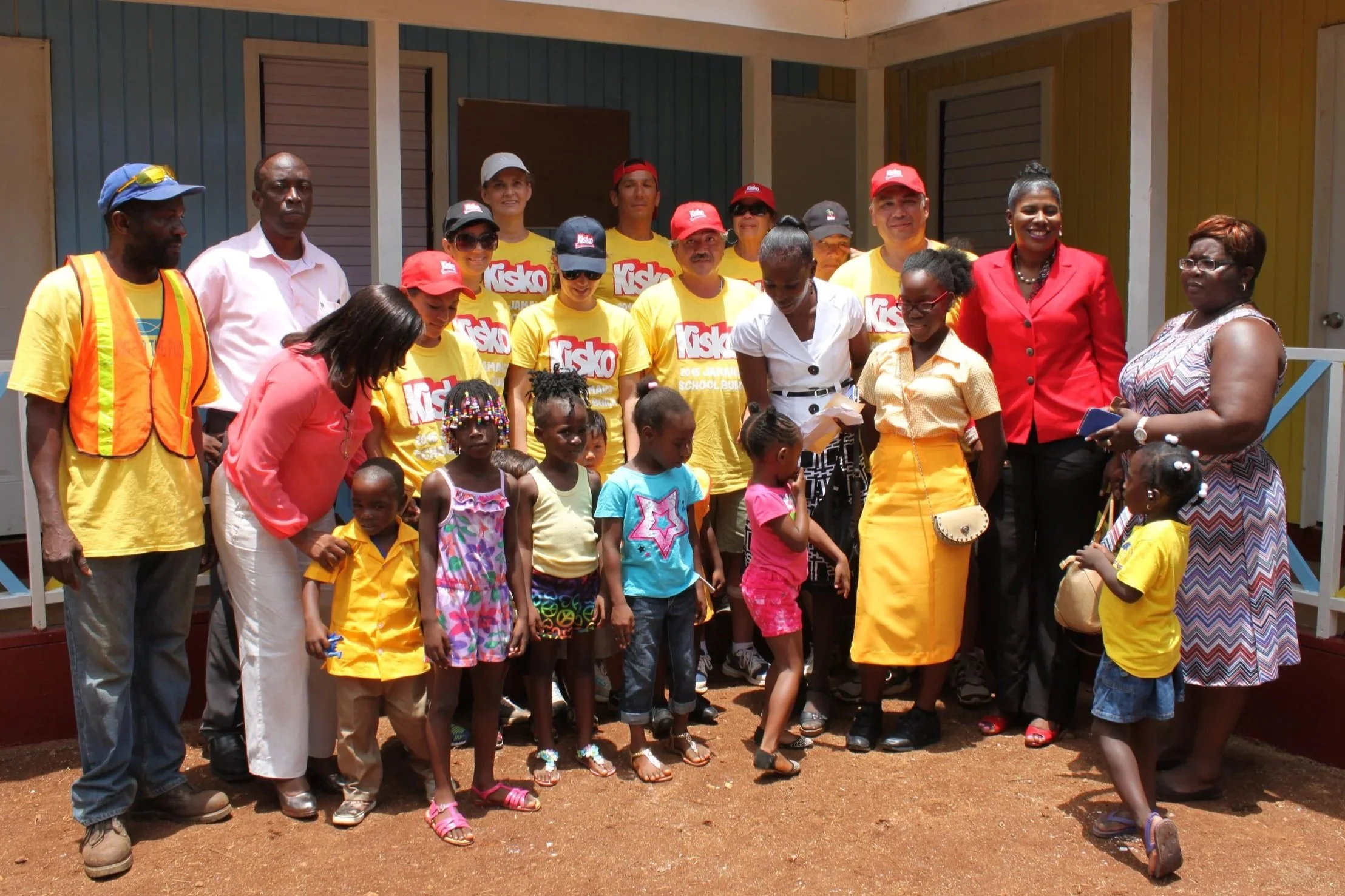
A defining moment came in 2013 when Ian Clarke, then chief financial officer of Maple Leaf Sports & Entertainment, asked Hale whether Helping Hands Jamaica could take about 70 MLSE employees and partners to Jamaica to help build a school while experiencing the country. Although the foundation had never organized a volunteer project of that scale, Hale was confident that he and his Jamaican partners could deliver.
Watching volunteers work alongside one another and then seeing children enter the new school altered his understanding of what the foundation could become. It was not simply about transferring money to a construction partner. Volunteers could participate directly, develop a stronger bond with Jamaica and witness the long-term impact of their work.
“You saw this new school being built and what it will do for generations,” Hale said. “You also saw the voluntourism side of it. I said to our team, ‘This is so impactful and so special. Instead of just depending on other partners, let’s do this ourselves’.”
The foundation’s work took on renewed urgency after Hurricane Melissa devastated sections of Jamaica in 2025. Supporters responded with an outpouring of assistance, and the organization later rebuilt a school it had constructed in 2020 that was destroyed by the storm.
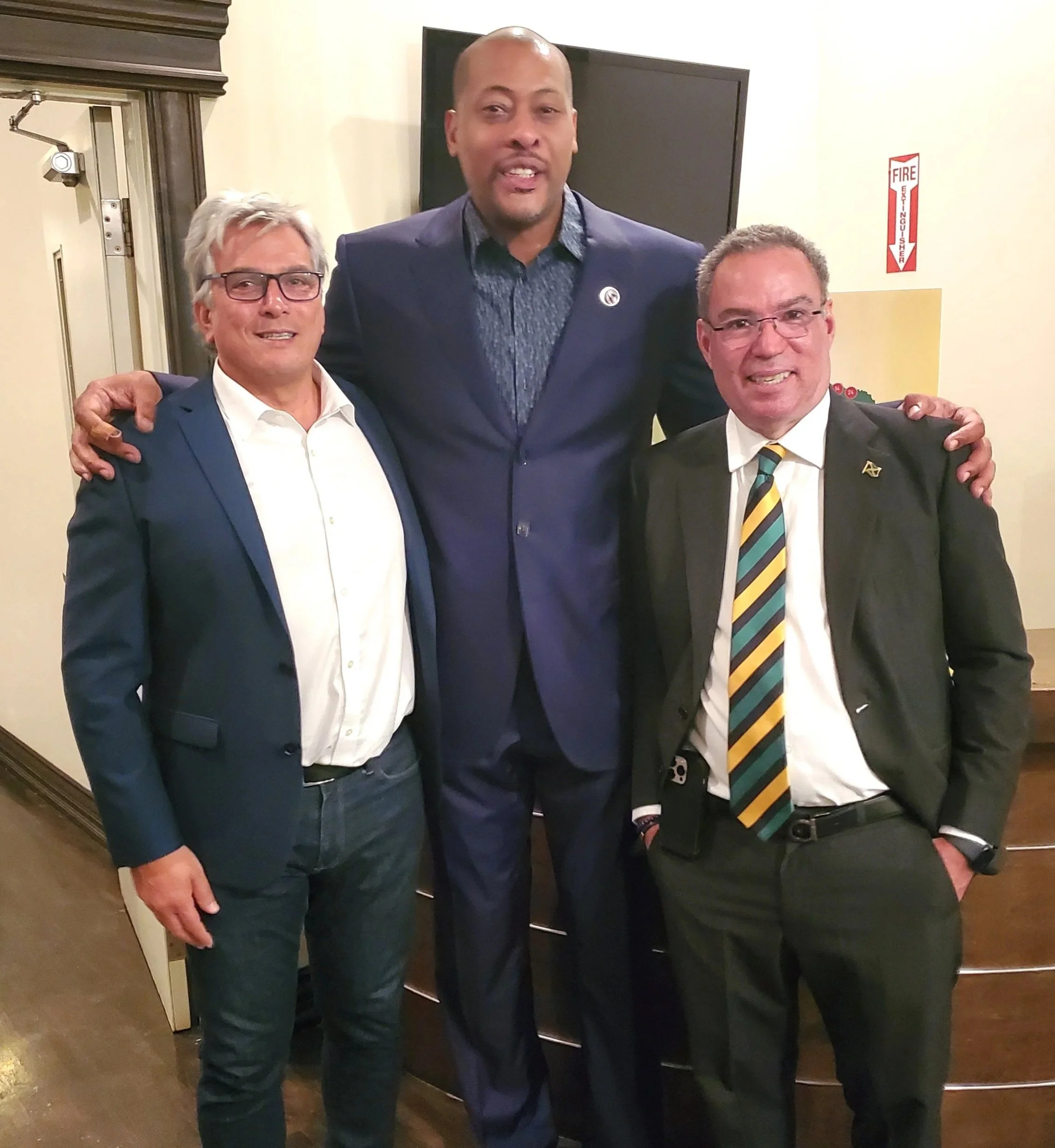
Karl Hale (l) with retired National Basketball Association player Jamaal Magloire and Jamaican politician Daryl Vaz at the Helping Hands Foundation gala in Toronto in 2022 (Photo by Ron Fanfair)
In October, Hale will receive Jamaica’s Order of Distinction in the rank of Officer for his contribution to the country. Of the honours he has accumulated, none carries more meaning.
“This is definitely the most prestigious award I could ever have imagined,” he said. “I never imagined or expected something like this.”
Hale is quick to redirect the recognition toward the volunteers, donors and partners who sustained the foundation over 20 years and helped tens of thousands of children.
“It wasn’t just me,” he said. “It is a community of people who have been unbelievable stalwarts of our charity and giving back to Jamaica.”
The honour brings his journey full circle.
Jamaica, which he left at age 10, shaped his identity and gave him the privilege of representing his country. Canada provided the opportunity to develop his talent and build a career, while Japan broadened his worldview. The international racquet-sports community later gave him a platform to help shape the games he loves.
Hale is uncomfortable with the word ‘legacy’. He prefers to measure a life more simply.
“Whatever the job, perform it to the best of one’s ability, never judge people by their economic standing and leave every place better than you found it,” he said. “Economic success is not what I value when I look at people. It is that you maximized the talent you had and you made the people -- your family, friends and communities -- better around you.”
Long before the tournament titles, global leadership positions, businesses, schools and national honour, two men at a North York tennis bubble gave a boy free court time. They could not have known precisely what he would become. They simply recognized that possibility should not be reserved for those who could afford it.
Hale has spent the rest of his life extending that same invitation -- one court, one club, one school and one helping hand at a time.