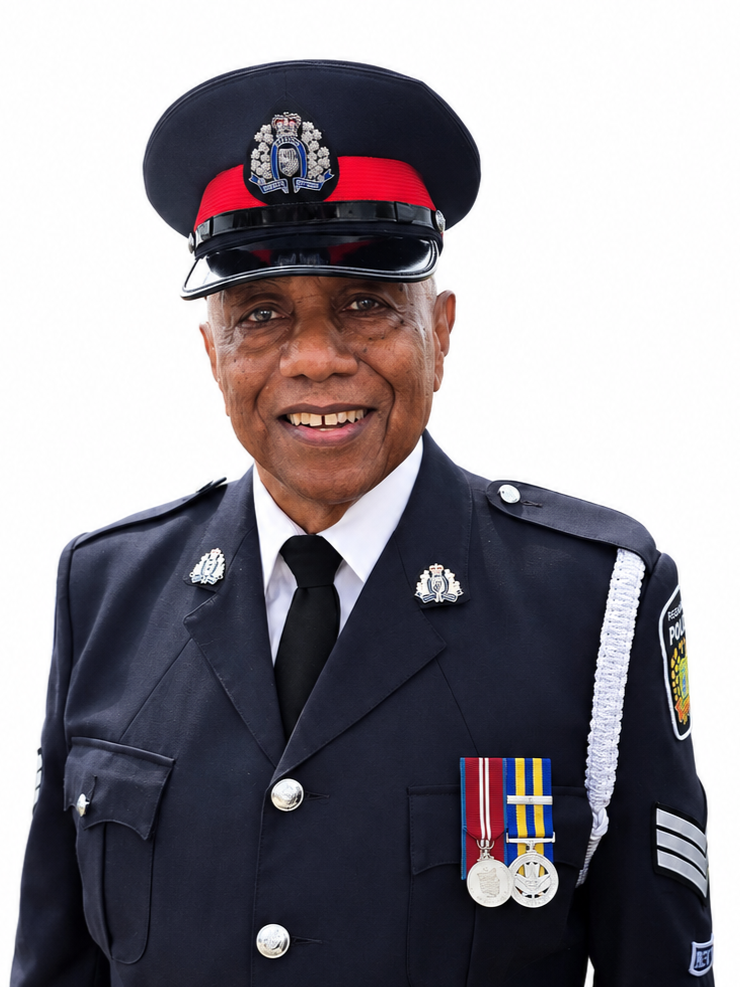
Street honour permanently places Lonsdale Blackett in Brampton’s history
August 18, 2026
When Lonsdale ‘Lonny’ Blackett helped recruit Dianne Steele-Beer to Peel Regional Police in the 1980s, he was doing more than filling a vacancy.
He was helping open a door that had once been closed to people who looked like them.
The granddaughter of the late Alton Parker, Canada’s first Black police detective, followed in her trailblazing grandfather’s footsteps, becoming one of Peel’s earliest Black female officers.
Blackett understood the responsibility that came with breaking barriers.
A decade earlier, he became Peel’s first Black police officer, entering a profession in which few uniformed members looked like him and serving a community where the Black population was still small.
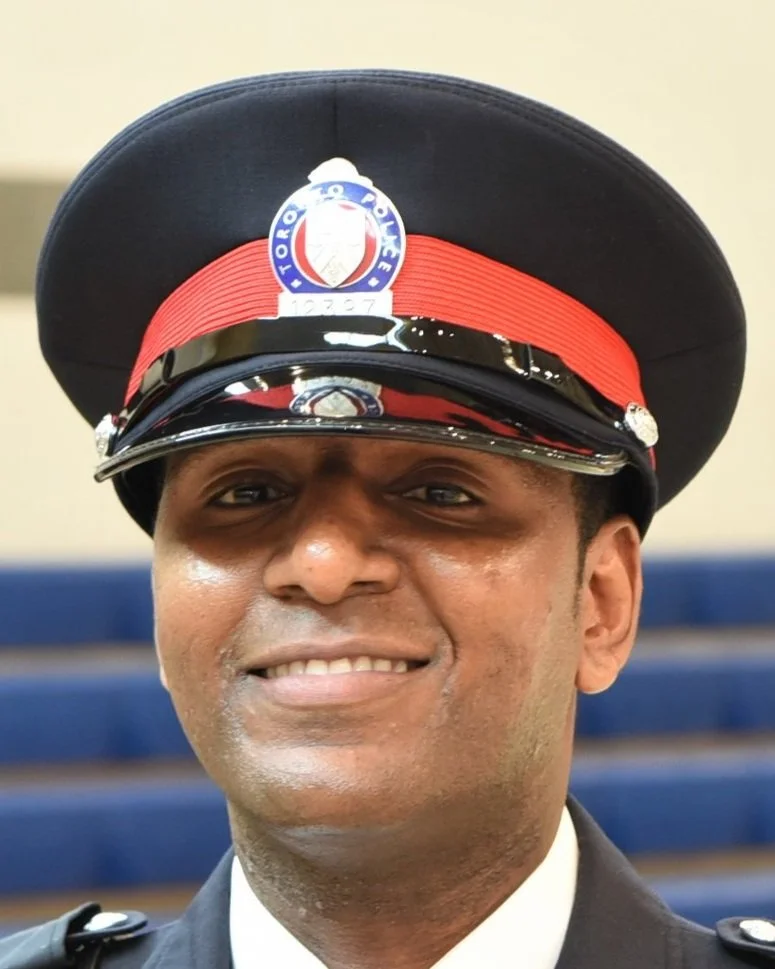
Since Peel Regional Police recruited Blackett as its first Black officer in 1974, both the service and the community it serves have changed dramatically. Today, the organization is led by Sri Lankan-born Chief Nishan Duraiappah, reflecting the diversity of one of Canada’s fastest-growing and most multicultural regions.
Parker’s contributions were later permanently recognized in Windsor, where a park and street were named in his honour.
On August 15, the historical connection between the two trailblazers deepened when a Brampton street near Mississauga Road and Bovaird Drive West was named in Blackett’s honour in the city he has called home since 1972.
The officer who helped Parker’s granddaughter enter policing had now received an honour similar to the one bestowed on her grandfather.
Another connection revealed at the street-sign unveiling stretched even further back.
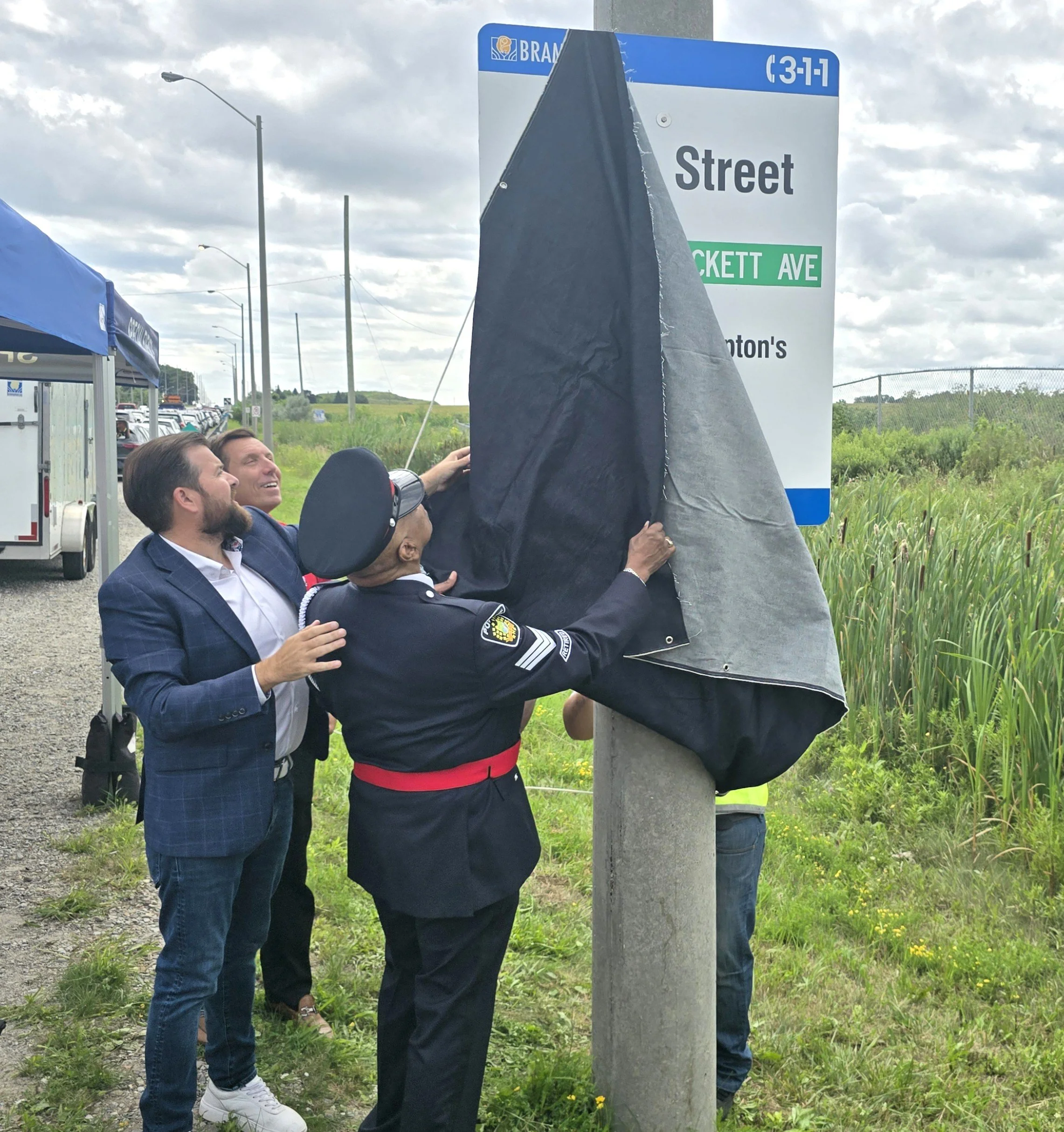
With Mayor Patrick Brown and Councillor Dennis Keenan’s assistance, retired Sgt. Lonsdale Blackett (Badge #445) unveils the street sign bearing his name (Photo by Ron Fanfair)
Deputy Chief Marc Andrews revealed that Blackett was responsible for his career in policing.
While weighing two possible careers in 1985, he applied to Peel and the Canadian Armed Forces, intending to accept whichever organization moved first.
Blackett, then a recruiter, impressed him immediately.
“Jesus, was he sharp,” Jamaican-born Andrews recalled. “He was well-dressed, articulate and immensely proud of who he was. He embodied everything I believed a police officer should be. The fact that he was a Black man made that image even more powerful for me and others who looked like me. He was fantastic.”
The Armed Forces acted first.
On the day Andrews was to report to Downsview to enlist, Blackett called and invited him to his final police interview. Andrews explained that he had already made a commitment and believed he had to honour it.
Blackett did not try to change his mind.
“He said, ‘I’m proud of you, son, but if you ever want to come home, we will be here waiting for you’,” Andrews recounted.
Five years later, the former University of Toronto Varsity Blues football running back remembered those words and joined Peel Regional Police in 1990.
Then there is retired officer Terry Perrin, whose candid advice helped put Blackett on the path to making history.
The two met in 1973 after Blackett saw Perrin’s cruiser outside a McDonald’s during his lunch break and approached him to ask about joining the police.
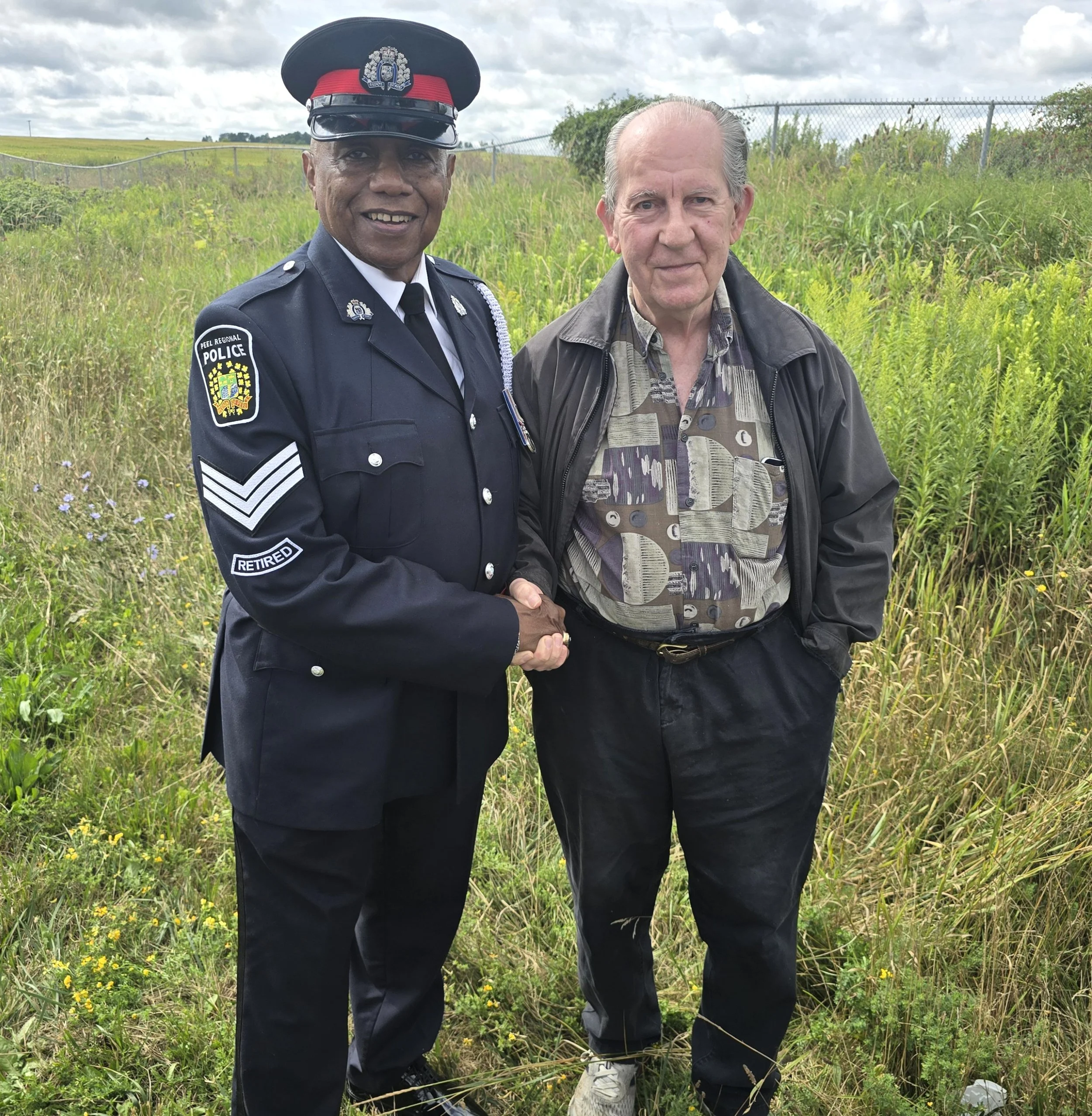
Lonsdale Blackett & Terry Perrin (Photo by Ron Fanfair)
The former Toronto officer, who later joined Peel, told him bluntly that prevailing racial attitudes within policing made his chances of being hired slim.
Blackett was advised to wait until 1974 when the Chinguacousy Police Service and four other municipal forces would amalgamate to form Peel Regional Police, creating more recruitment opportunities.
He followed the advice, applied that same year and was hired.
More than half a century after that chance encounter, the two men live in the same condominium building. Perrin, who retired in 1999, still jokes that Blackett refuses to pay his maintenance fees.
Parker’s legacy, Andrews’ career and Perrin’s advice demonstrate that Blackett’s impact extends far beyond being the first. It is reflected in the doors he opened, the careers he influenced and the institution he helped transform.
Councillor Dennis Keenan, who introduced the street-naming motion at Brampton City Council last February, noted that Blackett entered policing at a time when there was no established path for him to follow.
“Being the first comes with a unique responsibility,” he said. “It takes courage, determination and strength to enter a space where you are underrepresented and to prove through your character and service that you belong. Lonny Blackett did just that.”
During his 33-year career in public safety, Blackett -- who began his policing career at 21 Division -- helped revamp Peel’s selection and hiring practices. The changes were so successful that he joined a team that conducted week-long recruitment courses for police services across Ontario. He also helped establish the service’s airport division.
Yet Keenan said the significance of the officer’s career extends far beyond his assignments and accomplishments.
“His presence in uniform allowed young Black residents to see themselves represented in policing,” the Wards 3 & 4 regional councillor said. “The significance of breaking a barrier is not about being the first. It is about making sure that you are not the last. Every Black officer who followed his path, including our amazing Deputy Chief Marc Andrews, did so because Lonny had the courage to walk it first.”

Acting Inspector Paul Quashie (l), Superintendent Joy Edwards, Retired Sergeant Lonsdale Blackett & Deputy Chief Marc Andrews (Photo by Ron Fanfair)
Brampton Mayor Patrick Brown said city council needed virtually no debate before approving the honour. The motion passed unanimously, 11-0.
“It was not only without hesitation,” he pointed out. “It was with a sense of pride that we were able to honour a great man.”
Pointing to the large crowd gathered beside the road for the unveiling ceremony, Brown said the turnout reflected the admiration Blackett has earned.
“Thank you for being a role model for young people growing up in our city,” he told Blackett, an active member of the Peel Regional Police Retirees Association. “When they look at that sign and ask their parents, ‘Who was this great man?’ they will hear your story. You are now permanently etched into the history and infrastructure of our city. It is fitting that we celebrate a great officer, particularly in a year when we have mourned the loss of officers across Canada.”
For Blackett, who said the recognition had not fully sunk in, the honour marked another remarkable stage in a journey that began in Trinidad & Tobago.
He immigrated to Canada as a teenager, joining an aunt and two cousins in Montreal where he completed his schooling and later pursued college and university studies.
In October 1969, he witnessed the consequences of the city’s police strike which lasted about 16 hours and was accompanied by widespread disorder.
Blackett remembers leaving work, taking the subway home, locking himself in his apartment and following events on a small black-and-white television and radio.
“There was no law enforcement,” he said. “It was chaos. The Quebec government sent in the provincial police, but they were overwhelmed by the scale of the unrest. In fact, a Quebec officer was shot and killed before the army was eventually brought in to help restore order.”
The experience reinforced a conviction Blackett carried throughout his career that communities need policing, but officers entrusted with authority must be accountable for how they use it.
He moved to Brampton 54 years ago after his employer relocated amid political uncertainty in Quebec. The city bore little resemblance to the diverse Brampton of today. After he became an officer and began patrolling, he recalls finding only two other Black families in the area.
Racism was overt.
Before entering policing, Blackett was called the N-word in the apartment building where he lived with his deceased first wife. Once in uniform, his race made him conspicuous in another environment.
“Coming out of Peel, it was carving new territory,” he said. “It was quite a challenge for me. It was not easy.”
Blackett’s route into policing began with Perrin’s advice.
When Peel Regional Police was established, he walked into its recruiting office and applied. He excelled in the written, physical and psychological tests before facing a panel of senior officers.
“They put me through the wringer, but I prevailed,” Blackett recalled.
Even after receiving an offer, he hesitated. He was married and understood the implications of entering a profession with almost no one who shared his background. He called the recruiting inspector and said he intended to withdraw, but was summoned back and told the Service was impressed with his results and wanted him.
Blackett decided to give policing one year. If it did not work, he would leave.
The one-year experiment became a 33-year career.
There were still times when he considered walking away. His evaluations were consistently strong, yet he watched younger White officers, including some he had trained, receive investigative opportunities while his applications were rejected.
Frustrated by the lack of progress in the 1980s, Blackett applied to the Royal Canadian Mounted Police and again excelled in the selection process. The RCMP offered him a position in northern Alberta, far from his young family’s support system in Ontario and Quebec. When the organization declined his request for a posting in Atlantic Canada, he turned down the offer.
He remained with Peel, where opportunities gradually began to open. He completed specialized courses, moved through several assignments and became a sergeant in 1986 on his second attempt.
Remaining was not solely about his advancement.
Blackett understood that his success or failure might influence decisions about people who had not yet contemplated policing careers.
“I just stuck with it because I knew this was what I wanted,” he said. “I also believed that if I persevered, it could open doors for other minorities. If I left, they might have said, ‘They can’t do the job, so why should we hire them?’”
Blackett also has a special place in his heart for the colleagues who supported him.
His training officer, whose name he prefers not to disclose, treated him ‘as though I were his brother’ and challenged other officers when they made racist jokes or comments. Their friendship endured through retirement, and Blackett continued visiting him when he became ill and attended his funeral.
That combination of discrimination and support shaped the officer and recruiter Blackett became.

Lonsdale Blackett thanked former Halton Regional Police Chief Gary Crowell for treating him with the utmost respect when they served together at Peel Regional Police’s 11 Division (Photo by Ron Fanfair)
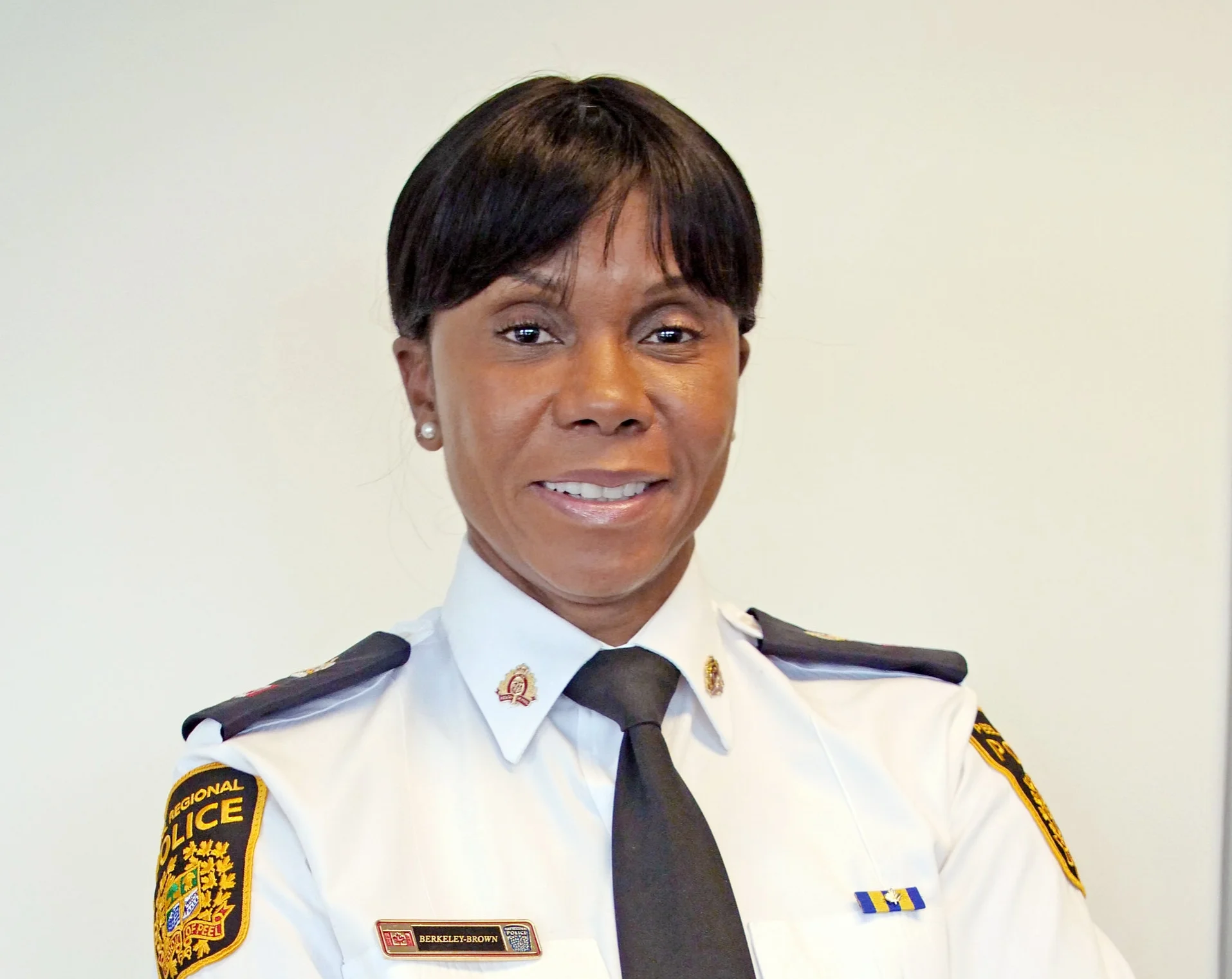
Retired Deputy Chief Ingrid Berkeley-Brown remembers Blackett as a trailblazer who created opportunities for Black candidates at a time when other police services were reluctant to hire them. During her recruitment, he visited her home, met her mother and conducted part of the interview there.
“At a time when other police agencies weren’t necessarily selecting us, Lonny was that guy who hired us,” she said.
Berkeley-Brown also recalls a hands-on sergeant who remained connected to frontline work and the community. While some supervisors preferred to stay behind, she said he regularly went on patrol and related easily to people.
“Lonny made friends everywhere he went because he is very personable,” she added. “He was never afraid to engage with people. He didn’t talk down to them. He spoke with them.”
Acting Inspector Paul Quashie met Blackett after joining the Service in 2003.
“Lonny paved the way for me and many other officers, particularly officers of colour,” he said. “His impact spans generations, and he epitomizes what a police officer should be.”
Blackett’s assignments included working as a hostage negotiator, lecturing at the Ontario Police College and serving at Pearson International Airport. His contributions were recognized with the Police Exemplary Service Medal and the Queen Elizabeth II Diamond Jubilee Medal.
One of the most dramatic tests of his career came on August 2, 2005, when Air France Flight 358 crashed while landing at Pearson during a violent thunderstorm.
Blackett was a patrol sergeant at the airport when the call came over the radio. He headed towards the crash site with officers behind him through rain and wind that struck sideways beneath a sky that had turned dark green.
The aircraft had left the runway and plunged into a ravine near Etobicoke Creek. Concerned that passengers might have been swept into the rising water, he requested marine units to search. Then, with the rear of the aircraft burning, he and another sergeant approached the plane.
Blackett wanted to enter.
“Don’t forget, we took an oath, man, to save lives,” he told him.
Despite having undergone knee surgery only days earlier, he climbed inside with assistance. The two sergeants moved along separate aisles with flashlights, calling for anyone who might be injured, unconscious or unable to escape. When thick black smoke began filling the cabin, they retreated.
Outside, Blackett noticed liquid pouring from a hole in one of the wings. At first, he thought it was rainwater, but then realized it was jet fuel and ordered officers surrounding the aircraft to move back. Minutes later, explosions began as the post-crash fire intensified.
All 309 people aboard survived.
Months later, Air France representatives returned to Toronto to thank emergency personnel, including the officers who entered the burning aircraft.
Blackett’s philosophy was characteristically direct.
“I did what I had to do,” he said. “I didn’t do it looking for anything.”
At the street-sign unveiling, Andrews said Blackett’s decision to put on the uniform more than 50 years ago represented far more than a historic first.
“It’s about courage, it’s about determination and it’s about stepping up and leading by example at a time when doing so required tremendous resilience and strength,” he said.
Andrews thanked Blackett for opening a door that had previously been closed in Peel and ensuring it remained open for those who followed.
“His achievement was not just a milestone of policing in Peel, but one for the Black community, minorities and people of colour,” he pointed out. “It sent a powerful message that talent, character and commitment should be measured by merit and not by the colour of one’s skin. But more than anything, we moved our Service closer to reflecting the diverse communities we are proud to serve today. Generations of officers have benefited from the path Lonny carved. Many may not fully appreciate the obstacles he faced or the barriers he overcame, but they continue to benefit from the example he set and the legacy he built.”
The legacy also continues within Blackett’s family.
His younger daughter, Melissa, has worked for Peel Regional Police for 27 years and is a records trainer for uniform and civilian members.
She said serving the community was always her father’s priority and that he instilled those same values in her and her older sister, Stefanie.
“This means the world to Dad,” Melissa said of the street naming. “For as long as I can remember, his priority has been serving the community. He has loved policing from the day he joined, and he instilled those same values in my sister and me. His example inspired me to join Peel Regional Police and serve the community as well.”

Lonsdale Blackett (r) with close family members Barbara Connor & her son Terrell Connor (l), his wife Maureen Meyer, sons-in-law Keith Robinson & Angel Santos, daughter Melissa Blackman & her son Joshua Blackett-Santos and eldest daughter Stefanie Blackett (Photo by Ron Fanfair)
Blackett entered policing at a time when he often stood alone. He was honoured surrounded by relatives, friends, retired and serving officers, municipal leaders and members of a community transformed since his arrival.
Today, Brampton is one of Canada’s most diverse cities, and Peel Regional Police bears little demographic resemblance to the organization he joined. He witnessed that change and helped advance it.
“This has been my home since 1972,” Blackett said. “My daughters were born here, my grandson was born here, and I have no intention of leaving Brampton.”
His name will now remain part of that home.
Some who pass the street sign will know that it honours Peel’s first Black officer. Others may learn that he recruited generations of officers, including Alton Parker’s granddaughter, or that his encouragement helped bring a future Deputy Chief back to policing.
A few may know that the man once warned to wait because of racism now lives in the same building as the officer who gave him that advice. Others may know the name as part of an address.
But behind it is the story of a young immigrant who planned to try policing for a year, endured the barriers placed before him and stayed long enough to help change an institution.
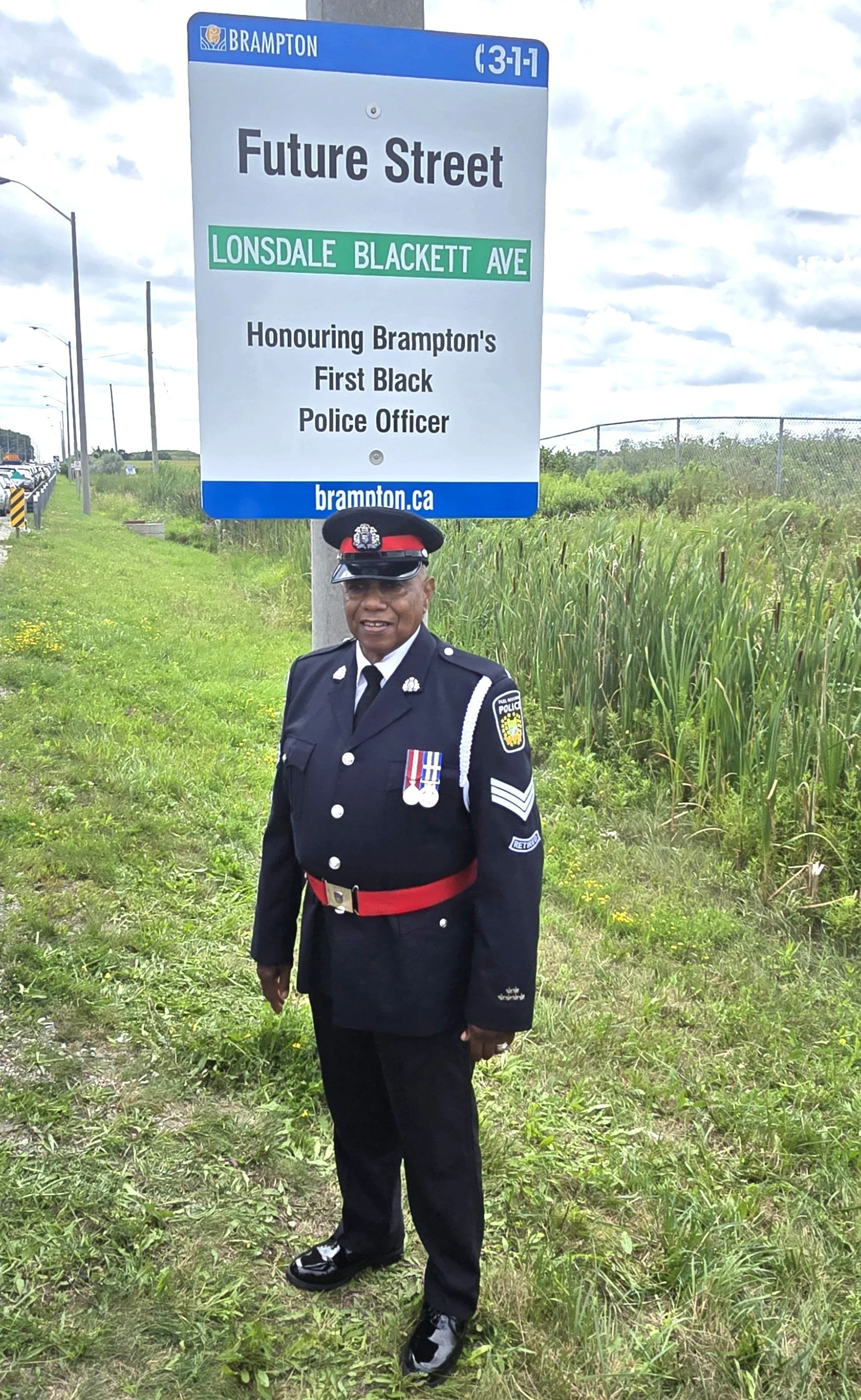
Lonsdale Blackett proudly stands under the street sign bearing his name (Photo by Ron Fanfair)
“I loved it,” Blackett said. “I wanted to be a police officer, and I can say with confidence that I made a difference.”
The street sign makes that difference visible. It permanently places him in the landscape of a city where he once stood out because so few people looked like him and where generations who followed can now see themselves reflected in the service he helped reshape.