Helping Hands Jamaica Foundation builds schools and transforms lives
July 25, 2026
Nine- and 11-year-old girls don’t usually jump out of bed at five o'clock in the morning to spend long days carrying building materials and working under the blazing Caribbean sun.
But that's exactly what Lauren Wilmott's daughters did during their first visit to Jamaica earlier this month, a trip that also marked their mother’s return to the island for the first time in about 25 years.
The Waterloo businesswoman expected the experience to teach her children about gratitude and service. She never imagined how enthusiastically they would embrace the opportunity to help.
“I didn't have trouble motivating my kids to get up at five o'clock every morning,” said Wilmott who is the chief executive officer of the Farley Group, the world’s leading manufacturer of sports domes. “They were excited to contribute to the project. Although they are kids, they were able to do something meaningful and were happy actually to participate.”
For her, that enthusiasm captured the spirit of the Helping Hands Jamaica Foundation (HHJF) which this year celebrates 20 years of creating educational opportunities for children in rural Jamaica.
Founder Karl Hale reflected on how a simple idea grew into one of the Jamaican diaspora’s most successful educational initiatives.
The foundation’s journey began in 2005 with a meeting involving then Jamaican Consul General Anne-Marie Bonner, former Air Jamaica area sales manager Norma Sale, the Alliance of Jamaican Alumni Associations past president Alene Chen and the late Denise Jones to discuss how members of the Jamaican diaspora could help improve educational opportunities for children in their homeland.
“I never imagined that this small group, along with so many dedicated board members, partners, volunteers and supporters, would grow into such a dynamic and impactful organization,” said Hale.
He credits the foundation’s success to the commitment of the Jamaican community and the many individuals who embraced its mission.
“From the beginning, what convinced me we would succeed was the passion, camaraderie and generosity of our community,” said the former Jamaica Davis Cup tennis player and National Bank Open tournament director. “I have learned that success is never about one person. It comes through the agency of others.”
Working with Food For The Poor Canada (FFPC) and hundreds of volunteers, the HHJF has provided educational opportunities to more than 10,000 children by constructing and restoring 28 kindergarten schools across Jamaica.
Natasha Borota, a volunteer and administrator with the organization for the past 11 years, said the cost of building a single kindergarten has risen to approximately C$250,000, reflecting increasing construction and material costs. Because many project expenses are paid in U.S. dollars, the foundation must raise about US$175,000 for every school it builds.
The HHJF has been able to maximize the impact of every donation by keeping administrative costs exceptionally low.
“We don't have much overhead because there's no office,” said Borota, the president and founder of The It Factor Ltd. “The organization operates out of my business, and our board is made up entirely of volunteers. Apart from unavoidable expenses such as credit card processing and fundraising platform fees, virtually every dollar we raise goes directly to Jamaica.”
That commitment to ensuring donations reach those in need was evident again following Hurricane Melissa, when supporters responded with an outpouring of contributions that enabled HHJF to help rebuild a damaged school and provide assistance to devastated communities.
About 50 volunteers travelled to St. Elizabeth earlier this month to rebuild Fyffes Pen Primary and Infant School which Helping Hands had originally constructed in 2019.
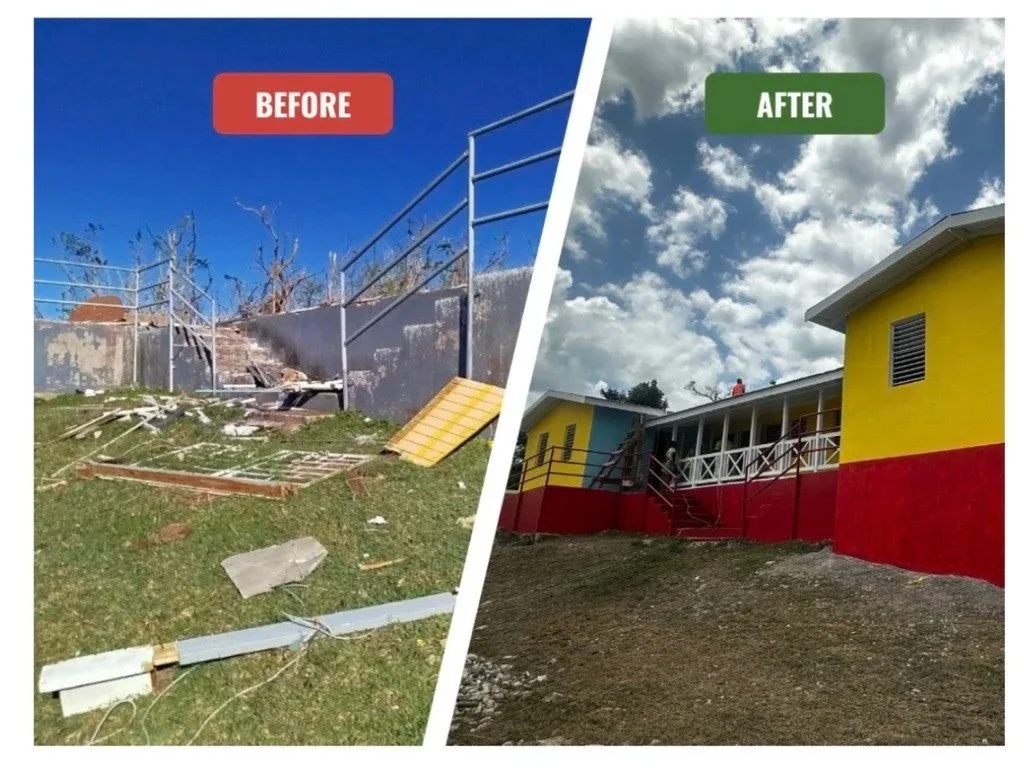
Over 50 volunteers worked on the construction of a new reinforced concrete structure at Fyffe’s Pen Primary & Infant School on the existing foundation of the former wooden building that was destroyed by Hurricane Melissa (Photo contributed)
Before volunteers built a three-classroom block, the rural school struggled to maintain an enrolment of more than 100 students. The classrooms were overcrowded and poorly ventilated, making teaching and learning difficult.
“Those additional classrooms immediately changed the narrative from a struggling rural primary school to the modernized school,” said principal Mordant Mitchell. “Enrolment grew from 106 to 202 students, while improved learning conditions contributed to stronger academic performance and renewed confidence among students and staff.”
That progress was undone when Hurricane Melissa destroyed the wooden classroom block last October, forcing classes into makeshift shelters covered with tarpaulins.
Helping Hands volunteers returned at the start of this month to rebuild the classrooms in reinforced concrete.
“The building is now stronger than before and more resilient to withstand hurricane-force winds,” Mitchell said. “This rebuild will return us to normalcy, improve the ethos of the school, increase enrolment and attendance, strengthen academic performance, reduce student infractions and boost teachers’ morale.”
Calling the project ‘a purposeful intervention of love for the marginalized in education’, he said the rebuilding effort demonstrated what can be achieved when Helping Hands Jamaica, Food For The Poor Jamaica, the Government of Jamaica, the Jamaica Tourist Board, Canadian volunteers and donors work together.
“When good thoughts and helping hands come together, good things happen,” Mitchell added.
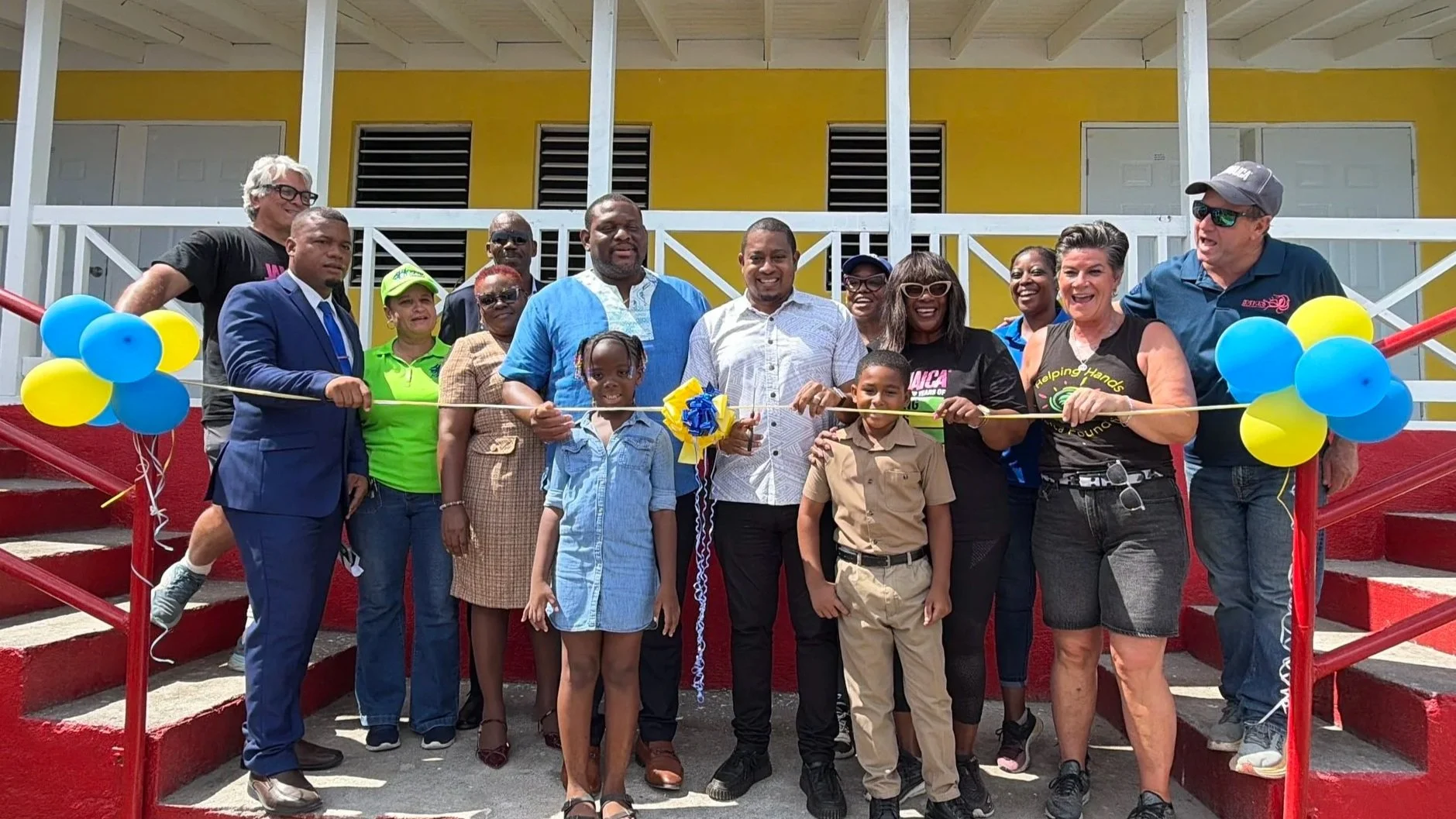
Karl Hale (extreme left), Natasha Borota (second from right) & Jamaica Tourist Board regional director in Canada Angella Bennett (fourth from right) at the ribbon cutting ceremony (Photo contributed)
The rebuilt classrooms represent far more than stronger buildings. They also reflect the foundation's belief that education has the power to transform communities.
For Wilmott, those lessons began long before she reached the construction site.
Driving through communities still recovering from hurricane damage gave her daughters a perspective no classroom could provide.
“I think meeting the children at the school and seeing that they're just kids like them gave a different perspective,” she said. “It made them appreciate that they get to go to school every day without having to think about whether their school is still standing.”
Just as memorable was the resilience she witnessed.
“It was devastating to see the damage, but there were still so many moments of joy,” Wilmott said. “There was music and dancing and people wanting to connect and enjoy their daily lives. The people are what made the experience unforgettable.”
When the week ended, she knew her daughters had received something that could never be taught in a classroom.
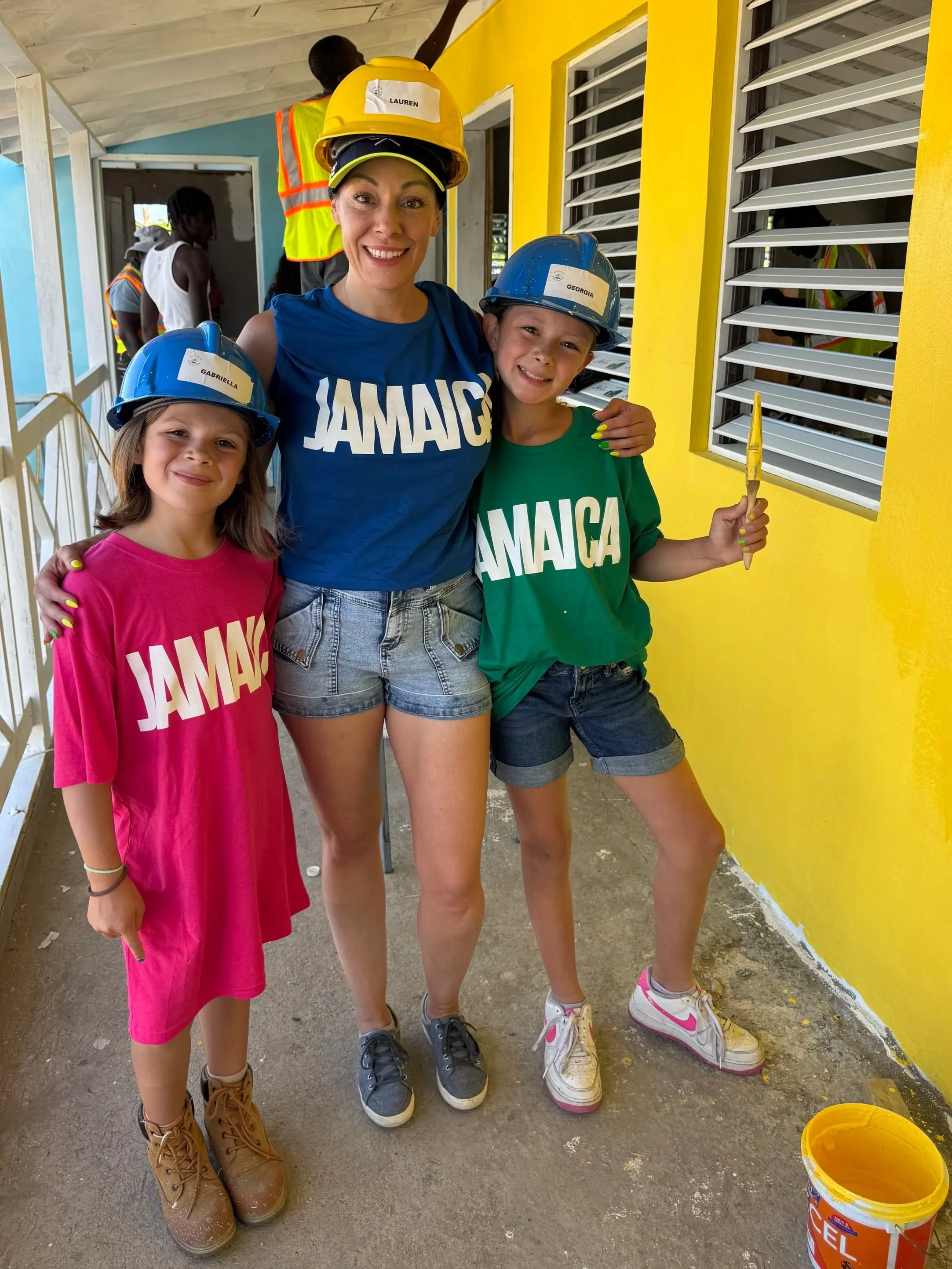
Lauren Wilmott & her daughters (Photo contributed)
“I have encouraged other Canadian families to bring their children,” she said. “For our kids to experience doing something for someone else, without knowing them and simply because they needed help, is something they will always remember.”
While Wilmott discovered the rewards of giving back through her daughters, Borota’s connection to Jamaica evolved into something much deeper.
While she treasures many memories from her volunteer work, one that has stayed with her is of a little girl she met during her first school build in 2015.
While volunteers worked nearby, four-year-old Shyan Brown quietly approached Borota. Unlike many of the other children, she wasn’t seeking attention. She simply wanted someone to talk to.
A friendship formed that day and has grown stronger with each passing year.

Natasha Borota & Shyan Brown at the Helping Hands Jamaica Foundation fundraiser in Toronto in 2018 (Photo by Ron Fanfair)
Today, Brown is an award-winning high school student who volunteers in her church and community and continues to participate in Helping Hands school builds whenever she can.
“She was just four years old when we first met, and now she’s almost 14,” Borota said proudly. “She is part of our legacy. She's basically my goddaughter. She’s family.”
She believes the greatest gift she could give Brown was confidence.
“What mattered most to me was that she could sit at any table -- with the CEO of a bank, with a reporter or with Karl Hale -- and know she belonged there,” the Michael ‘Pinball’ Clemons Foundation co-founder said. “That she has a voice is what matters.”
Borota’s connection to Jamaica began long before joining Helping Hands Jamaica. During her years as a thoroughbred racehorse trainer at Woodbine Racetrack, many of the grooms and stable workers she worked alongside came from Jamaica.
Through them, she developed a deep appreciation for the island's people, culture and sense of community. Her father also lived in Jamaica for a period, further strengthening her ties to the country.
“What started with the music, the food and the culture became something much deeper,” Borota said. “The people I worked with treated me like family, and I saw the pride they had in their country. When I realized I could use my time and skills to make a difference in a place that had already given me so much, volunteering became an easy decision.”
Each visit leaves her inspired rather than exhausted.
“The moment you step off the plane in Jamaica, it is like receiving a warm hug,” she said. “The smiles, the kindness and the sense of community fill your heart. I always leave feeling that I have received far more than I have given. I have met women who accomplish incredible things with very little, and children whose joy isn’t measured by what they own but by the love surrounding them. They remind me what’s truly important in life.”
Borota believes Canadians who venture beyond the resorts will discover a Jamaica defined not by hardship, but by extraordinary resilience.
“You become stronger the more time you spend with people from the country,” she said. “They are proud people. The stories behind the communities are just as important as the places themselves.”
Looking ahead, Borota said HHJF has adapted its construction methods in response to increasingly powerful hurricanes.
“We have learned that we have to build stronger and smarter,” she said. “Going forward, our kindergarten schools will be constructed using reinforced concrete wherever possible because we want them to withstand future storms. These schools are more than classrooms. They are safe spaces for children, symbols of hope for their communities and investments that should serve generations to come. Building them to last is one of the best ways we can honour the people who depend on them.”
Every school HHJF has constructed over the past two decades tells a different story for veteran builder George Dickens. Yet one project near Kinloss, in western Jamaica, remains especially close to his heart.
Relentless rain threatened to derail construction, forcing volunteers and local workers to labour through the night so the Canadian donors who had travelled to the island could still take part in raising the school.
In the midst of the project, Dickens received word that his father – Albert Dickens -- had died.
Determined not to let the work come to a halt, he remained at the construction site. He was later surprised to learn that the Canadian donors had honoured his extraordinary dedication by dedicating the completed school in his father's memory.
"Every school built means something to me," he said. "But that one is the most memorable."
The greatest reward for Dickens has never been simply completing another building. Over the years, he has witnessed firsthand how a new kindergarten can transform an entire community, replacing makeshift classrooms and verandas with safe, purpose-built learning spaces where children can flourish.
He recalled that in some communities, the percentage of children successfully moving on from basic school increased dramatically within just a few years of receiving a new kindergarten.
Dickens’ impact extends well beyond the schools themselves.
During 33 years with Food for the Poor Jamaica, including two decades working alongside HHJF, he has helped construct 69 schools while mentoring more than 650 young Jamaicans in construction trades.
Many now earn their livelihoods using the skills they acquired on the job, and several former crew members have gone on to supervise projects of their own, a legacy he values as highly as the schools he has helped build.
Dickens attributes the partnership's success to a simple philosophy.
“Every project deserves the same care and attention, regardless of its size," he said. "I always encourage my team to put their heart into every school because I believe quality workmanship and genuine commitment will always outlast shortcuts."
That same commitment, Dickens believes, is reflected in the people who make the work possible.
While HHJF has received support from individuals and organizations around the world, Dickens said Canadian donors have consistently distinguished themselves through their generosity, compassion and long-term commitment to Jamaica's children.
“Jamaicans appreciate every donor,” he said. “But Canadians stand out, and we are very thankful.”
Many volunteers, Dickens noted, return year after year, building not only schools but lasting friendships with the communities they serve.
“Every dollar they contribute helps give children opportunities they might otherwise never have,” he added. “Silver and gold will vanish away, but a good education will never decay.”
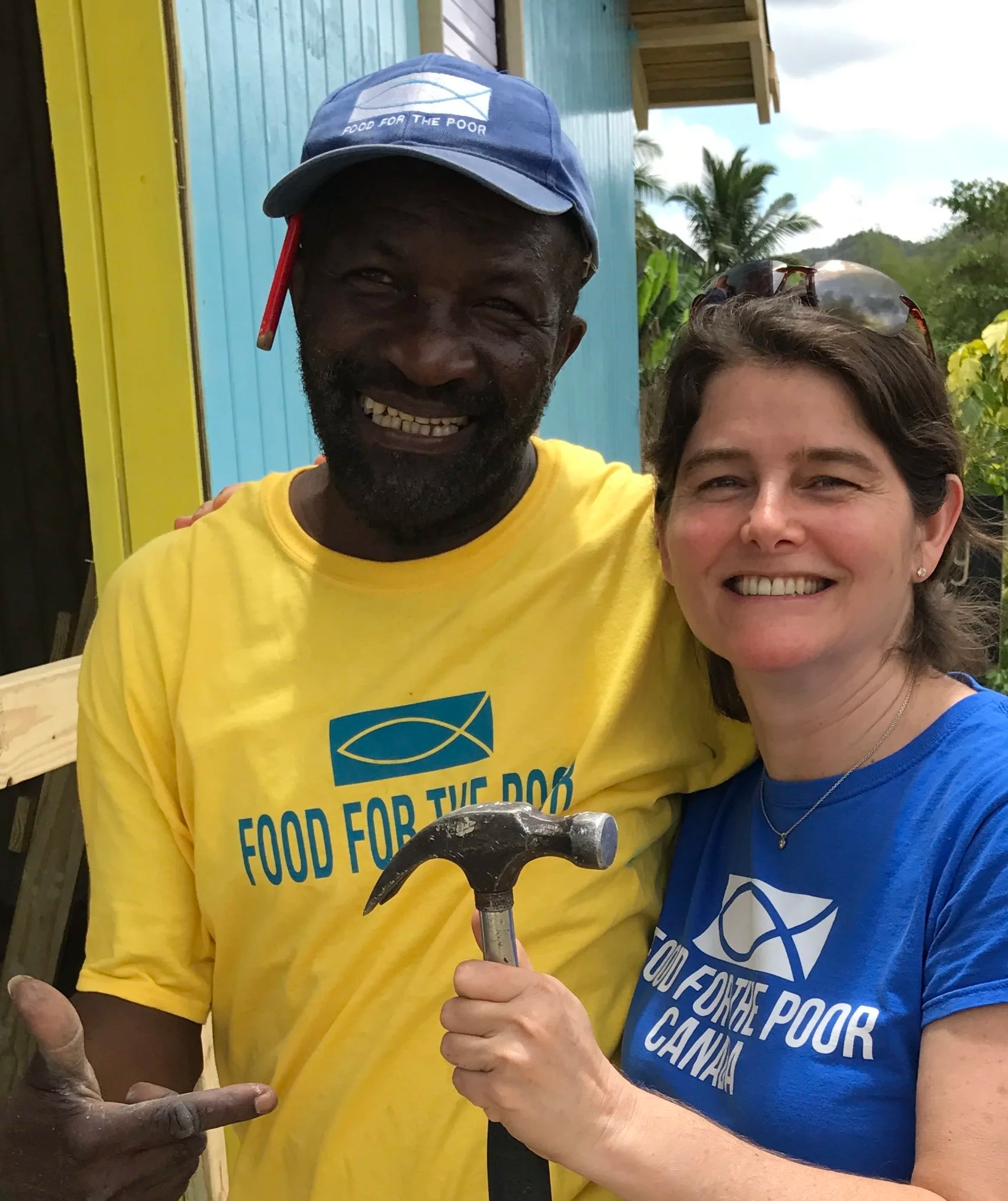
George Dickens & Food for the Poor Canada founder Samantha Mahfood (Photo contributed)
His words capture the philosophy that has guided HHJF for the past 20 years -- investing not simply in buildings, but in children, communities and future generations.
Hale said one of the defining moments in the foundation's history came in 2013 when Ian Clarke, then chief financial officer of Maple Leaf Sports & Entertainment, asked whether Helping Hands Jamaica could bring 70 MLSE employees to Jamaica to help build a school.
Until then, the organization had focused primarily on fundraising and had never organized volunteer build trips. Working with Food For The Poor Canada, the project exceeded every expectation.
“Watching volunteers work alongside members of the community, seeing the joy on the children's faces and witnessing friendships that have lasted for years convinced me that Helping Hands Jamaica had become much more than a charity,” Hale said. “It had become a movement.”
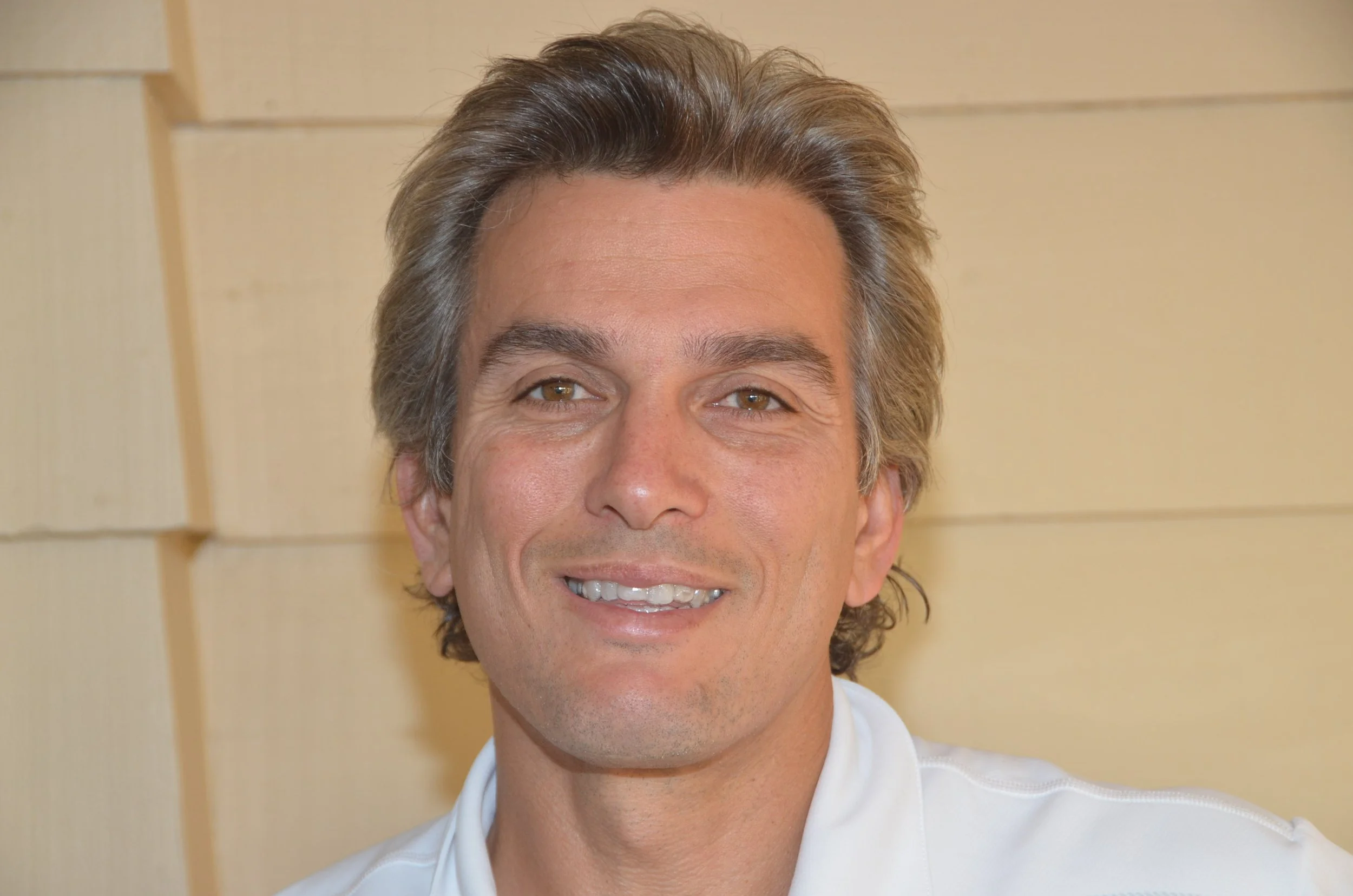
Karl Hale (Photo by Ron Fanfair)
That inaugural build laid the foundation for the organization's annual volunteer program.
Looking back on the foundation's first two decades, Hale believes its greatest achievement extends far beyond the schools themselves.
“Every child who learns, graduates and creates a better future strengthens their family, their community and ultimately Jamaica,” he said.
Hale hopes the organization's legacy will be measured not only by the classrooms it has built, but by the educational opportunities those schools have created and the lives they continue to transform.
He challenged members of the Jamaican diaspora to continue investing in the country's future by supporting educational initiatives, participating in volunteer school-build trips and encouraging younger generations to maintain their connection with Jamaica.
“Education remains one of the greatest investments any country can make,” said Hale, chief executive officer of Premier Racquet Clubs. “Better schools create greater opportunity, stronger communities and a more prosperous future. Jamaica has extraordinary potential and, if we continue to invest in its children, one student, one classroom and one school at a time, I believe the best is still ahead.”
For the children who now learn in safe, purpose-built classrooms, for Canadian families like the Wilmotts who discovered the value of service together, and for friendships like the one between Borota and Brown that grew into family, HHJF has created something far more enduring than buildings.
Its lasting legacy is measured in opportunity, compassion and human connection, built one classroom, one volunteer and one child at a time.