Sixty years of Jamaican farmworkers in Canada
July 24, 2026
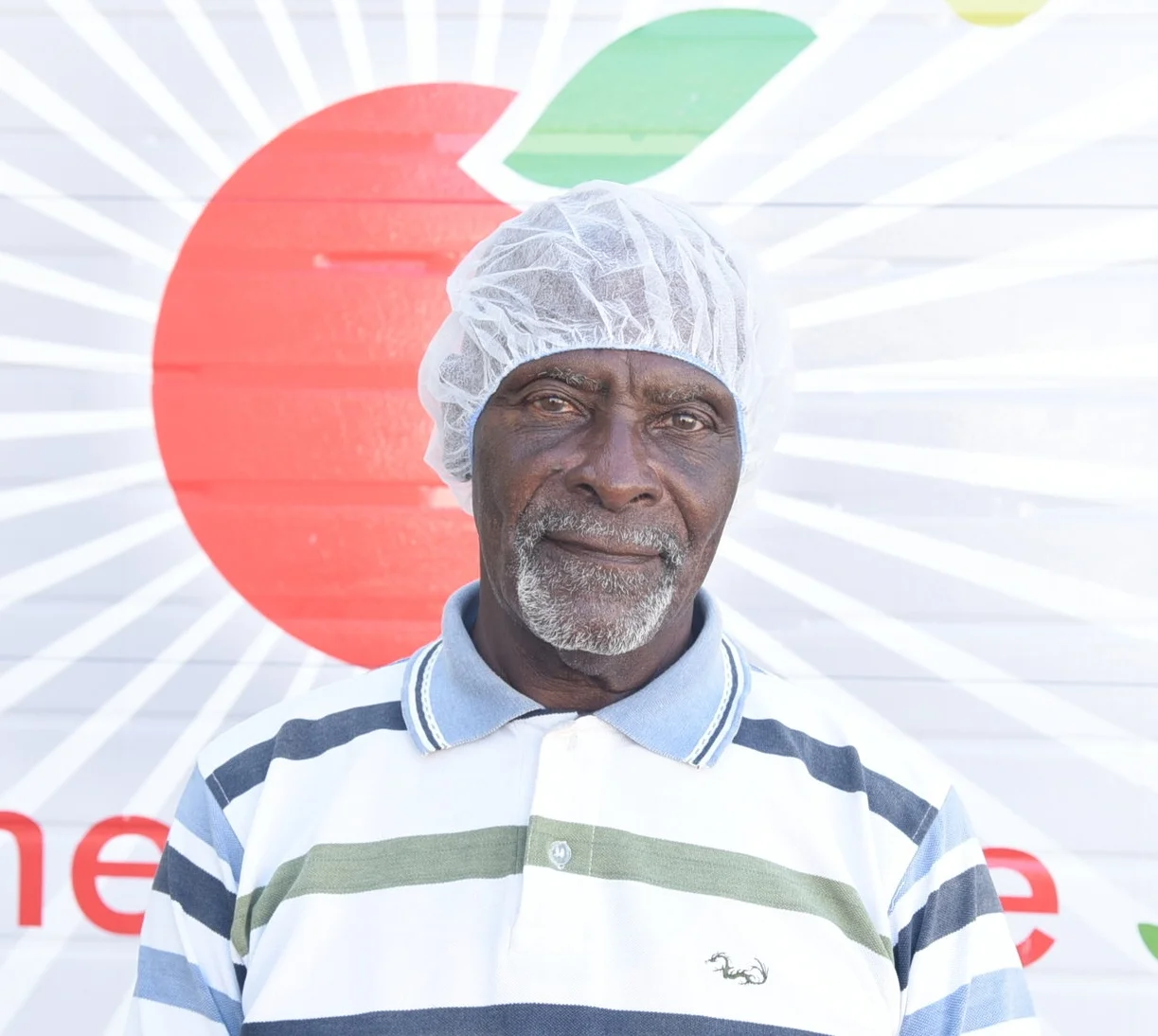
When Victor Robinson boarded a flight to Canada on July 23, he wasn’t simply beginning another growing season.
He was continuing a journey that has spanned nearly four decades.
For the 67-year-old Jamaican from Clarendon, this marks his 38th year in the Seasonal Agricultural Worker Program (SAWP). This initiative has transformed not only his own life, but those of thousands of Jamaican families since the first contingent of workers arrived in Canada in 1966.
“It's a good program, and it’s helped me a lot,” Robinson said without hesitation. “It helped me take care of my family. I sent my kids to college and university."
The benefits of those decades of hard work are visible.
“I bought land, a house and a beautiful vehicle,” Robinson noted. “It helped a lot of guys as long as they are willing to work.”
His story mirrors that of thousands of Jamaicans who spend months away from home each year harvesting fruits and vegetables that feed Canadian families, while using their earnings to build better futures for their own children.
This year, however, Robinson found himself surrounded by a new generation of workers embarking on the same journey that changed his life.
Among them is Sanjay Denton.
The Clarendon resident said the decision to join the program came down to one simple reason.
His children.
“It's a great opportunity,” Denton said. “I have two daughters back home, aged six and four, and I want to do everything I can to provide them with a better future.”
Previously employed as a plumber with Jamaica's National Water Commission, he left that position hoping the seasonal employment program would provide greater opportunities for his young family.
“It's my first time coming to Canada,” Denton said. “I'm going into the program with an open mind. I will put in the work, and hopefully I will be back next year.”

Sanjay Denton (Photo by Ron Fanfair)
Robinson and Denton’s stories bookend one of the longest and most successful labour partnerships between Jamaica and Canada.
As the SAWP celebrates its 60th anniversary, it represents far more than six decades of labour migration.
It is the story of thousands of Jamaican men and women who missed birthdays, graduations, anniversaries and countless family milestones while working in Canadian fields so their children could attend university, their families could own homes and their communities could enjoy opportunities created through their sacrifice.
For Jamaica's Minister of Labour and Social Security, Pearnel Charles Jr., the significance of the program extends well beyond economics.
“It goes far beyond just being a program providing opportunities for thousands of men to work in the agricultural sector in Canada,” he said. “It is actually one of the strongest elements of our relationship between Jamaica and Canada.”
Charles described the initiative as one of the enduring pillars of bilateral cooperation between the two countries.
“It is the cement that affords us the authenticity and the understanding between nations,” he pointed out. “The trust established through the farmworker program has strengthened cooperation on numerous issues beyond agriculture.”
Its impact, Charles added, can be measured in classrooms and communities throughout Jamaica.
“Hundreds, perhaps thousands, of Jamaican children have been able to attend university, acquire valuable skills and gain access to health care and educational opportunities because of this program,” he said.
Remittances sent home by seasonal agricultural workers have helped finance higher education, construct homes, care for elderly parents and create businesses across Jamaica.
Many workers have also returned with valuable agricultural knowledge, technical expertise and management skills that have benefited their own farms and rural communities. Others have chosen to make Canada their permanent home, marrying, raising families and contributing to the country's economic and cultural landscape.
Yet the anniversary also offers an opportunity to acknowledge the sacrifices behind those achievements.
For months at a time, workers leave behind spouses, young children and aging parents, often missing milestones that can never be recovered. Although the program has traditionally been male-dominated, women have also made significant contributions since joining the program in 1989.
For all participants, the emotional strain of prolonged family separation has become an increasingly important part of discussions surrounding the program, alongside continuing efforts to improve housing, working conditions and overall worker well-being.
Charles said protecting those workers remains among his ministry's highest priorities.
“The primary guardrail for us in Canada is our Liaison Service," he explained. “We have a set of highly proficient professionals who are focused on delivering service at a high standard to protect the welfare of these farmworkers and make sure that their working and living conditions are at the standard that we find to be acceptable.”
Charles described the liaison service as ‘perhaps the single most important element’ in ensuring Jamaican workers always have someone advocating on their behalf while employed in Canada.
For Canadian employers, the program’s success has always depended on more than simply filling labour shortages.
Over the decades, they have developed relationships with Jamaican workers that extend far beyond the fields, with some describing them as members of their extended families.
Few have witnessed that evolution more closely than Andy Vergeer who grows crops at Gubbels Farms in southwestern Ontario and serves as vice-president of F.A.R.M.S (Foreign Agricultural Resource Management Services), the organization that administers the SAWP in Ontario.
The third-generation farmer grew up alongside Jamaican seasonal agricultural workers. His father's family joined the program in 1972, and the family's current farming operation near London has employed Jamaican workers continuously since 2001.
“I grew up immersed in the Jamaican culture,” Vergeer said.
Today, his tobacco and tomato farm employs 11 workers, all of whom are returning employees. Two have been with the operation for more than two decades.
Vergeer credits much of the farm’s success to the pride and commitment those workers bring each day.
“They take great pride in the work that they do and they make it very clear that they're there to make sure that not only they succeed, but that my farm succeeds,” he said.
The conversations between employer and employees, Vergeer pointed out, rarely revolve only around crops.
Instead, workers frequently speak about their children, their spouses and the opportunities they hope to create once they return home.
“We talk constantly about family back home and why they are here,” Vergeer said. “They are here to support them and give their children new opportunities.”
Those relationships continue long after the growing season ends.
“We stay in touch throughout the wintertime,” Vergeer said. "We are like family.”
He believes the workers’ dedication is difficult to replace.
“The work that they do is unmatched," Vergeer noted. “They bring great pride and great dedication to the work they do. They show up every day early. I can always rely on the workers on my farm to do what’s best for my farm and for themselves."
As agriculture faces increasing labour shortages across Canada, those qualities have become even more valuable.
Yet Vergeer is equally mindful of the sacrifices workers make each season.
Having previously worked in golf construction, which often required lengthy assignments away from his own family, he said he understands, albeit on a smaller scale, the emotional toll that separation can bring.
“I certainly understand, respect and honour the sacrifice that these people are making to come to a different country, work on a farm and be away from their families for as long as they are,” Vergeer said. “It's quite a commitment."

Andy Vergeer (Photo by Ron Fanfair)
Recognizing those challenges, he has worked to improve workers' quality of life both on and off the farm.
Vergeer currently chairs an Ontario housing working group that is developing higher accommodation standards for seasonal agricultural workers across the province.
His own farm also provides workers with Chromebook computers and internet access so they can regularly communicate with loved ones in Jamaica through video calls and messaging applications.
The initiative began during the COVID-19 pandemic but has since become a permanent part of supporting workers’ mental well-being.
That commitment to workers was echoed by Ontario Associate Minister Charmaine Williams who welcomed the latest group of Jamaican arrivals by emphasizing both their economic contribution and the province’s appreciation.
“We thoroughly value all of the work that you are coming here to do and appreciate the longstanding relationship that we have between Canada and Jamaica,” she told the workers.
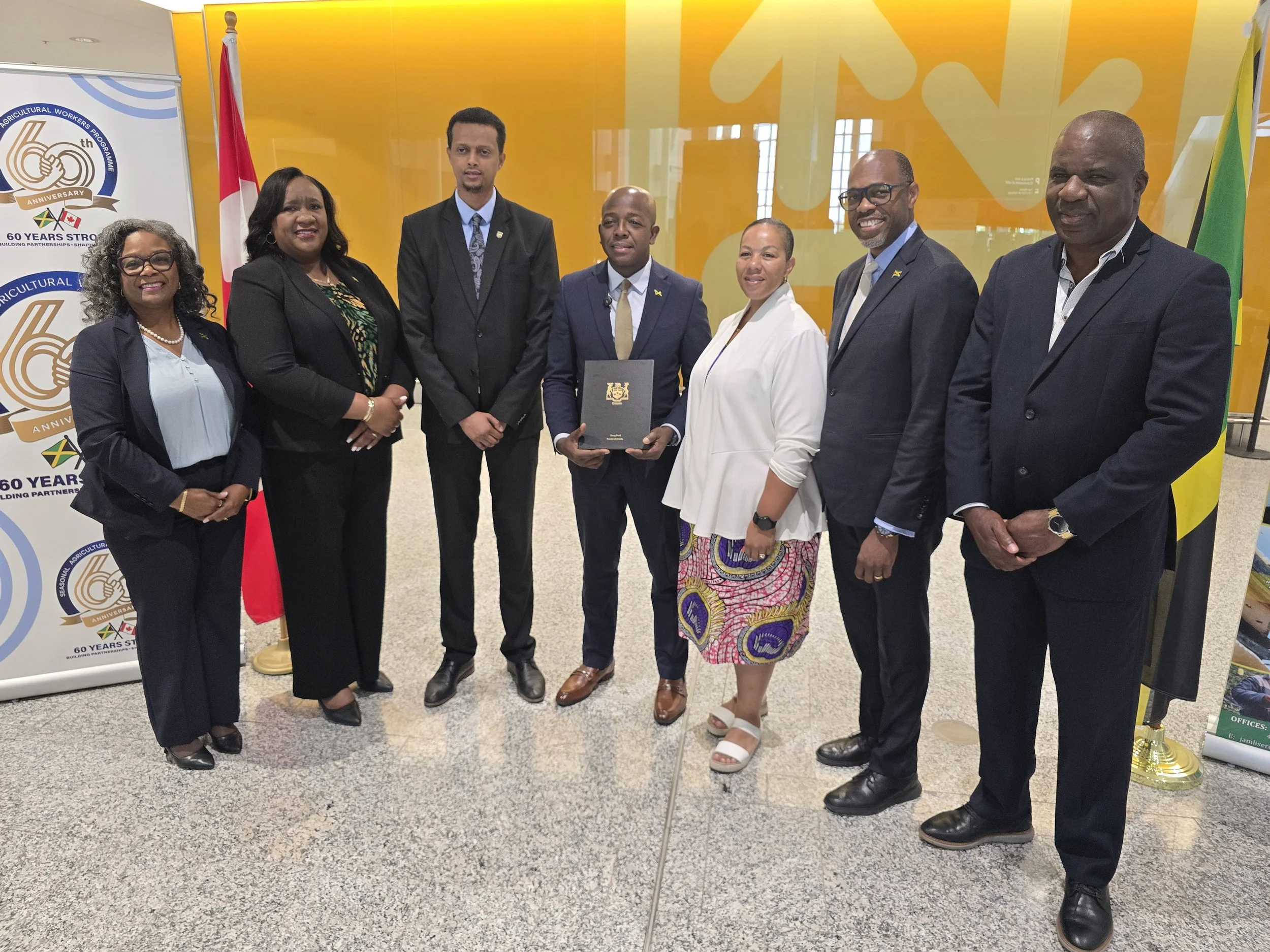
To mark the 60th anniversary of the SAWP, Ontario's Associate Minister Charmaine Williams presented a Certificate of Recognition to Jamaica's Labour & Security Minister Pearnel Charles Jr. in the presence of the program's chief liaison officer Althea Riley (l), Jamaica's High Commissioner to Canada Marsha Coore Lobban, York South-Weston MPP Mohamed Firin, Jamaica’s Consul General in Toronto Kurt Davis & Delory Palmer, Jamaica's Director of the Overseas Employment program (Photo by Ron Fanfair)
Williams reminded them that their efforts extend far beyond the farm gate.
“You are helping keep our economy strong and your work is so valued amongst us," she said.
Supporting workers has also become a priority for financial institutions serving the Jamaican diaspora.
Two years ago, JN Money Services established a formal partnership with the Jamaica Liaison Service to strengthen financial support available to workers while they are employed in Canada.
Regional manager Claude Thompson said the partnership grew from a shared commitment to workers’ welfare rather than simply providing banking services.
The organization now welcomes arriving workers, participates in outreach events, assists with banking services and offers short-term loans to first-time participants who may need financial assistance before receiving their first paycheques.
“We provide a short-term loan to assist them with their obligations back home,” Thompson added. “Ninety per cent send it back home to their family.”
The support does not end there.
Through a scholarship program launched this year, six children of seasonal agricultural workers received financial assistance to pursue their education in Jamaica.

Claude Thompson, JN Money Services Canada regional manager & JN Bank Canada Representative Office chief representative officer Monique Broughton (Photo by Ron Fanfair)
The organization also helps workers open bank accounts and establish savings plans before they return home, encouraging them to build long-term financial security from their seasonal earnings.
Those initiatives reflect how the SAWP has evolved.
As the program enters its seventh decade, another question is beginning to emerge.
What will farming look like 20 or 30 years from now?
Rapid advances in robotics, artificial intelligence, automated harvesting equipment, drones and precision agriculture are already transforming farms around the world. Some observers have questioned whether these innovations could eventually reduce Canada's reliance on seasonal agricultural workers.
For now, however, many agricultural experts believe that day remains some distance away.
Much of Canada's fruit and vegetable industry still depends on the experience, judgment and dexterity of workers who can recognize produce at its peak of ripeness and harvest delicate crops without causing damage. While machines have become increasingly sophisticated, they continue to struggle with the adaptability and precision required for many labour-intensive crops.
Rather than eliminating jobs, technology is more likely to reshape them.

Jamaican farmworkers arrive in Canada as the landmark Seasonal Agricultural Worker Program celebrates its 60th anniversary (Photo by Ron Fanfair)
Future participants in the SAWP may find themselves operating autonomous harvesting equipment, monitoring irrigation systems through digital platforms, using drones to assess crop health and working alongside robotic technologies.
As agriculture becomes increasingly sophisticated, workers will have opportunities to develop valuable technical skills that can be applied not only in Canada but also on farms and in businesses across Jamaica and beyond.
Yet one reality is unlikely to change.
Canadian agriculture will continue to depend on skilled, adaptable and dependable people whose experience, judgment and work ethic cannot be automated.
Innovation will undoubtedly shape the program's future, but its greatest strength has never been technology. It has always been people.
For 60 years, thousands of Jamaicans have left their families behind, crossed borders and worked tirelessly to help feed Canadians while creating brighter futures for their own children, families and communities.
Machines may transform how food is grown, but they cannot replicate the resilience, sacrifice and humanity that have defined the program since 1966. That enduring legacy remains its greatest harvest.