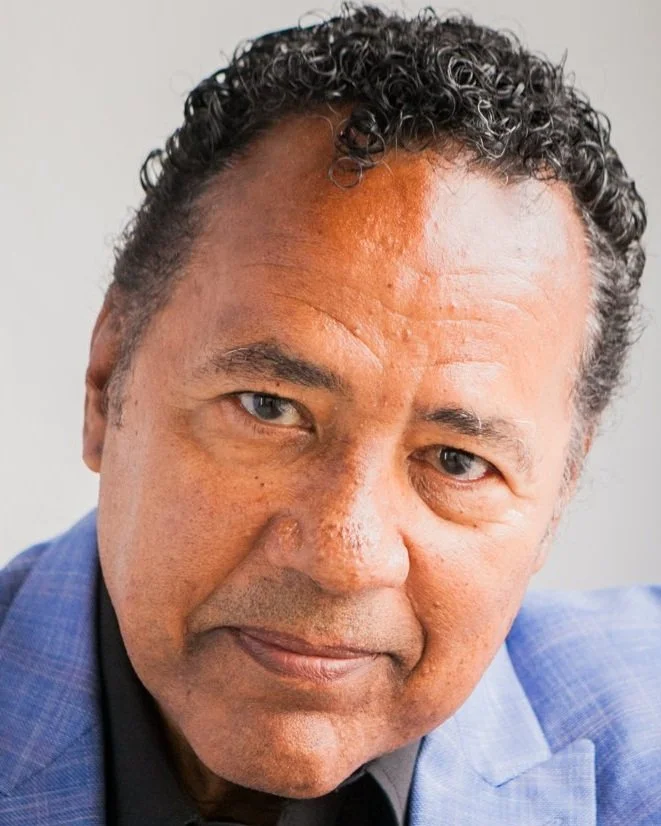
Oliver Jones was one of Canada’s greatest jazz pianists and cultural ambassadors
July 23, 2026
The music has fallen silent, but Oliver Jones' legacy will continue to resonate for generations.
He died on July 22 at age 91.
For more than seven decades, the internationally acclaimed pianist captivated audiences with a rare combination of virtuosity, humility and an unwavering commitment to excellence.
From the streets of Montreal's Little Burgundy to some of the world's most prestigious concert halls, he carried the spirit of Black Canadian artistry with elegance, dignity and pride.
For filmmaker Rosey Edeh and actor/producer and director Anthony Sherwood, however, Jones' greatest legacy extends far beyond the piano.
Both describe him as a man of extraordinary generosity, uncompromising principles and a lifelong commitment to the Black community that nurtured him.
Jones, Sherwood and late jazz legend Oscar Peterson grew up at Montreal’s historic Union United Church, the spiritual and cultural heart of the city's Black community.
“I just saw Oliver not too long ago sharing laughs with him at the church,” Sherwood, who produced the original stage production, Follow the North Star for the Canadian government, recalled. “We lived just blocks away from each other. We grew up in the same neighbourhood.”
He paid tribute to that shared history in his 2007 documentary 100 Years of Faith, which chronicles the remarkable story of the church, founded in 1907 and regarded as one of Canada's most significant Black institutions.
The film highlights the church's profound influence on generations of Black Canadians, including Jones, Peterson, actor Percy Rodriguez and numerous community leaders who helped shape the history of Montreal's Little Burgundy.
Sherwood and Jones' friendship endured long after childhood.
The two later collaborated with Oscar Peterson on plans for a stage musical inspired by Rockhead's Paradise, the legendary Montreal nightclub that helped shape Canada's Black entertainment history.
Owned by Jamaican-born Rufus Rockhead, the club was the hottest nightspot in the city.
Yet it was Jones the man, not simply Jones the musician, who left Sherwood with his most enduring memories.
“He was probably one of the most generous human beings I have ever met,” the former Obsidian Theatre Company president said. “He was such a kind and wonderful human being, as well as one of the world's greatest jazz pianists.”
Asked how history should remember Jones, Sherwood placed him among Canada's musical royalty.
“If Oscar Peterson is considered the King of jazz music in Canada, Oliver Jones is certainly the Prince of Jazz,” he said. “He never attained the international fame as Oscar, but he was certainly right up there in terms of his legacy and his contributions to jazz music in Canada and around the world. Let’s not forget that Oliver also performed all around the world."
Jones was the subject of Edeh’s first documentary, Oliver Jones: Mind Hands Heart, a project that ultimately transformed her own career.
After being laid off by Global Television a decade ago, she decided to tell the story of a Black Montrealer whose life had inspired both the community and herself.
“I wanted to tell a story about a Montreal individual, somebody who influenced the Black community and me," Edeh said. “Oliver Jones’ name just stuck out to me.”
Rather than contacting Jones directly, she approached his record label, Justin Time Records.
The response left her deeply moved.
“They said they would pass it on to Oliver Jones,” she recalled. “Once they told him, he said, “I know Rosey’. He knew so much about me. I was so touched. He said, ‘Of course we will do this documentary’, without hesitation.”
What began as a passion project soon became an invaluable historical record.
Shortly after agreeing to participate, Jones announced his retirement from major touring.
Edeh followed him across Quebec and Ontario, documented performances at the Montreal International Jazz Festival and eventually travelled to Barbados where he gave what became his final major concert.
“It was absolutely unforgettable,” she said. “It was a way for him to honour his parents, his family and the country of Barbados where his parents migrated from.”
The experience also revealed a side of Jones that audiences rarely saw.
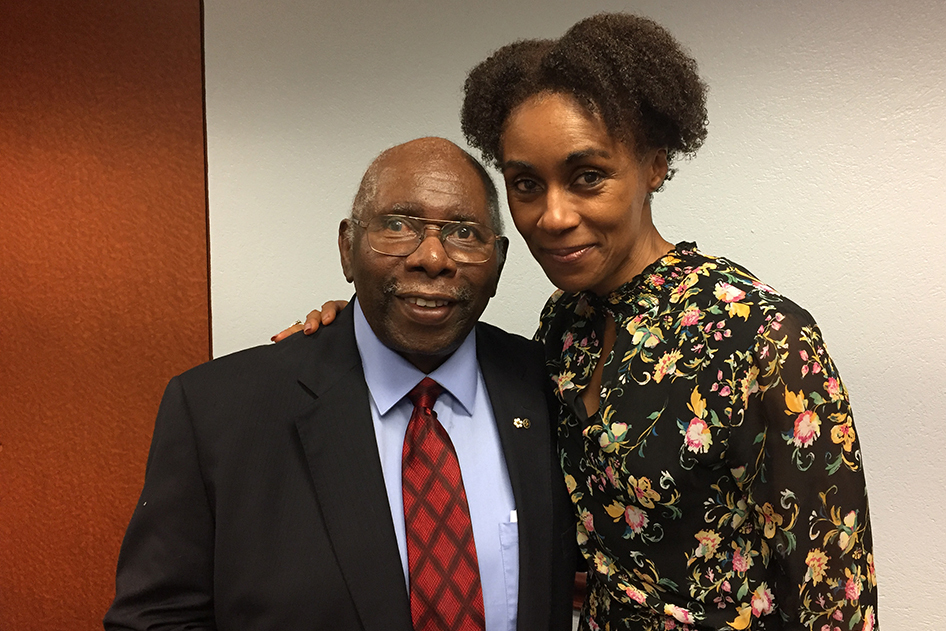
Oliver Jones and Rosey Edeh (Photo contributed)
While the public knew him as gracious and humble, Edeh discovered an artist who demanded excellence from himself and everyone around him.
“He was no one to be trifled with,” said Canada's first world-class 400-metre hurdler. “If it wasn’t right, if it wasn’t produced well, he would let you know because he was a perfectionist and a man who stood on his principles. At the same time, he was warm and kind. He was a mentor.”
Watching Jones work became a lesson in leadership.
“He really inspired me,” Edeh added. “You don't have to be mean and cruel, but you do have to voice your opinion and make sure your standards are met. I will deeply miss him. He is gone, but I will never forget him.”
Jones’ influence reached far beyond those who knew him personally.
For nearly two decades, he closed concerts around the world with Oscar Peterson's stirring composition Hymn to Freedom, a piece that became both his theme song and his signature finale.
“I always told Oscar I played this tune much more than he did and he should be paying me the royalties,” Jones joked during a March 2019 event in Waterloo celebrating the world premiere of a new arrangement of the inspirational work.
Jones, who recorded his own interpretation of the composition in the 1980s, said its message resonated with him from the very first time he heard it. He performed the piece in about 70 European cities and always reminded audiences that it was Peterson's masterpiece.
“I always ensured that audiences knew it was Oscar’s composition,” he said.
One performance in Sweden remained especially memorable.
Jones met an African American choir director who had translated the song into five languages and invited him to accompany the choir after learning he was from Montreal.
“That was because of Oscar and his worldwide appeal,” Jones said.
The song's impact extended far beyond the concert hall.
After years of opening Black History Month celebrations in the Kitchener-Waterloo region with Lift Ev'ry Voice and Sing, retired nurse and community organizer Lauris DaCosta envisioned creating a distinctly Canadian tradition centred on Hymn to Freedom.
Determined to turn that vision into reality, she sought the support of people closely connected to the song and its legacy. Among those she contacted was Oliver Jones, one of Oscar Peterson's closest friends and musical collaborators.
“My phone rang one day and, to my surprise, the caller on the other end identified himself as Oliver Jones,” she recalled. “We talked, and he thought it was a good idea worth pursuing. He forwarded a copy of the letter to Oscar Peterson’s widow, Kelly, who endorsed the idea and offered whatever support she could. Those endorsements gave me the motivation I needed to vigorously pursue the project.”
Jones and his wife travelled from Montreal to attend the world premiere of the new arrangement of Hymn to Freedom at First United Church in Waterloo seven years ago.
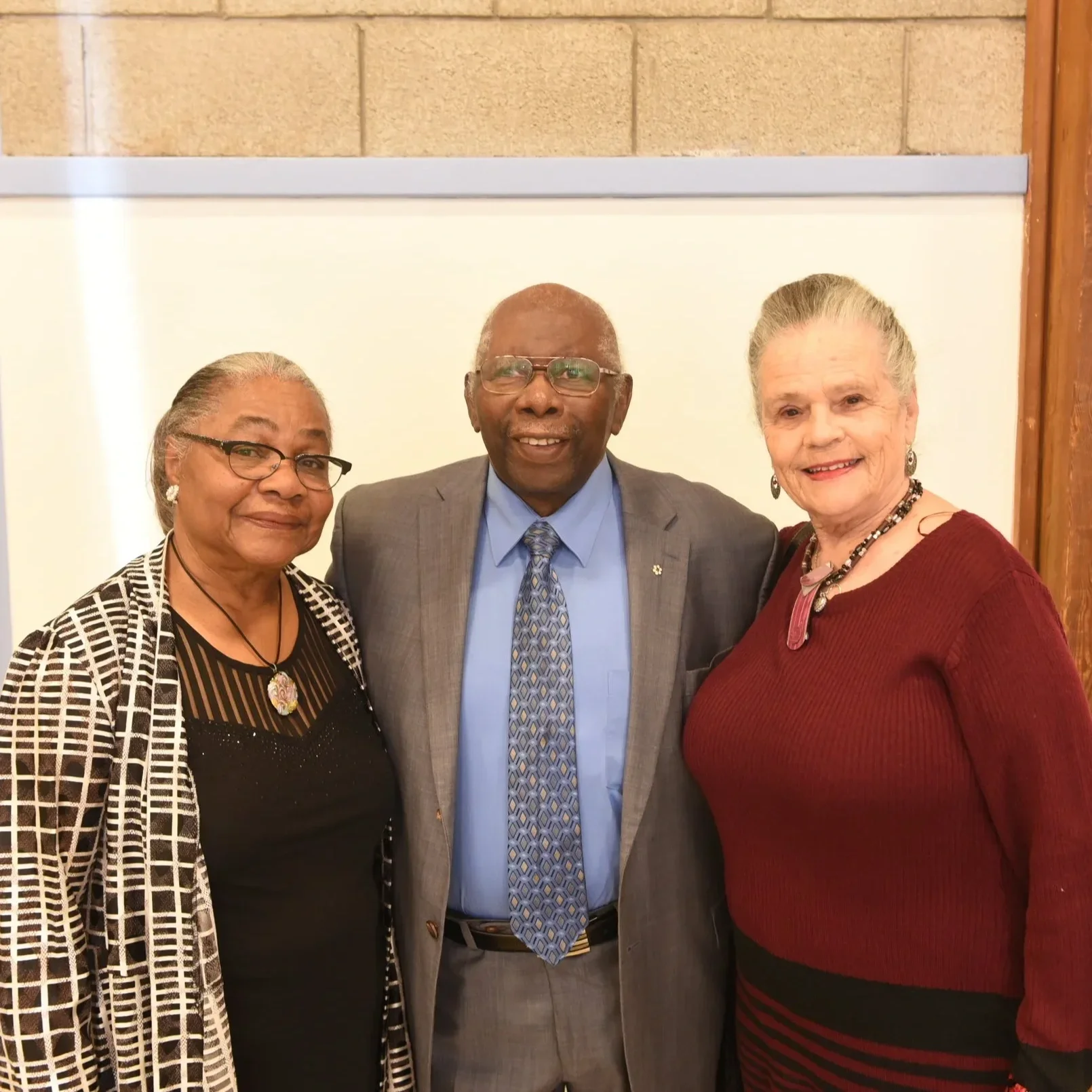
Lauris DaCosta (l) with Oliver Jones and his wife Monique Leclerc (Photo by Ron Fanfair)
The applause that followed him throughout his extraordinary career has faded, but the music he created, the students he inspired and the generosity he extended to others will resonate for generations.
Perhaps no song better reflected Jones’ life than Hymn to Freedom, a composition he carried faithfully to audiences around the world while ensuring they never forgot the genius of Oscar Peterson. In doing so, he also secured his own place among Canada’s greatest cultural ambassadors.
A two-time Juno Award winner, he was appointed to the Order of Canada in 1993, inducted into the Canadian Music Hall of Fame in 2023 and received the Governor General’s Performing Arts Award in 2025.