From Barbados roads to Toronto schools, road tennis finds a new generation
October 14, 2026
At the Ontario Sports Hall of Fame’s 2022 induction gala, Ron Kellman watched guests dressed for an awards ceremony pick up racquets and try a game many had never seen before.
Two leading road tennis players had travelled from Barbados to demonstrate the sport. The guests’ enthusiasm encouraged him, but a young man with autism left the deepest impression. His brother said he had never seen him so happy.
“That was the same night that triggered me,” Kellman recalled. “If that young man can find road tennis and it allows him to do that, there is something special with this sport.”
That experience strengthened a commitment that later brought him to David and Mary Thomson Collegiate Institute in Scarborough on September 28 for the launch of a partnership between the Toronto District School Board (TDSB) and Gauntlet Road Tennis Inc.
Led by Kellman as chief executive officer, the company partnered with the board to introduce the Barbadian sport to students.
Educators, elected representatives and Barbadian community leaders gathered for remarks, a demonstration and the signing of an agreement.
The setting held personal significance for Barbadian-born Kellman who moved to Canada at age nine and grew up in Scarborough, where baseball and basketball, rather than road tennis, were his sports.
Years later, hearing Barbados Prime Minister Mia Mottley discuss road tennis on television prompted him to explore bringing the game to Canada. His early efforts included a demonstration in Aurora in 2019.
The response at the Hall of Fame gala reinforced his belief that Canadians would embrace it. Bringing the game to students in the community where he grew up made that work especially rewarding.
“My community where I grew up is now going to start playing road tennis,” Kellman said. “I couldn’t ask for a better place and a better way to introduce it than where I spent so much of my time as a child in Scarborough.”
The sport carries a history of making play accessible.
Road tennis originated in Barbados in the 1930s among working-class residents who could not afford to play lawn tennis. Using roads and small open spaces as courts, they developed an affordable game that became part of community life.
Barbados’s High Commissioner to Canada, Gline Clarke, recalled that sense of connection in the village where he grew up.
“Neighbours knew one another, children waited their turn to play and spectators kept up a running commentary as matches unfolded,” he said. “When a game of tennis started, people gathered. It was more than competition on the court. It brought people together to compete, to celebrate, to exchange stories and build friendships.”
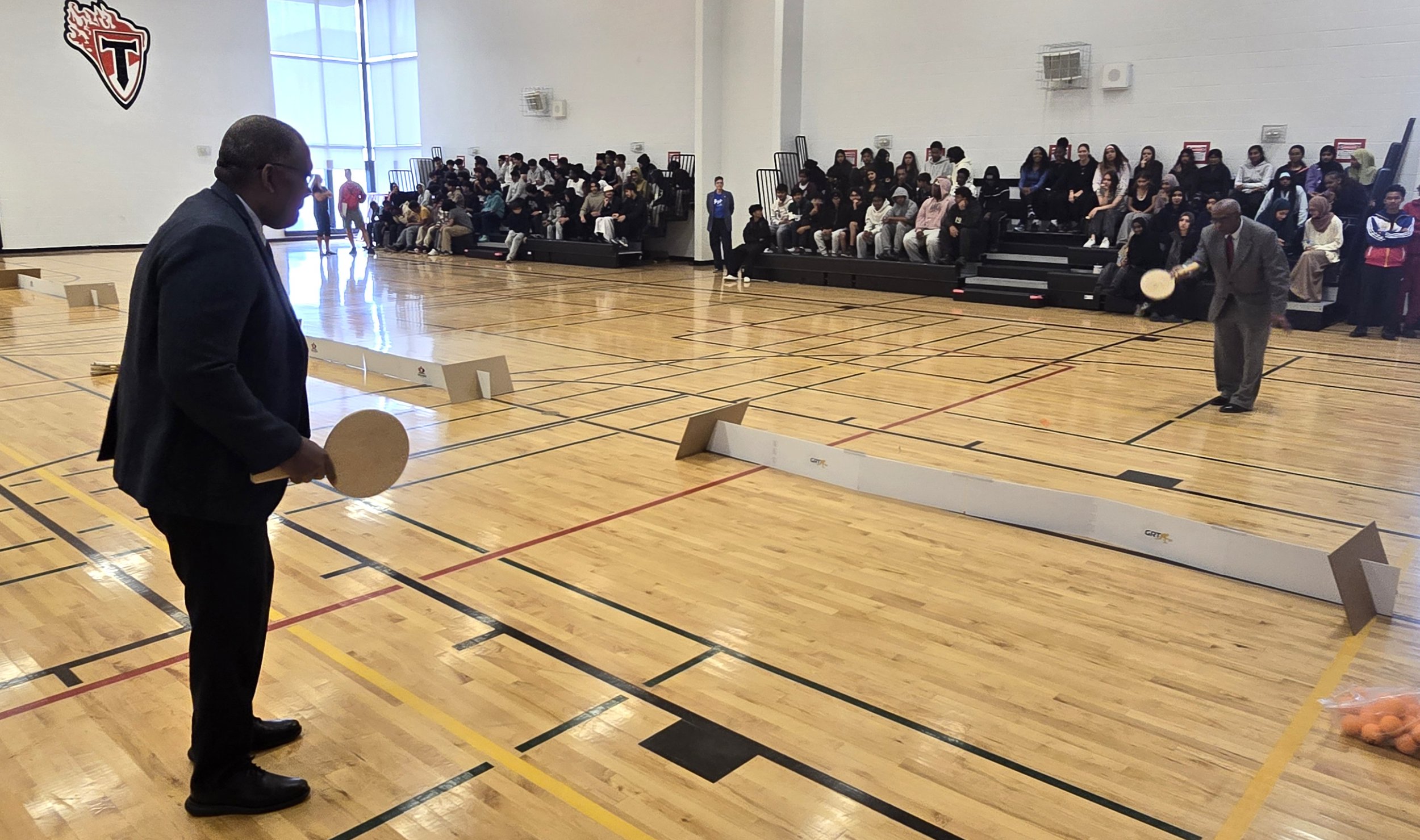
Barbados High Commissioner to Canada Gline Clarke ® and Consul General Anthony Branker demonstrate road tennis (Photo by Ron Fanfair)
The lessons extended beyond the result of a match.
“Players learned discipline and how to handle both victory and defeat,” Clarke said. “An opponent on the court was still a friend, schoolmate, neighbour or relative when the game ended.”
For students in Toronto, learning road tennis offers an introduction to that community tradition as well as a new physical activity.
“When you pick up that racquet, you are participating in something historical,” Clarke told them. “You are playing a sport that young people in my country, Barbados, have enjoyed for generations. You are now becoming part of a new chapter.”
Jason Kandankery, a TDSB superintendent of education, said the agreement would help introduce road tennis in schools and raise its profile.
“Its modest equipment needs and relative ease of introduction make it appealing, as does the chance to teach students about its origins,” he said. “We want it to be culturally relevant and responsive. The fact that it has this deep connection to Barbados is something that we want to share and have it shared throughout the entire school board.”

Ron Kellman and TDSB superintendent Jason Kandankery sign the agreement (Photo by Ron Fanfair)
David and Mary Thomson principal Lisa Edwards encouraged students to approach the demonstration with curiosity.
She recalled encountering field hockey for the first time as a student at nearby Winston Churchill Collegiate Institute. One of the girls who took up the sport alongside her went on to become an Olympian.
“You may discover a sport you’ve never played before,” Edwards said. “You may find that you are naturally good at it, or you may simply just have fun at learning something different.”
She urged students to participate, ask questions and encourage one another.
“You never know where something new may bring you,” Edwards added.
Some of the elected representatives were also discovering the game.
Scarborough Centre MPP David Smith, a former TDSB trustee, welcomed another opportunity for young people to be active and said he wanted to learn more about how road tennis could grow.
He also recognized what its introduction could mean to Barbadians living in Canada.
“Bringing people who come from Barbados, who are here in the diaspora, they might have thought it was forgotten,” Smith said.
Toronto Councillor Michael Thompson initially misunderstood the name. When Kellman first approached him, he imagined matches taking place on Toronto streets already crowded with traffic.
Learning how the game could be adapted to other spaces helped him see its potential for students, both as players and as advocates.
“You are now going to become ambassadors of this new sport,” Thompson told them, urging them to share what they learned with friends.
He said playing could help students develop balance and dexterity while giving them another way to participate with their peers.
Sustaining that interest will require support for the people who teach the game.
Tammy Shubat, the chief strategic officer at Ontario Physical & Health Education, which supports health and physical education, said it developed a road tennis safety standard after Kellman’s group approached it.
The guidance helps schools introduce the sport safely.
Clarke also emphasized coaching, noting that Barbados had completed occupational standards that could support the development of training courses for road tennis coaches.
“We do not only want people to learn how to play tennis,” he said. “We also need people who know how to teach it. A good coach can introduce dozens of young people to the game, some of whom may eventually teach others.”
The partnership comes as Barbados and Canada mark 60 years of diplomatic relations. Formal ties began when Barbados gained independence in 1966, although connections between their people and institutions reach further back.
In a Toronto school, those ties take a form students can experience directly, learning a game with friends and perhaps sharing it with family members who remember playing it in Barbados.
Kellman hopes that interest could eventually extend beyond Canadian courts.
He said there had been discussions about road tennis cultural tours that would take Canadian students or community members to Barbados to learn about the game where it began. Such visits could combine playing with an introduction to Barbadian communities and heritage.
Clarke envisioned exchanges in both directions.
“Perhaps one day you will see Canadian players travelling to Barbados to compete,” he said. “Perhaps we will see children from this school travelling to Barbados, and Barbadian players coming to Canada for major competition.”
No school trip or competition was announced at the launch. Those possibilities depend on developing a base of players, teachers and coaches, but they suggest how a sport introduced in Scarborough could deepen young Canadians’ connections with Barbados.
Clarke hopes the agreement’s significance would emerge through the activity it generated.
“The courts that are marked, the racquets that are picked up, the teachers who introduce the game, the coaches who are trained and, above all, the young people who play,” he said.
A young man’s joy had helped Kellman see what road tennis could offer. At David and Mary Thomson, the invitation was extended to a new generation to pick up a racquet and discover it for themselves.