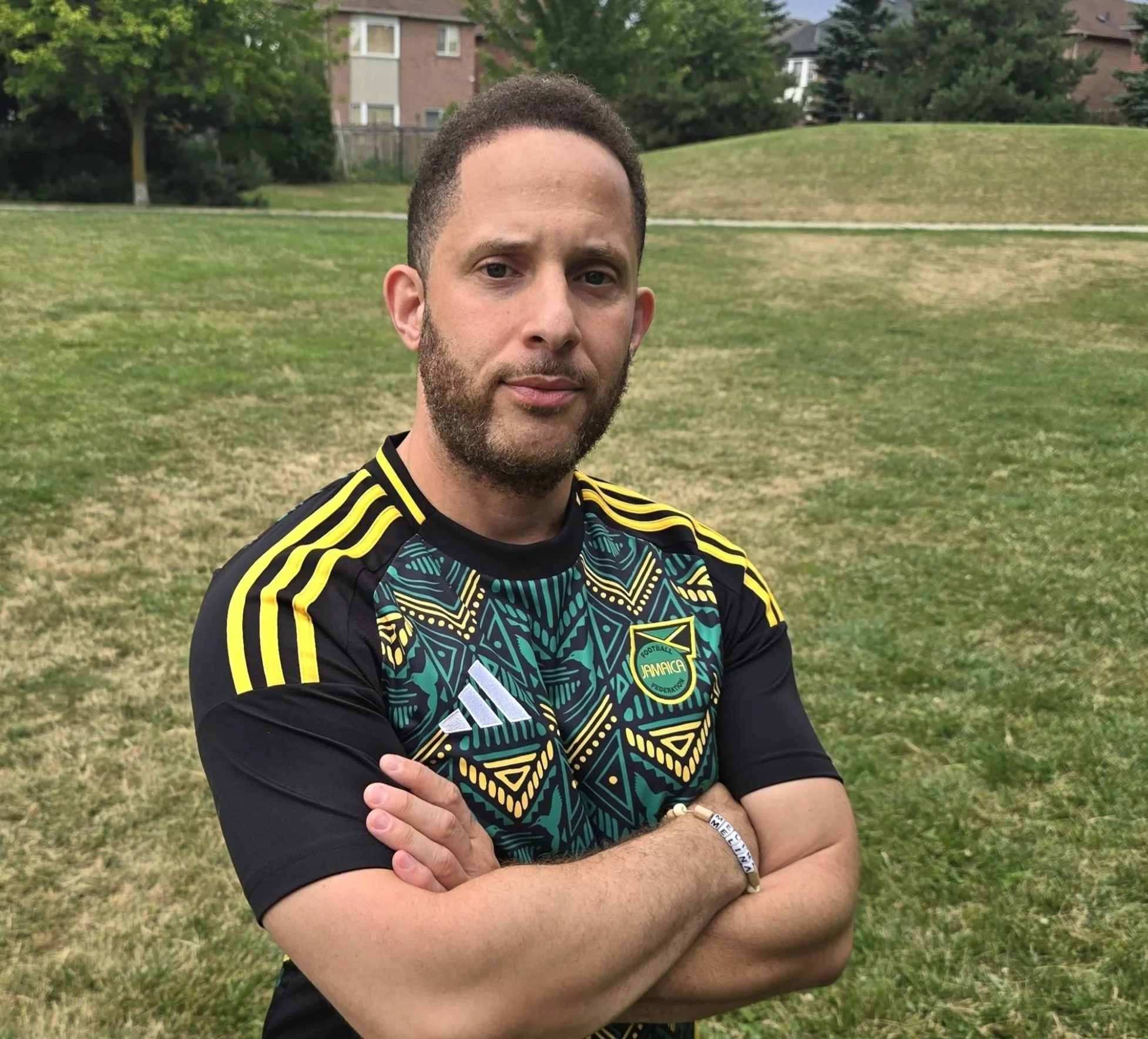
Dan-e-o built a career on authenticity
August 5, 2026
On a warm summer evening at Sankofa Square last month, Dan-e-o could easily have been somewhere else.
At 49, after nearly four decades devoted to hip hop, the Toronto artist has long since earned the right to be selective about where he performs. He could have spent the time relaxing with his 12-year-old daughter or enjoying a rare break from a career built through persistence, sacrifice and unwavering commitment to his craft.
Instead, Dan-e-o chose to share the stage with Keysha Freshh, Phoenix Pagliacci, Taaylee G and other predominantly women artists at HEATWAVE, a special themed concert in the Melanin Market series. His presence underscored his commitment to supporting artists whose talent and contributions are too often overlooked within Canadian hip hop.
When his performance ended, he did not quietly slip away. He stayed to pose for photographs, congratulate performers and encourage emerging artists.
It served as another reminder that, for Dan-e-o, success has always been about more than record sales or celebrity.
Throughout a career spanning nearly 40 years, he has understood that hip hop grows stronger when established artists create opportunities for others. That philosophy has defined not only the artist he has become but also the man behind the microphone.
Reflecting on his journey, Dan-e-o speaks less about accolades than gratitude.
“There is a range of emotions,” he said. “One of them is definitely pride because as a kid, I fell in love with music before my recollection even kicked in. My mom told me I used to sing in the crib, and I would pick up the hose in the backyard and sing into it when my parents would be playing reggae, calypso or whatever. I always saw myself as an artist.”
Long before audiences came to know him as one of Canada’s most respected hip hop artists, Daniel Faraldo -- better known as Dan-e-o -- imagined himself on stage. As a child, he dreamed of becoming Michael Jackson before discovering another musical language that felt more authentic.
“By the time I was 10, I discovered hip hop and thought, ‘I can do this better than trying to be like Michael Jackson’,” he recalled.
That discovery eventually led to Dear Hip Hop, the song that launched Dan-e-o’s recording career in 1996 and remains one of the defining tracks in Canadian hip hop. Three decades later, he takes particular satisfaction that his first major release continues to reflect exactly who he is.
“Everything that I said in it still holds,” he said. “It’s still my reality and where my heart is at with respect to the music, the culture, my devotion to writing and recording and performing and being true to myself as an artist. All of those things that I mentioned in the song are still true. So, I am proud that that is the song that was the first one.”
Tony ‘Master T’ Young, who played a significant role in the growth of Black music in Canada, said he first became aware of Dan-e-o 36 years ago during a rap competition on Electric Circus, then one of Canada's most influential music television programs.
He competed alongside Lindo P, and while many artists came and went during that era, Master T noted that both performers have remained active and relevant.
He recalled recognizing Dan-e-o immediately as someone with exceptional talent.
“What impressed me most was that he never tried to imitate the dominant American rap sound of the day,” said Master T who was a stunt double in ‘Police Academy 3: Back in Training’. “Instead, he developed his own identity, combining a rapid-fire delivery with thoughtful lyricism that explored issues beyond the traditional bravado associated with hip hop. He had his own style and his own swagger, and his confidence and authenticity made him stand out from the beginning.”
Beyond his technical ability, Master T believes Dan-e-o's longevity comes from his genuine love for the culture.
“Whether performing before a packed venue or a handful of people, he brings the same enthusiasm because he is driven by a desire to share both his craft and the values of hip hop,” noted the creator of ‘X-Tendamix’ in 1990 that transitioned three years later into ‘Da Mix’ that aired on MuchMusic for 11 years and was one of the network’s highest rated shows. “He loves the performance and would rap to ten people in a library or five people. It doesn't really matter.”
Reflecting on Dan-e-o's signature song Dear Hip Hop, Master T said its enduring popularity comes as no surprise. He described it as ‘beautifully written’ and said it reflects both the artist’s passion for the music and his role as an educator.
“Thirty years after its release, the song continues to resonate because it captures a moment in Canadian hip hop while demonstrating the lyrical foundation that has sustained Dan-e-o's career,” he added. “That is what keeps you in the game. People remember where they were when they heard it.”
Those qualities -- originality, authenticity and an enduring love of hip hop -- are precisely the ones Dan-e-o believes have sustained him throughout his career.
“I am also proud that I stuck to my guns,” he said. “When I got into the music business, I thought success meant becoming famous and making money. It didn’t work out exactly the way it has for many bigger artists, but I have come to realize there is so much more to it. As an artist, I love my art and I love performing.”
That passion, he admits, explains why he still eagerly accepts invitations to perform despite having little left to prove.
“I might have other things to do, but I love performing,” said Dan-e-o who was born in Toronto to a Jamaican mother and a Spanish father, giving him a multicultural upbringing that has shaped both his life and music. “The fact that I am still involved in something that I love means a lot to me. I pour my heart out when I write my lyrics and when I perform.”
His perspective stands in sharp contrast to what he sees among many younger artists entering the industry today.
“They jump into it thinking, ‘I can become a star’,” he said. “I teach youth, so I know that a lot of them have that attitude. If it doesn’t pan out, they quit. Having not quit, I can look back and say, ‘Man, I’m so proud that that was the attitude that I had’. Thirty years later, I am still living it.”
There was, however, one period when even Dan-e-o questioned whether the struggle was worth continuing.
Following the release of his second album, See No Evil, Hear No Evil in 2004, he found himself increasingly frustrated by the direction commercial hip hop had taken.
The music he admired was receiving less attention while artists chasing trends were enjoying commercial success. As an independent artist investing his own time, money and energy into every project, the rewards seemed increasingly elusive.
“I thought, ‘Man, I don’t know if I can keep doing this’,” Dan-e-o admitted. “Mentally, I had reached the point where I was saying, ‘This is it for me’.”
Although he never officially retired, he began exploring other creative outlets. Acting, teaching songwriting, podcasting and writing broadened his artistic horizons.
Ironically, those experiences reaffirmed what had always been at the centre of Dan-e-o’s identity.
“All they did was remind me where it all started and what it was all about,” he said. “It was the music. I never officially left, but I knew I wanted to come back stronger than ever.”
Looking back over three decades, Dan-e-o identifies three defining moments that shaped both his career and his character.
The first came at just 13 years old when he won the rap competition on Electric Circus, Canada's iconic music television program. Until then, he had never stepped inside a professional recording studio. He recorded homemade tapes by pressing play on one cassette deck and record on another, convinced he had something to offer.
Winning the competition validated that confidence.
“That has to be moment number one,” he said. “Winning the contest proved it and made me feel like the man.”
The second arrived in 1996 when Dear Hip Hop was licensed to Beat Factory's Rap Essentials Volume One. The compilation introduced him to audiences across the country through MuchMusic's Rap City, where he was interviewed and performed live.
“That is really what set it off for me,” said Dan-e-o who, in 2015, was honoured with the Black Canadian Award for Best Hip Hop Artist. “The nation got to discover who I was.”
The third, he says without hesitation, had nothing to do with music.
“Becoming a father in 2014 is the biggest moment of my life,” he said. “I dedicated an entire album to that called The Day It All Changed. It was an example of my growth, maturity and songwriting experience, focusing on being an artist and not just a guy trying to become rich and famous.”
Fatherhood transformed more than Dan-e-o's personal life. It reshaped his music, his priorities and ultimately his understanding of success.
While his daughter Melina inspired an entire album, it is their relationship that brings the greatest sense of accomplishment. Speaking about her, the confidence that characterizes his performances gives way to unmistakable pride.
“She’s amazing,” Dan-e-o said. “I am so thankful, man, because becoming a dad meant there were concerns around even how I was going to have the opportunity to raise her. Going about my business to ensure that we shared custody of my daughter became my number one mission after she was born.”
Today, father and daughter share a bond built on honesty, creativity and mutual respect.
“My daughter has grown up smart, funny, polite and kind,” Dan-e-o pointed out. “She’s an artist in her own right too. She’s always singing and making up songs. We have this relationship where we can be very silly with each other, but she also talks to her dad. She tells me what happened in school and why she’s decided not to be someone’s friend anymore. She’s already navigating life as a pretty mature kid.”
Watching her interact with other children has reinforced the values he hopes he helped instill.
“She was always the kid who would say, ‘You can go first’, and let someone else go down the slide’,” Dan-e-o said. “She’s a wonderful child, and she makes it easy to be a dad.”
That sense of maturity extends to the way he now views both his own career and the evolution of Canadian hip hop.
When he began recording in the early 1990s, earning international recognition as a Canadian rapper seemed almost impossible. Artists often felt compelled to seek validation south of the border before being taken seriously at home.
Today, the landscape is dramatically different.
“I grew up in an era where trying to earn global or at least international respect as a Canadian hip hop artist felt impossible,” he said. “Now we can speak about people like Drake, as well as several other Canadian artists who have made themselves international successes. We can now look at Toronto and go, ‘Listen, it’s a city you don’t play around with’.”
Yet with greater opportunity has come a new challenge.
Rather than finding their own voice, Dan-e-o believes too many aspiring artists are chasing formulas that have already proven commercially successful.
“Instead of focusing on originality, they’re like, ‘Let me do it Drake’s way or this artist’s way’,” he said. “Today I’m hearing a lot of music that sounds like a lot of other people’s music. Abandoning originality, uniqueness, being yourself and staying true to you, which is what I grew up on, has become more of the norm. I think that’s one of the problems because people are looking at it like, ‘Let me follow the guy who’s making money and try to be like him’.”
It is a message Dan-e-o delivers regularly in the songwriting workshops he teaches.
For him, talent alone has never guaranteed longevity. Passion does.
“You’ve got to love it,” he said. “If you’re here to become a multi-million-dollar rapper, I’m the wrong guy to teach you because I would have done it myself. But if you love this, you will overcome a lot of the things that we’ve already spoken of.”
That love has enabled him to weather disappointing concerts, financial uncertainty and an industry that has changed almost beyond recognition. It has also encouraged him to expand beyond recording.
“If you can do all of that, it’s because you love it enough,” he explained. “I also act, host events, teach classes, do presentations. It’s all within the umbrella of being this artist. I can earn money still as Dan-e-o because I have found ways to take this talent and utilize it in various forms instead of just saying it’s either music or nothing.”
Those experiences have made Dan-e-o as comfortable interviewing people and hosting events as performing before thousands.
“It has helped me discover the many different facets of this talent that I have,” he said. “They have influenced each other because they have given me the confidence that I can do this and that I am meant to do it.”
As he looks toward the next chapter of a career approaching its fourth decade, Dan-e-o measures success differently than he once did.
Chart positions, awards and commercial milestones have their place, but they are no longer the standard by which he wishes to be remembered.
“I definitely want to be respected as an artist who stayed true to who he was,” said Dan-e-o who is a member of the Scarborough-based groups Monolith and Perfeck Strangers. “Whether he sold a lot or didn’t, sold out shows or didn’t, you know what you are going to get from Daniel. The music will be solid and the messages will be important.”
He points to legendary American R&B group The Whispers as the model he hopes to emulate, not because of their record sales, but because of their unwavering commitment to performing with integrity decades after they first stepped onto a stage.
“When people pay their money to see a live performance, that is what we have got to give them,” Dan-e-o said, recalling advice he received from members of the group. “You can never say Dan-e-o got on stage and lip-synched a song. You can never say Dan-e-o didn’t put his heart into his music.”
Ultimately, he hopes his career sends a message to artists who may never become household names.
“I would like people to look at my catalogue and go, ‘This guy never quit, he stuck to his guns and was a real one throughout’,” said Dan-e-o. “Hopefully that will inspire artists who will say, ‘Even if I don’t make it big, this is still for me. I love it so much that if he can do it, so can I’.”
That may explain why the scene at Sankofa Square felt so fitting.
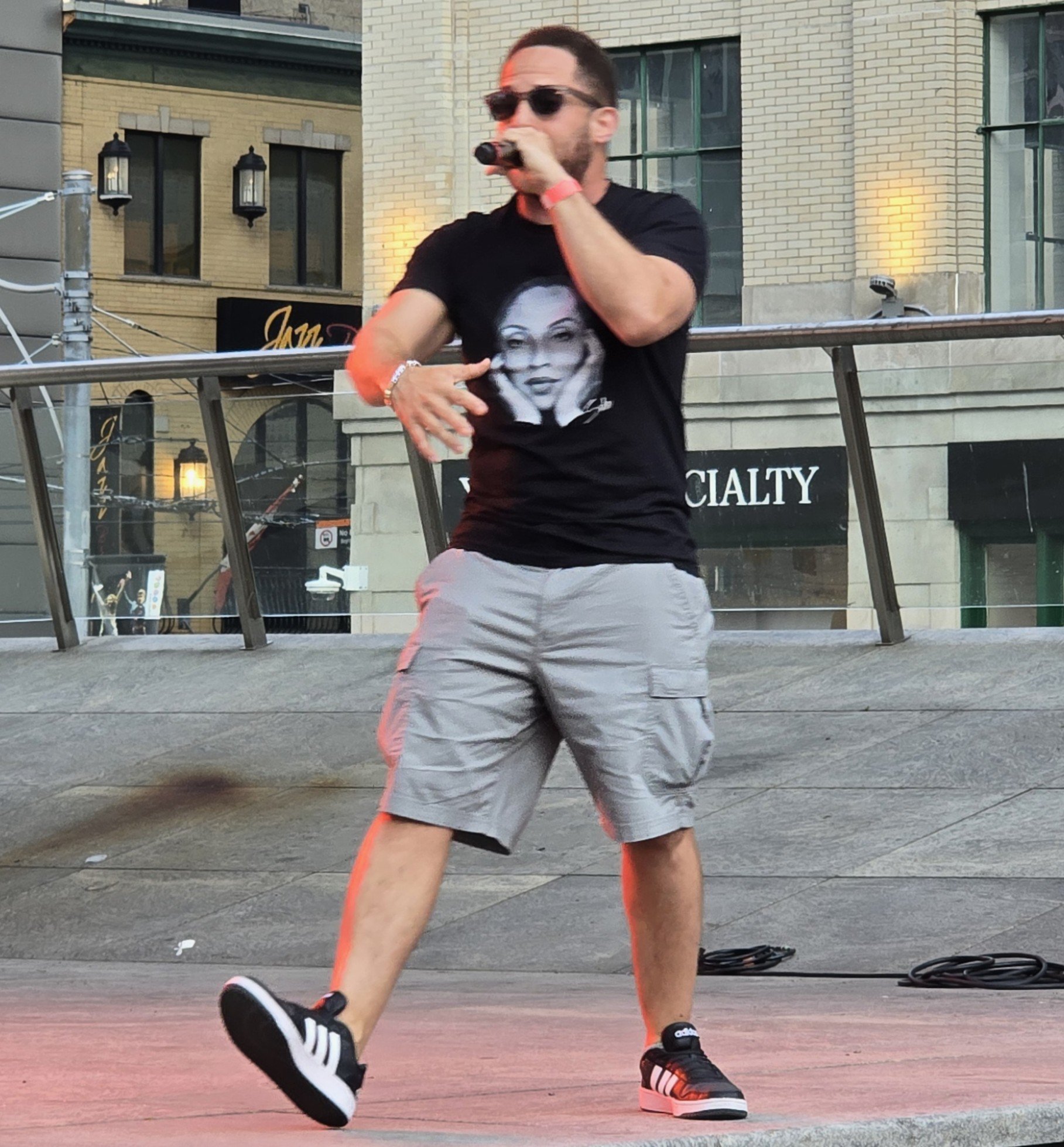
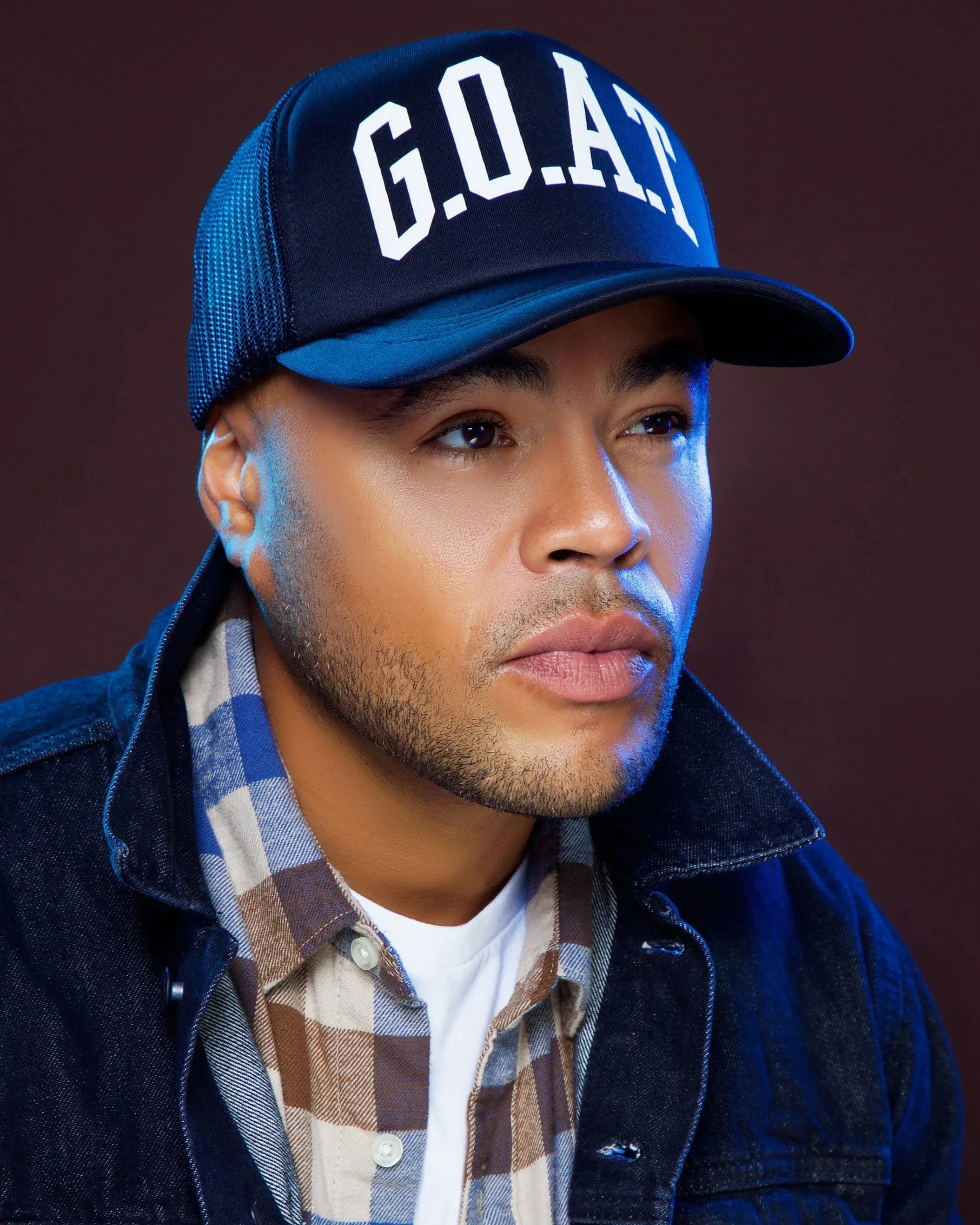
Dan-e-o performing at HEATWAVE at Sankofa Square in July 2026 (Photo by Ron Fanfair)
While others might have seen only a veteran rapper making a guest appearance, those who lingered after the music stopped witnessed something more enduring.
They saw an artist who has spent nearly 40 years proving that authenticity outlasts popularity, that service carries as much weight as success and that the strongest legacy is often built not by standing above the next generation but by standing beside it.
Long after the applause faded and the photographs were taken, Dan-e-o remained exactly what he had promised hip hop he would be three decades ago which is a genuine artist whose greatest hit may well be a career defined by conviction rather than compromise.