Bartlett calls for tourism to build resilience before crisis strikes
July 30, 2026
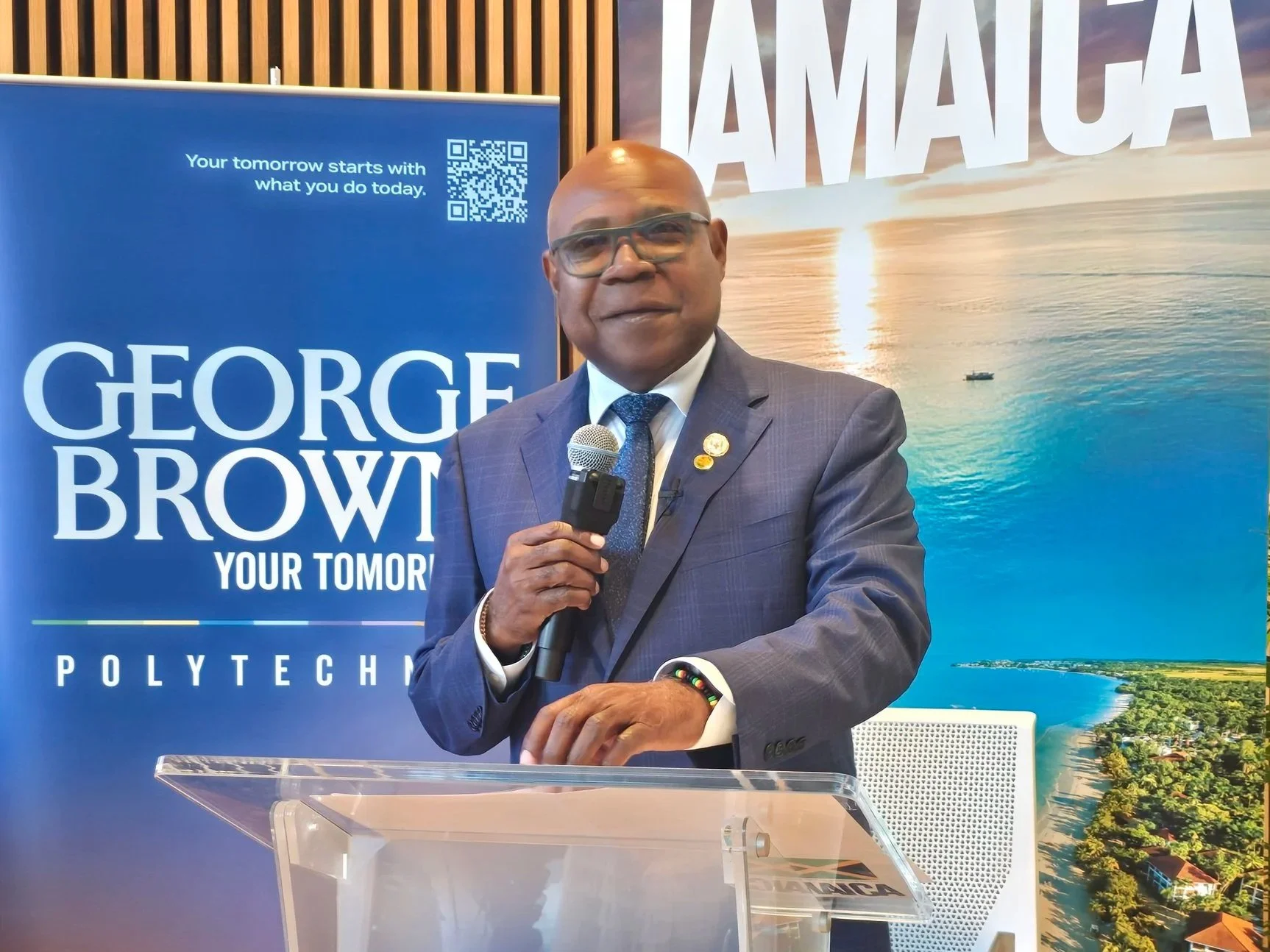
When Jamaican Tourism Minister Edmund Bartlett rose to deliver the keynote address at George Brown Polytechnic's Canada Caribbean Tourism Resilience Symposium on July 29, he did not begin by speaking about beaches, visitor arrivals or hotel occupancy.
He began with smoke.
The thick haze drifting across Canada from hundreds of active wildfires, he asserted, represented far more than an environmental emergency.
Bartlett said it symbolized a world where climate change, geopolitical conflict, cyber threats, pandemics and artificial intelligence increasingly converge to create what scholars now describe as a ‘polycrisis’.
“The fires in Canada are not only a Canadian story,” he said. “They are a mirror held to the world. They tell us that the world has changed, not temporarily, not superficially, but fundamentally.”
Addressing tourism leaders, academics, policymakers and industry stakeholders from Canada and across the Caribbean, Bartlett said resilience can no longer be defined simply by how quickly destinations recover after disasters.
“It is about redesigning tourism so destinations emerge stronger before the next crisis strikes,” he said. “We have entered the age of resilience. The industrial age rewarded productive capacity. The information age rewarded connectivity. The age of resilience rewards adaptive capacity which is the ability to anticipate disruption, absorb shocks, reorganize intelligently and transform before vulnerability becomes collapse.”
That shift, Bartlett contended, requires a different kind of leadership, one that embraces uncertainty, acts before consensus forms and values local knowledge alongside scientific expertise.
Throughout his address, he challenged conventional measures of tourism success.
While visitor arrivals, hotel occupancy and tourism receipts remain important indicators, Bartlett said they tell only part of the story.
“Tourism is also a system of trust,” he said. “Every ticket purchase is an act of confidence, every hotel reservation is a belief in stability and every conference booking is a wager on peace.”
Because tourism depends on confidence, Bartlett said it also becomes one of the world's most sensitive indicators of instability.
“When confidence rises, people move,” Jamaica’s longest-serving tourism minister noted. “When fear rises, movement contracts.”
Using Canada's 2024 Jasper wildfire evacuation as an example, Bartlett said resilience should not be judged solely by whether hotels reopen or iconic attractions survive.
“A destination is resilient when its people continue to live, work, create and hope,” the transformative leader said. “Governments should integrate climate adaptation, transportation, housing, emergency planning and economic development into a single resilience strategy.”
Bartlett devoted a significant portion of his address to global conflicts and their ripple effects throughout the tourism economy.
Wars in Europe and the Middle East, he noted, influence airline routes, insurance costs, cruise itineraries and travellers' confidence thousands of kilometres away.
“A destination does not have to be struck by a missile to be wounded by war,” said Bartlett who is a co-founder and chair of Consolidated Tourism and Investment Consultants Ltd. “It may be wounded by an airspace closure, by a travel advisory, by an insurance premium, by a cancelled convention or by a family deciding that uncertainty is too great.”
Yet, he maintained, tourism also possesses a unique capacity to foster peace.
“Tourism is one of humanity's quietest peace institutions,” Bartlett said. “It turns strangers into neighbours and it allows cultures to encounter one another outside the language of conflict.”
Describing tourism as ‘the diplomacy of encounter’, he said governments negotiate between nations, but tourism builds understanding between ordinary people.
Artificial intelligence emerged as another major theme.
Bartlett praised AI's potential to improve wildfire detection, forecast visitor flows, identify cyber threats and strengthen emergency preparedness.
However, he cautioned that technology must not deepen existing inequalities.
“Our task must be to democratize artificial intelligence,” Bartlett said. “The craft producer should be able to reach global markets, the small hotel should be able to forecast demand, and the tour guide should be able to communicate across languages. AI should amplify human capability, not erase human dignity.”
He also called for stronger safeguards around data privacy, transparency and accountability to ensure smaller destinations are not reduced to suppliers of data while wealthier nations reap the benefits of AI.
“The future must be smart, but it also must be trusted,” said Bartlett, who, in 2023, was honoured with the Pacific Area Travel Writers Association's (PATWA) International Travel Award for Lifetime Achievement in the Promotion of Sustainable Travel and Tourism at ITB Berlin in Germany.
Drawing on Jamaica's recovery following Hurricane Melissa in October 2025, he acknowledged that hotels reopened quickly after the storm.
However, Bartlett said genuine recovery cannot be measured by hotel occupancy alone.
“The deeper story of Melissa was not only the reopening of hotels," he said before pointing to the craft vendors, taxi operators, farmers, fishers, entertainers and guesthouse owners whose livelihoods remained disrupted long after visitors returned.
The former Chairman of the Board of Affiliate Members of the United Nations World Tourism Organization urged governments to rethink how they evaluate recovery.
“We must not ask only, ‘Are the hotels open’?” Bartlett said. “We must ask, ‘Has the farmer returned to the supply chain? Has the craft producer replaced inventory? Has the family business regained access to credit? Has the community recovered its dignity?'”
The tourism sector, he argued, cannot declare success while its smallest businesses remain closed.
Calling micro, small and medium tourism enterprises (MSMTEs) the backbone of the industry, Bartlett said they preserve culture, connect tourism with agriculture and transportation, distribute income throughout communities and create opportunities for women and young people.
“The businesses that make tourism memorable are often the businesses least able to survive the shocks,” he said. “This is not merely an unfortunate feature of the market. It is a policy failure and it must be corrected."
Bartlett also reflected on the growing influence of the Global Tourism Resilience and Crisis Management Centre (GTRCMC), which he founded in Jamaica.
He recalled leading the successful United Nations resolution proclaiming February 17 as Global Tourism Resilience Day.
“Small states need not have small ideas," Bartlett declared. “Countries that live closest to vulnerability often see the future first.”
Looking ahead, he envisioned the GTRCMC evolving into a global intelligence platform linking universities, governments, climate scientists, economists and tourism leaders to share knowledge before crises occur.
“No destination should have to face the next crisis alone and no small economy should be priced out of knowledge,” he said.
Perhaps Bartlett’s most ambitious proposal was his renewed call for a Global Tourism Resilience Fund.
Rather than financing recovery only after disasters dominate international headlines, he said the fund would support the entire resilience cycle, investing in preparedness before crises, emergency assistance during disasters, post-crisis recovery and long-term transformation.
“We recover,” he said. “But with support and guidance, we thrive.”
He proposed that governments, multilateral development banks, airlines, cruise companies, hotel groups, universities, philanthropic organizations and the global diaspora contribute to the initiative, with Canada playing a leading role.
“Canada brings financial expertise, research capacity, technological innovation and climate science,” Bartlett said. “Jamaica brings stories and leadership, lived experiences of vulnerability and the Global Tourism Resilience and Crisis Management Centre. The Caribbean diaspora brings trust, capital, market access and a human bridge between our regions.”
Returning to the image of wildfire smoke that opened his address, he urged delegates to place people, not simply infrastructure, at the centre of tourism policy.
“The smoke above Canada is a warning, but it can also be a summons,” he said. “The world has changed and tourism must change with it. We must move from reaction to anticipation, from vulnerability to transformation, from fragmented recovery to shared resilience. If we summon the courage to finance what we already know is necessary, tourism will remain more than an industry. It will remain a bridge between peoples, a generator of dignity, a guardian of culture, an agent of sustainable development and one of humanity's most enduring pathways to peace.”
Bartlett’s keynote ultimately challenged delegates to rethink tourism not as an industry measured primarily by arrivals and revenue, but as a vehicle for economic resilience, social stability and international cooperation.
His message echoed the symposium’s central theme that in an increasingly unpredictable world, the destinations that thrive will be those that invest in people, strengthen communities and prepare for disruption long before the next crisis arrives.