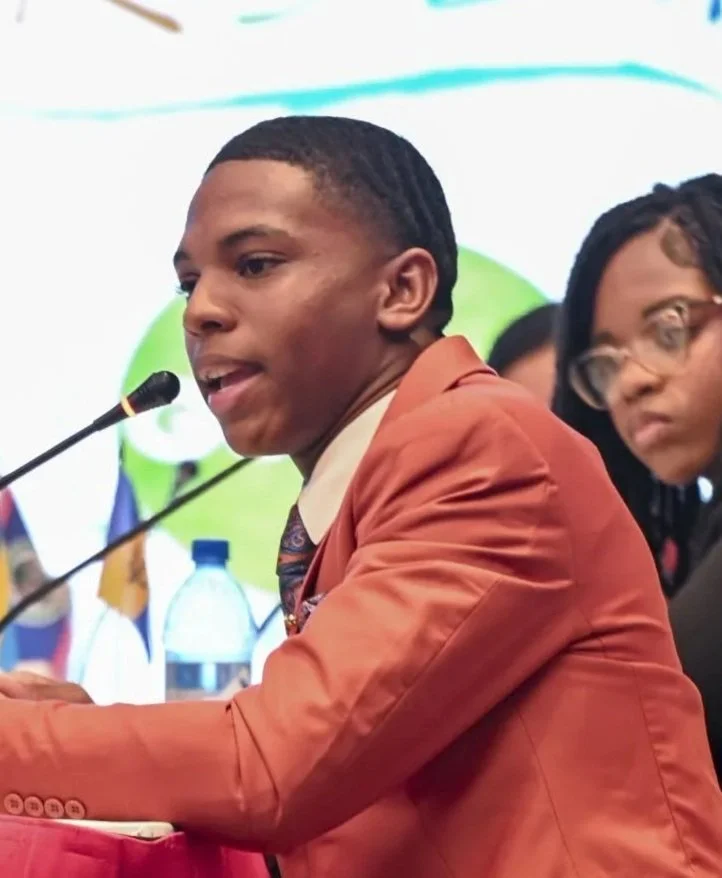
Young leaders share their vision for Caribbean tourism
November 8, 2026
Amarni Webster invited Caribbean tourism leaders to imagine a flight departing for the future, then asked whether the workforce expected to power that journey was ready to board.
The Anguillian student proposed connecting the region’s talent with opportunities in an industry central to Caribbean livelihoods.
“For decades, we have measured tourism by how many visitors land on our shores,” he said. “Perhaps it is time we also measure it by how many Caribbean people we give the runway to.”
That appeal helped Webster win the Caribbean Tourism Organization’s (CTO) Regional Tourism Youth Congress in Georgetown, Guyana, on October 8, earning him the title of Regional Junior Minister of Tourism ahead of 17 other delegates.
Raia Cargill of The Bahamas placed second, Barbados’ Jahneil McKenzie finished third and Antigua and Barbuda’s Janica Adams received special mention.
Held at Atlantic Suites by Hyatt during the State of the Tourism Industry Conference (SOTIC), the congress explored ‘Caribbean Tourism Through the Eyes of Tomorrow’.
Webster addressed the gap between young people seeking work and employers struggling to find the skills they need. His proposals included a regional talent database, collaborative training laboratories and exchanges enabling expertise to circulate among destinations.
“Our islands may be separated by water, but our talent does not have to be,” he said.
His call to invest in people reflected the congress’s broader purpose of preparing young Caribbean voices to help shape tourism’s future.
Sharon Banfield-Bovell, CTO’s Director of Resource Mobilization and Development, described a forum where participants research issues, defend positions and respond under pressure.
“It creates a space where young people can examine the issues shaping our industry and contribute their own ideas about where the region goes next,” she said.
The initiative dates to 1999. Its relevance extends across economies where visitor spending supports jobs and businesses in agriculture, transportation, the arts and other sectors.
A 2026 International Monetary Fund assessment described tourism as a key Caribbean source of income, employment and foreign exchange, accounting for more than 70 percent of CARICOM service exports.
Understanding that reach can help young people influence how tourism’s benefits are shared and its resources protected. The congress also introduces them to careers and professional development opportunities.
Barbadian Javon Griffith’s career illustrates those possibilities.
He represented his country as Junior Minister of Tourism at the Caribbean Tourism Conference in Aruba in 2004 and later received a CTO scholarship to pursue postgraduate studies in air transport management at Cranfield University.
Griffith went on to become General Manager of the Atlantis Historic Inn and chaired the Barbados Hotel and Tourism Association from 2024 to 2026.
In Guyana, delegates offered their own ideas for the industry, with several exploring how culture could enrich visitor experiences and generate income for local talent.
Cargill used the ingredients of Bahamian lemonade to illustrate how music, film and entertainment could blend into a distinctive tourism offering.
She proposed hosting the Caribbean Music Awards, expanding CTO’s allied membership to include Disney Studios and Netflix, and increasing international marketing investment in cultural events.
“Age is not a limitation when innovation is our objective,” Cargill said.
Her argument extended beyond attracting attention to giving visitors reasons to return.
“Sun, sand and sea may attract, but memorable experiences bring people back,” added Cargill.
Adams envisioned a year-round cultural entertainment series in Antigua and Barbuda, partnerships with digital storytellers and an innovation hub helping young creatives develop tourism businesses.
“When the music fades, the cameras stop rolling and the curtains close, what remains is the feeling we leave behind,” she said.
Grenada’s Ella-Rose Charles emphasized turning cultural promotion into dependable earnings. She proposed monthly community festivals, immersive digital experiences linked to bookings and a film prospectus connecting international producers with Grenadian locations and talent.
“The more skilled talent we develop at home, the more jobs and businesses we create, and the greater the economic value for Grenada,” she said.
Nevis’ Rondré Daniel, one of the federation’s 25 Most Remarkable Teens in 2024, similarly argued that heritage could support new enterprises.
His proposals included cultural and wellness experiences around the historic Bath Hotel, a creative academy and incubator, and technology bringing historical stories to life.
“We are stronger with culture,” Daniel said.
Saint Lucia’s Tiffany Jn. Jacques proposed a platform making community events bookable throughout the year, stronger links between local talent and international film productions, and a purpose-built entertainment venue.
“Let us build a Saint Lucia where every festival creates opportunity, every film sparks curiosity, and every cultural experience creates a lasting memory,” she said.
Ensuring that artists share fairly in tourism revenues was central to Saint Kitts representative Rainier Martin’s presentation.
Her proposed ‘The Island Is the Stage’ programme would commission local stories, invite visitors into creative activities and establish clear ownership and licensing arrangements so creators could earn from both the experiences and the finished content.
“They need audiences, ownership and income,” Martin said of local creatives.
Saint Vincent and the Grenadines’ Braxton Lewis advocated deeper visitor participation in carnival, a stronger screen tourism industry and an artists’ cooperative connecting local performers and creators with hotels and cruise lines.
“We ensure reward through fair pay because our artists deserve more than exposure,” said Lewis, winner of his country’s 2025 National Secondary Schools Public Speaking Competition.
His proposal included training young people in film production so international projects would leave skills and career opportunities behind.
Other delegates examined how destinations could bring grandparents, parents and children together through experiences rooted in local life.
McKenzie proposed digital tools connecting visiting families with Barbadian households, a passport encouraging exploration of attractions and an artificial intelligence travel companion matching activities to different generations.
“Connections are sparked around the dinner table through cultural exchanges, leading to lasting friendships and visitor loyalty,” she said.
Cayman Islands representative Arianna Chin put accessibility at the centre of family travel. Alongside a cultural immersion resort and family planning app, she proposed slip-resistant surfaces, double handrails, free amphibious beach wheelchairs and subsidies to help transport providers make their fleets accessible.
“As someone who has family with mobility issues, I have seen firsthand how quickly a simple family outing can become stressful,” the territory’s 2026 tourism ambassador said. “We must ensure quality time is reachable for everyone.”
Host country representative Himanshi Kumar saw multigenerational tourism as an opportunity for Guyanese families overseas to reconnect with their heritage and for residents to explore more of their country.
“We should not simply sell families a vacation,” she said. “We should give them an opportunity to pass Guyana on from one generation to the next.”
Named Best Speaker at the 19th Regional Youth Parliament in September, Kumar proposed heritage journeys, a diaspora programme and subsidized domestic packages, with transportation and facilities suitable for different ages.
Sint Eustatius’ Reuel Schmidt drew on his island’s history, landscape and traditions. He proposed reviving cultural activities, creating beach spa experiences and building replicas of traditional stone ovens where families could bake local pastries and bread.
Digital interpretation narrated by local historians would enrich visits to heritage sites,” he said. “Statia is not only an island with a museum. Statia is the museum.”
Turks and Caicos Islands representative A’Navia Mantock proposed a physical and digital Legacy Passport linking families with heritage, artisans, community events and conservation activities.
“Many destinations invite visitors to see culture,” she said. “We want them to live it with us.”
Her underlying question was whether visitors could contribute to what future generations inherit.
“What if every family could leave our shores better than they found them?” asked Mantock, who co-designed the territory’s baton for the Glasgow 2026 Commonwealth Games.
The relationship between visibility and responsibility occupied delegates examining social media.
Rihanna Lara, who is pursuing an associate degree in tourism studies at the University of Belize, advocated redirecting promotion towards less-visited areas when popular sites become crowded, equipping communities to tell their own stories and using location-based alerts to communicate environmental guidelines.
“The central issue is no longer how many visitors arrive, but where their footprints fall,” she said.
British Virgin Islands representative Mary Joseph proposed a strategy built around targeting smart travel, authenticating content and guiding local support. Her vision included promoting lesser-known places and connecting visitors with local food, music and history.
“What you see online should be what you experience when you arrive,” said Joseph, who gained experience at Nanny Cay through the BVI Tourist Board & Film Commission’s 2026 summer internship programme.
Jamaica’s ThaeJadore Kerr also argued that digital promotion should spread opportunity while encouraging responsible visitor behaviour. She proposed highlighting less-visited attractions, promoting travel that protects destinations and showcasing experiences supporting communities.
“Social media should do more than inspire travel,” she said. “It should inspire responsibility.”
Earlier this year, Kerr and Montego Bay High School for Girls schoolmate Kaira Bowman won a content creator challenge at a Jamaica Information Service Social Media for Social Change workshop.
Tobago’s Shania Phillips focused on helping people recognize tourism’s range of careers. She proposed a career navigation platform, technology-assisted training hubs and a regional talent registry recognizing qualifications and experience.
“Imagine a tourism worker handling a difficult guest through an AI simulation before facing it on the job,” she said.
Phillips proposal included assistive technology and sensory-friendly spaces for differently abled and neurodiverse learners, alongside regional mobility agreements and worker protections.
“People practise before they perform,” she said.
Bermuda’s Christopher Madeiros envisaged stronger regional connections through training exchanges, a digital tourism skills passport and itineraries linking destinations.
“Instead of learning tourism only within our own borders, our future professionals should learn from the expertise of our entire region,” he said. “The Caribbean itself can become the classroom.”
Together, the presentations demonstrated the breadth of issues young people are ready to address, from intellectual property and disability access to labour mobility, cultural ownership and pressure on communities.
The congress gave them practice in researching those questions and explaining their choices to an audience that included people with the authority to act.
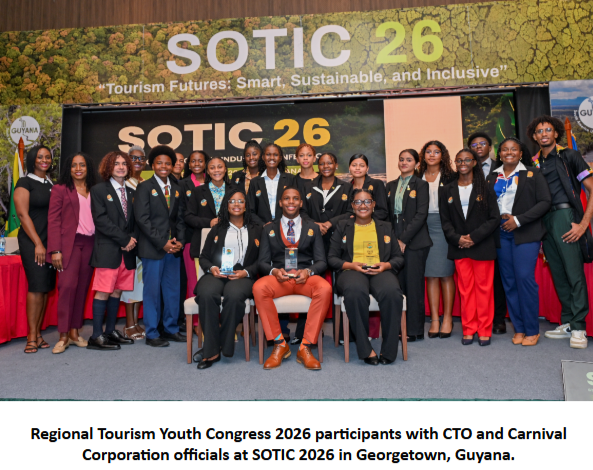
Nicolas Scott, CTO’s Programme Coordinator in Resource Mobilization and Development, helped coordinate the gathering and support its participants.
“Regardless of the final results, participation in this congress is an achievement in itself,” he said. “These students have represented their countries proudly.”
Scott recalled encouraging nervous participants before their presentations, a reminder of the preparation and support behind their performances.
Banfield-Bovell announced plans for a Tourism Youth Council to advise the CTO Secretariat and bring young people’s perspectives into its work.
Webster will receive mentorship from a team representing congress lead sponsor Carnival Corporation. Cargill will serve as junior CTO secretary-general and receive mentorship from Secretary-General and CEO Dona Regis-Prosper.
Tobago’s Jolé St. John, the 2025 winner, chaired this year’s proceedings.
Those opportunities can extend the congress’s influence beyond the stage. Their lasting value will depend on whether participants continue to gain experience, responsibility and access to decision-making.
Webster supplied a clear standard for judging that progress.
“There can be no sustainable tourism without a sustainable workforce,” he said.
The 18 delegates had shown the region what they could imagine. Caribbean tourism’s next responsibility is to give them room to build it.