50 years ago, West Indies crowned cricket's first World Cup champions
May 28, 2025
Typically viewed as risk-averse, accountants are responsible for compliance and minimizing financial uncertainty for their clients.
Sitting near the West Indies dressing room with the team struggling at 166-8, still needing 101 runs for victory against Pakistan in the inaugural 1975 World Cup cricket tournament in England, Gordon Andrews told Clive Lloyd that the Caribbean cricketers were 66-1 to win the match and that he had just put a bet on the team to come out on top.
To accompany the wager, he took a case of Pale Ale to the dressing room.
“I asked Gordon if he was drinking and if he knew what he was doing,” recounted Lloyd who is recovering from hip replacement surgery.
Though frowned upon in professional sports, the captain could not resist knocking back a few beers during the high-pressure contest that the West Indies clinched by one wicket with two balls to spare.
“With the last pair at the wicket still needing another 50 runs and 14 overs to go, I drank about six Pale Ales,” said Lloyd who took the most catches in the series, 4. “There was palpable tension as we got closer to the target. Beating Pakistan made us realize we could win the competition.”
With wicketkeeper Deryck Murray as the stabilizer, the last two wicket partnerships involving Vanburn Holder and Andy Roberts yielded 101 in 24 overs to rescue West Indies from the brink of defeat in their second group match.
The two tailenders faced 76 deliveries and spent a combined 90 minutes at the crease.
“Team members were jumping up and down because we would not have advanced if we dropped that match,” Lloyd, whose teams lost two matches in three World Cups, pointed out. “I think that is when our side came together as a cohesive unit.”
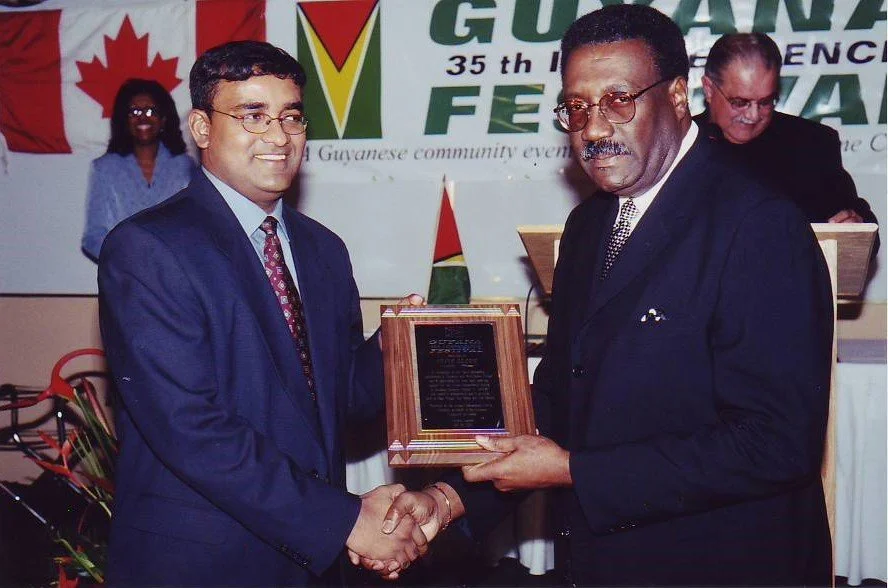
Then Guyana President Bharrat Jagdeo makes a presentation to Clive Lloyd at the Guyana independence celebration in Toronto in 2001 (Photo by Ron Fanfair)
Murray, who made his West Indies debut 12 years earlier under the captaincy of the late Sir Frank Worrell, came to the wicket in the 32nd over with his team struggling at 145 for 6.
As vice-captain and the last of the recognized batsmen, he accepted the responsibility to dig his team out of a huge hole, finishing with an unbeaten 61 off 76 balls.
It was not the first time that Murray, a Cambridge Blue who served as Trinidad & Tobago’s High Commissioner to Jamaica from 2019 to 2023, proved he was a useful lower-order batsman.
Five months before the Prudential Assurance-sponsored 60-over tournament, he helped Lloyd put on 250 for the sixth wicket in the first innings of the last Test against India at the Wankhede Stadium to guide their team to a 201-run victory and a 3-2 series win.
The former International Cricket Council (ICC) match referee scored an unbeaten 242 and Murray recorded 91, his highest score in 62 Tests.
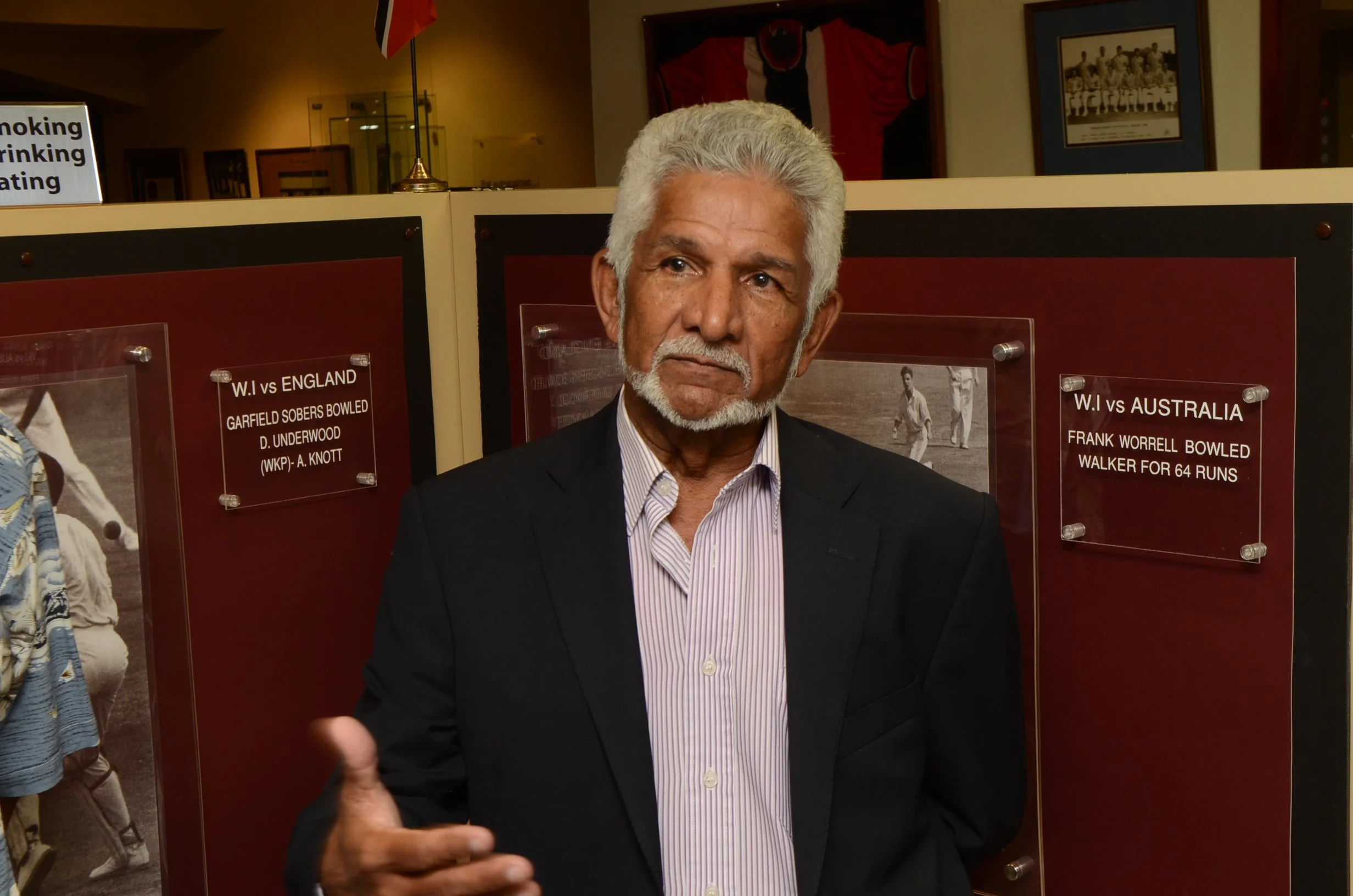
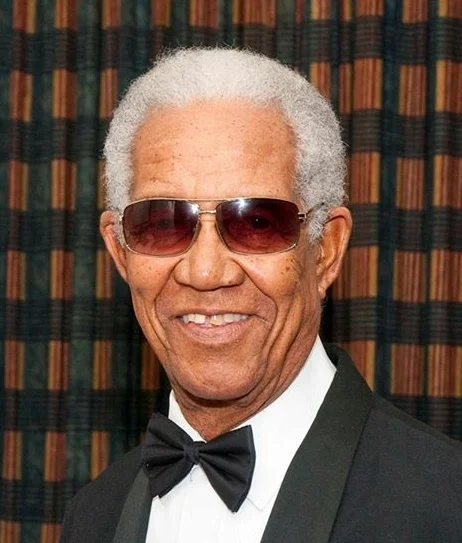
Deryck Murray (Photo by Ron Fanfair)
“Deryck had played some wonderful innings for us, holding things together at the bottom,” Lloyd said. “He was very dependable like Larry Gomes.”
In his autobiography ‘Colour Blind: Struggles, Sacrifice and Success of the Cricket Legend’, Alvin Kallicharran said the team was discouraged after the fall of the ninth wicket.
“As West Indians, we normally didn’t give up,” he noted. “Nevertheless, we were packing up our kits in the change rooms before the game was even over. They (Murray and Roberts) batted with heart, grit and determination…We were elated and almost in disbelief when they scored the winning run. To me, this was a pivotal point of the tournament. We dodged a bullet and knew we couldn’t let any slackness or complacency slip into our camp.”
Even manager Sir Clyde Walcott thought his team might lose the game.
“I had almost given up and was downstairs waiting for the official presentation to take place,” he noted in his autobiography, ‘Sixty Years on the Back Foot’. “But I did have my fingers crossed. Murray was a capable batsman with a sound temperament who scored many valuable runs for his side in company with the tailenders. Roberts showed the value of having tailenders in your side who could play straight and not throw their wickets away.”
Buoyed by the comeback, West Indies – led by Kallicharran – brushed aside Australia by seven wickets with 14 overs to spare in their last group match.
The diminutive left-handed batsman stole the show, hitting Dennis Lillee – then considered one of the world’s fastest bowlers – for 35 off 10 deliveries in a skillful and entertaining innings of 78.
“When I scored those runs with nearly all in boundaries, I didn’t consider that to be BMT (Big Match Temperament),” Kallicharran, the tournament’s sixth top scorer with 197 runs, said in his book. “It was my job and my job was to take advantage of the loose and lousy deliveries. He bowled many in that spell. Jeff Thomson was even quicker, but all I had time to focus on was the ball. I never cared who bowled it. When I followed the simple formula of seeing it early, playing it late, I succeeded.”
Caribbean sports personality Joseph ‘Reds’ Perreira was part of the broadcast team.
“I handed the microphone to John Arlott and, after about 10 minutes, he remarked on air, ‘this is no place for an Englishman to be and I think I will hand you back to Reds Perreira so he can have the joy of watching Kallicharran and Lillee’,” he said. “I went back on the air and did the next 10 minutes. It should not have been me, but Cozier and either Christopher Martin-Jenkins or Henry Blofeld had gone downstairs to enjoy their break, not expecting that Arlott would cut short his session.”
Kallicharran’s superb form extended to the semi-final against New Zealand, hooking Dayle Hadlee for six to reach his half-century on the way to a game-high 72 in a five-wicket win with 19.5 overs remaining.
True leaders don’t shy away from the big moments.
They embrace them as opportunities to showcase their abilities and inspire others around them.
With 4,000 pounds at stake and the chance to lead his team to the first World Cup title, Lloyd seized the moment at Lord’s, considered the world’s most iconic cricket ground, before a capacity crowd of 26,000 who paid 66,000 pounds which was then a record for a single day of cricket in England.
He was at his brilliant best, scoring 102 and taking one wicket for 38 runs in his allotted 12 overs to capture the Man-of-the-Match award.
Coming to the wicket at 50 for 3 with Roy Fredericks, Gordon Greenidge and Kallicharran back in the pavilion after 80 minutes play, Lloyd and 39-year-old Rohan Kanhai in his last match for the West Indies (he was a last-minute replacement for an injured Gary Sobers), put on 149 for the fourth wicket to transform a disaster scenario into a commanding position.
The innings covered 85 balls and included two sixes and 12 boundaries.
After Lloyd pulled a Gary Gilmour delivery into the Mound Stand, Arlott remarked, ‘The stroke of a man knocking a thistle top off with a walking stick’.
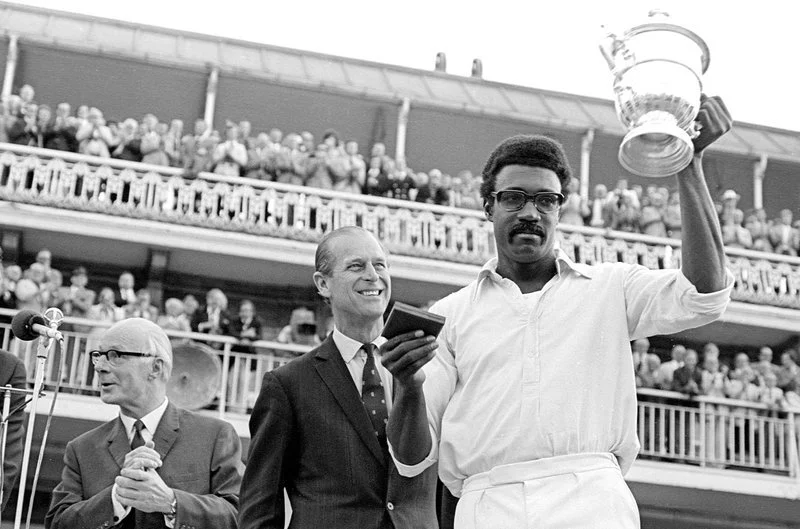
Clive Lloyd lifts the World Cup presented by the late Prince Philip (Photo contributed)
West Indies registered 291-8 and the Aussies – who a month earlier lost to Eastern Ontario by five wickets in a five-match warm-up series in Canada -- responded with 274 in 58.4 overs.
“We knew that on that wicket, we had to make a fairly big score and that at least one of our batsmen had to really fire,” said Lloyd after the match. “I happened to be in good form, but although I would rank my innings as one of the best I’ve played, we would have been nowhere without the support of Rohan Kanhai and the thrust given at the end by the lower order.”
Perreira, who covered five World Cups and has resided in St. Lucia since 1984, was impressed with the way Kanhai embraced the second-fiddle role.
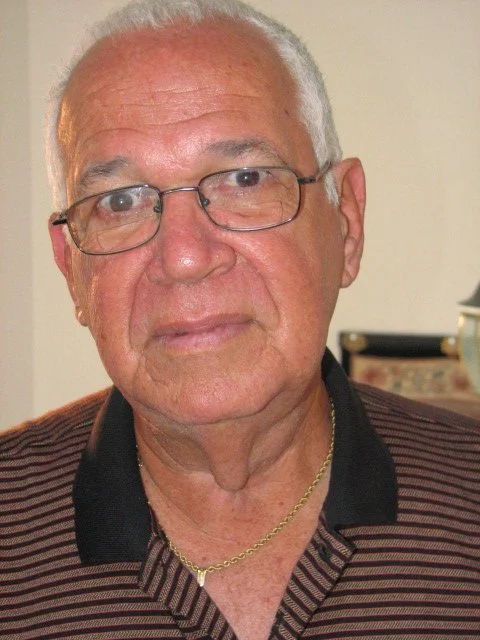
Joseph ‘Reds’ Perreira (Photo by Ron Fanfair)
“While Lloyd was the aggressor, Kanhai was very skillful, working the ball around and turning over the strike,” the former Organization of the Eastern Caribbean States sports desk director said. “Occasionally, he would produce a cover drive or flick through midwicket. It was a wonderful partnership that brought us right back into the game as the Aussies were on top.”
In ‘A History of West Indies Cricket’, late Jamaican Prime Minister Michael Manley said Lloyd’s innings was one of the great performances of modern cricket.
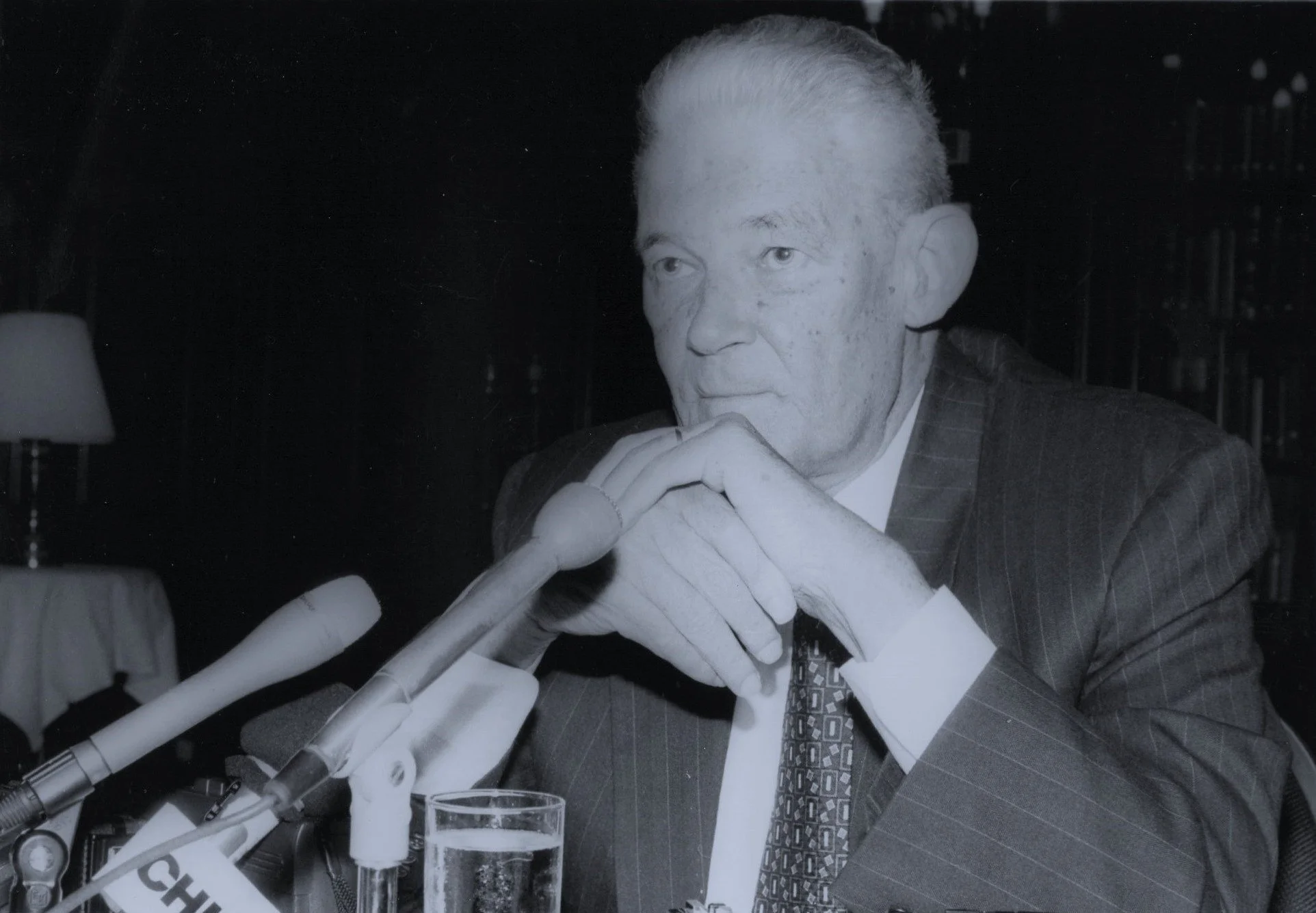
Michael Manley (Photo by Ron Fanfair)
“It was full of power, chanceless (he was dropped at 26) and with the element of courage without which no batsman has lived who could stand up to Lillee and Thompson, both at the peak of their careers,” he wrote.
Australia’s captain Ian Chappell hailed Lloyd’s match-winning performance.
“His innings was magnificent and it was this that changed the game in the first place,” he pointed out. “He also bowled excellently. It was a superb all-round achievement.”
Late England captain Ted Dexter was also complimentary of Lloyd’s outstanding accomplishment.
“Cricket lovers will always remember the day when victorious West Indies skipper Clive Lloyd became King of Lord’s with a majestic century in even time,” he wrote in the Sunday Mirror.
Writing for the Sunday Express, deceased England player Denis Compton said, ‘his spectacular 102 was one of the greatest innings I have ever seen’.
Fielding is a vital and often underappreciated aspect of cricket, playing a major role in influencing the outcome of matches.
Though he scored just 38 runs in the tournament, Viv Richards made a significant impact in the final, effecting three run outs.
“When I talk of the passion I have for the game which I often do, I inevitably find myself thinking back to winning the Prudential World Cup, not once, but twice,” he said in his autobiography ‘Hitting Across the Line’. “The first time in 1975 in England proved to be a turning point in cricket history. It was the first real proof that the public actually wanted a more compact form of the game – a game with a shorter time span and much faster action.”
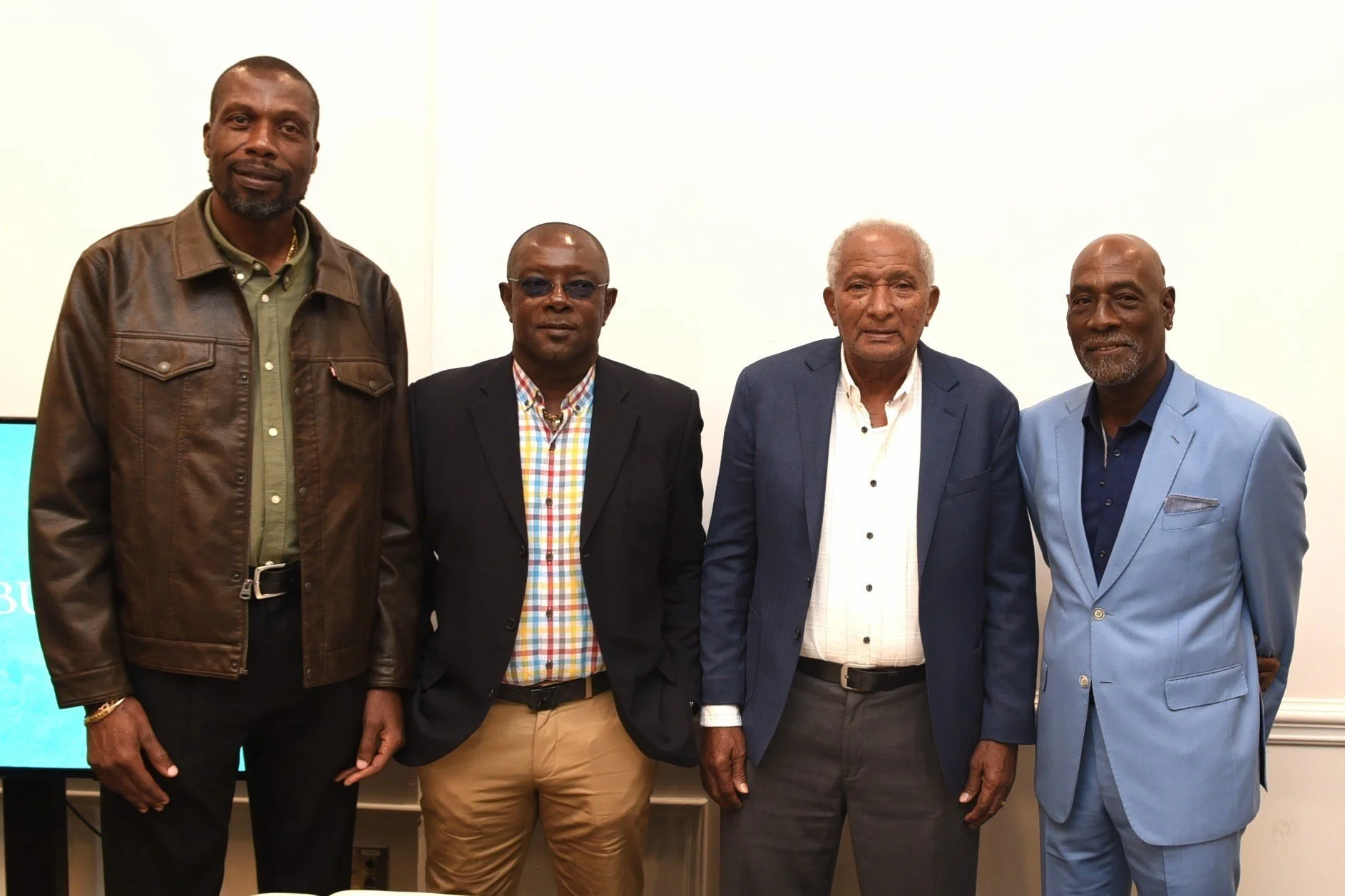
Andy Roberts and Viv Richards (r) were the first Antiguans to play Test cricket for the West Indies. Joining them at an event in Toronto in May 2024 were Curtly Ambrose (l) and Richie Richardson (Photo by Ron Fanfair)
A month after the final, Lloyd, Kallicharran and Fredericks returned to Guyana to a hero’s welcome.
Driven in a Cadillac from the airport, Lloyd held the 18-inch-tall Prudential Cup aloft to the delight of cheering crowds that lined the streets.
He was later presented the Golden Arrow of Achievement, the country’s fourth-highest national award.
“By your brilliant captaincy and performances, you have written valuable pages into the annals of cricket,” said Acting President Edward Luckhoo who was the Chancellor of the Orders of Guyana. “You are a great sportsman and a fine captain. You have done much for the credit and prestige of our dear land of Guyana.”
After his short stay in his birth country, Lloyd was honoured by the West Indies Cricket Board at a reception in Trinidad & Tobago before flying back to England to rejoin Lancashire, his English county team.
“I enjoyed the celebrations, but we didn’t get much for our efforts,” he said. “Shirley Field-Ridley (then Minister of Sport who died in 1982) presented us with gold chains, but the West Indies Board did not give us anything.”
To commemorate the 50th anniversary of the team’s World Cup triumph, Cricket West Indies has invited the 12 surviving team members (Fredericks and Keith Boyce are deceased) to a celebratory event in Barbados on June 22.
Boyce and Bernard Julien were the second leading wicket-takers with 10.
Perreira still has fond memories of the first World Cup.
The octogenarian along with Dominican Jeff Charles who was head of the British Broadcasting Corporation (BBC) Caribbean Service that ceased operating 14 years ago and the late Tony Cozier were part of the Caribbean Broadcasting Union (CBU) commentary panel.
“Even though the West Indies were among the favourites, they knew that it was not going to be easy because Australia, India, Pakistan and New Zealand were strong,” said Perreira.
The Murray-Roberts partnership, he pointed out, was a game and tournament changer.
“They batted sensibly and with good judgment,” said Perreira. “Murray has a steady head and is very responsible. I think he inspired Roberts at the other end. They did not take unnecessary risks as they had a lot of overs in front of them. The Pakistani crowd outnumbered the West Indians and the entire atmosphere was tense with everyone on their feet as the overs wound down.”
The tension filled the players’ dressing room.
“Speaking to Clyde Walcott after the game, he told me that just one member of the team was on the balcony watching the action,” recounted Perreira. “The others preferred to watch the game on television from inside. The smokers, Fredericks and Boyce, were puffing nonstop to relieve the tension. At the end of the game, there were plenty of tears because the players realized that if the team had not won, they would have been out of the World Cup.”
Convinced that Pakistan would win the contest, match referee Tom Graveney went to a bar and returned in time for the presentation. Not knowing the result, he named Sarfraz Nawaz, who took 4-44 off his allotment of 12 overs, Man-of-the-Match.
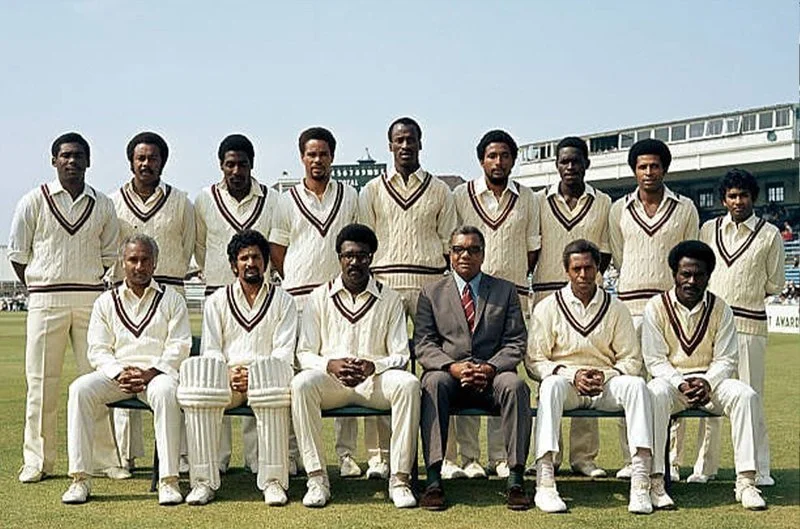
The winning West Indies team. Back row from left are Gordon Greenidge, Maurice Foster, Viv Richards, Keith Boyce, Vanburn Holder, Andy Roberts, Collis King, Bernard Julien and Alvin Kallicharran. Sitting from left are Rohan Kanhai (l), Deryck Murray, Clive Lloyd, Sir Clyde Walcott, Lance Gibbs and Roy Fredericks (Photo contributed)
After the final, Perreira and Cozier were invited to the West Indies dressing room to celebrate with the team.
“Someone brought in a huge cake and there was a fair amount of spirits,” he said. “The Australians went to the West Indies dressing room to celebrate over a few alcoholic beverages and then invited our team members into theirs to have a few beers. It was a major celebration.”
Cozier said the first World Cup was the boldest and most ambitious innovation since the legislation of overarm bowling.
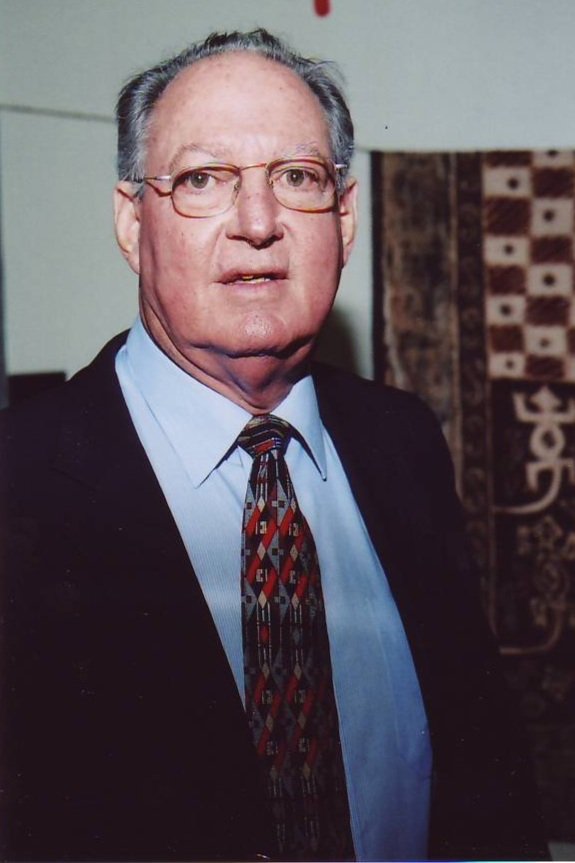
Tony Cozier (Photo by Ron Fanfair)
“The hyperbole was not misplaced for its success, well beyond the expectations of even the most fervent optimist, instantly guaranteed its future,” he said at the time. “…The West Indians were justifiable favourites and lived up to the bookmakers’ confidence. Their strength lay in their all-round depth, their fielding and the experience that 11 of their squad of 14 had of the special demands of the limited-overs format from their seasons of county cricket.”
Five days before the start of the World Cup, heavy snow fell on the second day at Buxton, resulting in the abandonment of the second day’s play of the Derbyshire and Lancashire county match in which Lloyd scored an unbeaten 167 on the first day.
The weather, however, was excellent during the two-week World Cup tournament with no time lost and the final finishing at 8.45 p.m. on the longest day of the year.
After losing all three Tests by an innings and winning just five of the 30 first-class matches on their first official Test tour of England in 1928, legendary English correspondent Neville Cardus remarked that the invitation to play the Test series was a compliment motivated more by sentiment than by logical expectation.
“The West Indian cricketers’ ambition outstripped his powers of performance and I hope that Lord’s will see these trials of national skills are not cheapened,” he wrote in the Manchester Guardian.
It is a pity Cardus was not around to see the start of West Indies domination of world cricket for the next 20 years despite their 5-1 loss to Australia in the Test series after the World Cup.
He passed away four months before the start of the tournament.