Jackie Richardson’s remarkable journey honoured with Jean Augustine Excellence Award
September 7, 2026
Arriving in Canada from the United States as a child, Jackie Richardson found the space to develop her talents and become one of the country’s most accomplished and versatile entertainers.
More than six decades after beginning a professional career as a teenager, the acclaimed singer and actor is being celebrated with the fourth annual Jean Augustine Excellence Award.
Presented in partnership with the CaribbeanTales International Film Festival and the Caribbean Film Festival, the award recognizes an artist whose work has made an enduring contribution to Canadian culture and inspired generations through excellence, generosity and leadership.
Richardson will receive the honour on September 12 at Harbourfront Centre during Screen Share: Honouring Our Legends. The event will also celebrate Augustine’s 89th birthday and feature a special screening of Queen of Soca.
“The award was created to recognize icons who have spent years giving back, supporting, mentoring and empowering their communities,” Augustine said. “Jackie’s outstanding body of work, national recognition, commitment to mentorship and willingness to share her talent generously make her a fitting recipient.”
Richardson has received many honours throughout her distinguished career, including a Gemini Award, a Dora Mavor Moore Award, the Toronto Blues Society’s Lifetime Achievement Award and membership in the Order of Canada.
However, an award bearing Augustine’s name holds special significance for her.
“Receiving an award from your own community is beyond words,” Richardson said. “It honours all of us who support and recognize one another. That is the strength of our culture.”
Her admiration for Augustine dates back to their encounters at the North York Central Library, where they discussed women’s organizations, community groups and the differences among Canadian, American and Caribbean history. Their conversations also explored the deep roots of Nova Scotia’s Black community and the importance of learning parts of Canada’s history that have too often been overlooked.
Richardson later watched Augustine move from community advocacy into federal politics, becoming the first Black woman elected to the House of Commons in 1993.
“To see her forge ahead against all odds, make herself known and visible and declare, ‘I am here to work for my community,’ before becoming our representative in Parliament was remarkable,” the septuagenarian said. “My gosh, she is a shero.”
The honour is especially fitting because Richardson’s own life has also been defined by opening doors, preserving Black cultural memory and helping others find their way through them.
Born in Donora, Pennsylvania, she moved with her family to Toronto in 1954 and grew up in a household filled with music. Her father was such a familiar presence at Toronto’s Town Tavern that the avid jazz enthusiast was known as ‘Big Daddy’ and had his own seat. At home, he and his friends would lie on the floor with their ears close to the speaker, listening intently to recordings by jazz greats.
Her mother enjoyed Frank Sinatra, Tony Bennett, Lena Horne and Billy Eckstine, while her sister Judy preferred Ella Fitzgerald and Sarah Vaughan.
Richardson absorbed those influences, but it was the Motown sound that captivated her as a teenager.
Motown captivated Jackie Richardson as a teenager (Photo by Ron Fanfair)
She sang with a high school band and recalls performing Johnny Mathis’s ‘Chances Are’ at a prom. Mathis was the only entertainer whose fan club she joined and remained a member for about 50 years.
“He taught me so much just by watching and listening to him,” Richardson said, pointing to the exceptional breath and vocal control that allowed him to sustain notes with apparent ease.
She began performing professionally at about age 15, entering Toronto’s emerging rhythm and blues scene with The Tiaras, a four-woman group rooted in the British Methodist Episcopal Church community.
Recommended when a vacancy arose, Richardson readily admits she sang flat during the audition. Still, the other members recognized her energy and potential. She contributed as the group’s choreographer while working diligently to improve her pitch and earn opportunities to sing solos.
“I am still surprised they gave me the job,” she said with a laugh. “They liked my energy and I became the choreographer to earn my keep. I did not get a solo for quite a while because I had to work on my flatness.”
The Tiaras became an invaluable training ground for the young performer. Singing songs popularized by Motown girl groups, they secured engagements at teen dances, including events at the Jewish Y near Bloor St. W. and Spadina Ave.
An even more influential classroom was the Blue Note club near Gerrard and Yonge Sts. Toronto largely shut down around midnight in those days.
However, owners Al Steiner and his wife turned the venue into an after-hours gathering place where visiting and local musicians could meet and jam after completing their regular engagements.
As Toronto became an important destination for Motown artists, Richardson recalls seeing The Supremes perform at Newmarket Town Hall. The steady flow of talent through the Blue Note gave the young women access to established singers and musicians, allowing them to learn by listening, observing and sharing the same space.
“Anybody who was anybody in the R&B scene hung out there,” she pointed out. “We were able to learn just by being there and experiencing the exceptional talent around us.”
The Steiners understood that parents would naturally be concerned about their teenage daughters performing at an after-hours club. They spoke directly with the families, assuring them that the Blue Note was a respectable establishment and that they would protect the young performers.
That blend of opportunity, protection and informal mentorship helped Richardson establish herself in a Canadian entertainment industry that was still relatively small. Although its size meant fewer jobs, it also encouraged performers to broaden their skills instead of remaining in a single artistic lane.
After leaving The Tiaras, she toured internationally with a version of The Platters. Returning to Toronto and finding that many of her connections in the local entertainment industry were gone, she took a job at an employment agency while rebuilding her network and looking for the next opportunity.
An advertisement for a community theatre group caught Richardson’s attention. For an annual fee of $25, members met three times a week, auditioned for roles and assumed at least one backstage responsibility. She remained with the group for three years, learning the craft from several perspectives.
That experience led to her first professional stage role with Black Theatre Canada in Lorraine Hansberry’s A Raisin in the Sun.
What began as a practical way to reconnect with Toronto’s artistic community opened an important new chapter in her career.
Richardson’s versatility and ability to work across music, theatre, film and television became hallmarks of her career.
“That is the great thing about Canada,” she said. “We could try everything because there were not 250 people lined up to audition for the same role. There was not enough work to stay in one area, so we had to be versatile.”
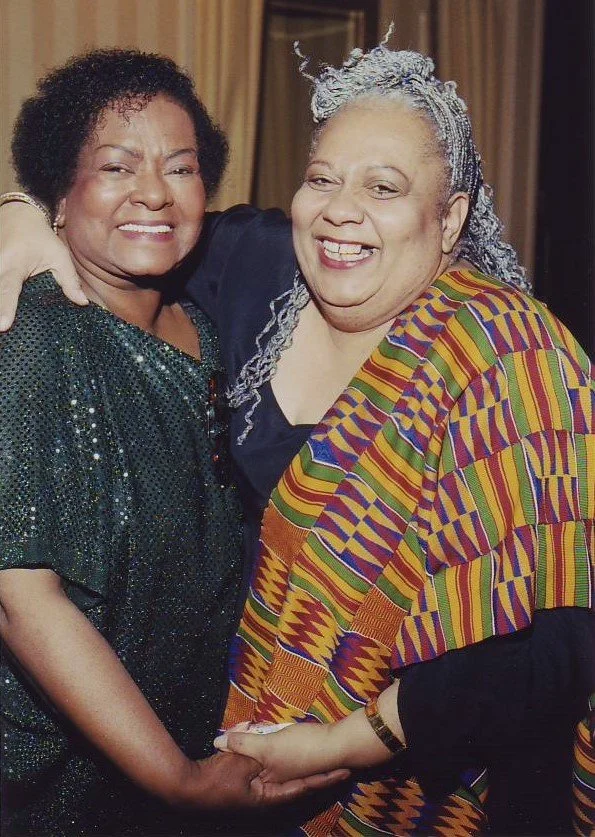
Jackie Richardson and the late Marguerite ‘Peggy’ Downes (Photo by Ron Fanfair)
Her musical identity evolved in much the same way.
Although jazz filled her childhood home and Motown shaped her teenage years, Richardson eventually stopped defining herself by genre.
The late Dianne Brooks, whom she still considers an idol and mentor, played an important role in that evolution. She admired Brooks’s elegance, originality and ability to move confidently among musical styles. Hearing her interpret songs associated with Nancy Wilson inspired Richardson to explore jazz more deeply.
“I reached the point where I stopped thinking about genre and focused instead on songs I liked,” she said. “I let everybody else put a label on me because I am not going to label myself. I just want to sing what I like.”
Salome Bey steered Richardson toward the blues while they worked together on Rainboworld, Bey’s series of children’s productions. The acclaimed singer repeatedly told her that her voice was well suited to the genre. Despite promising to learn a blues song, she never followed through, so Bey eventually made the decision for her.
“One day, she arrived with Madame Gertrude, a play she had written about blues pioneer Ma Rainey, and announced that I would play the lead,” recounted Richardson who performed with an African group at Expo’ 67 in Montreal. “That changed my world.”
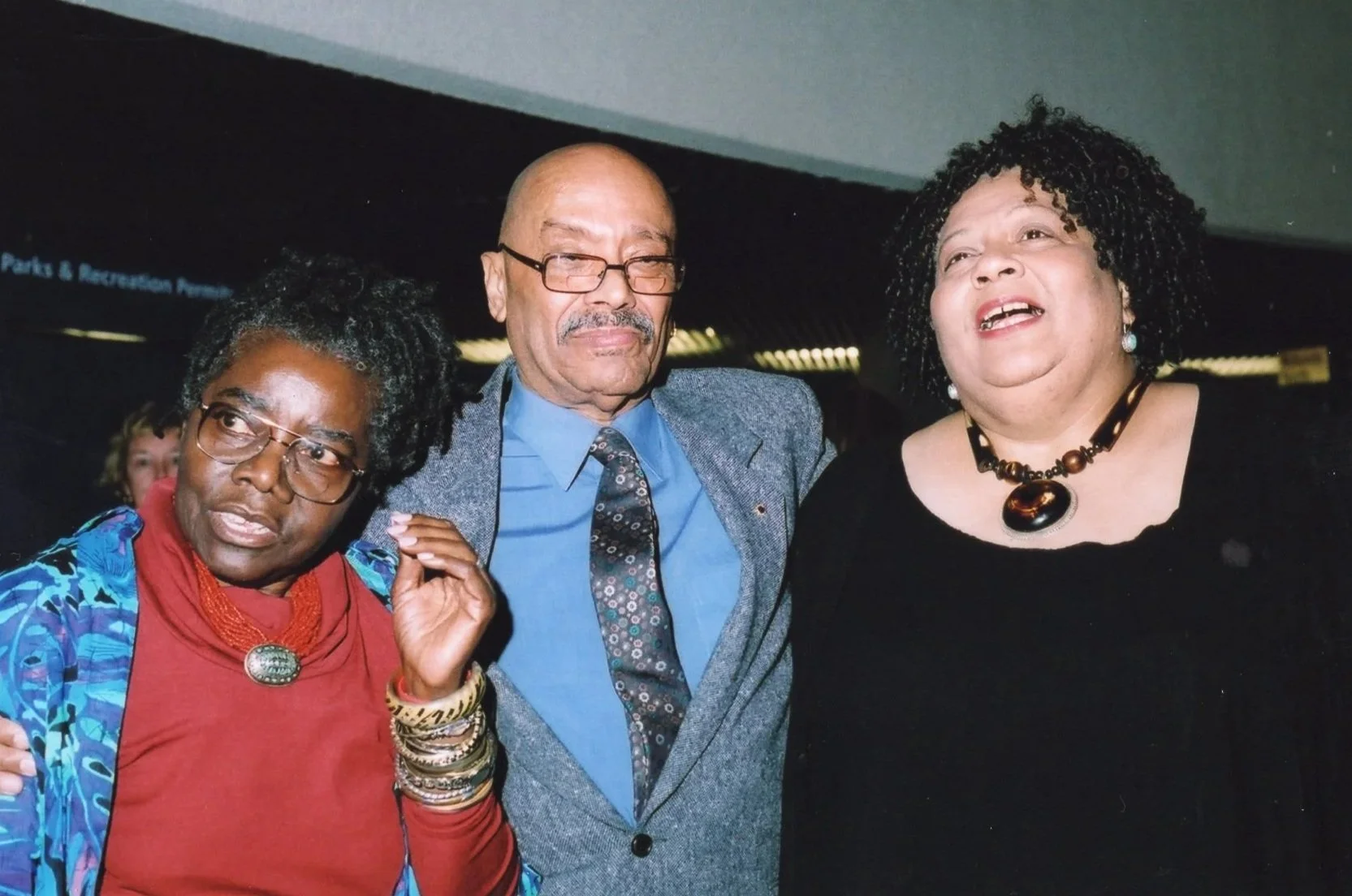
Jackie Richardson with the late Salome Bey (l) & Archie Alleyne (Photo by Ron Fanfair)
Researching Rainey taught her that the blues was more than a musical form. It was testimony, history and one of the few ways Black people could publicly tell their own stories.
She went on to portray several pioneering women, including Willie Mae ‘Big Mama’ Thornton, Alberta Hunter and Mabel Mercer.
The more deeply Richardson explored the lives of these women, the more carefully she considered the songs she performed and the messages she shared with audiences.
“Our job as vocalists is to communicate,” she said. “You get to know the audience, offer them something and see how they respond. You watch their body language and receive your answer. You are having a conversation.”
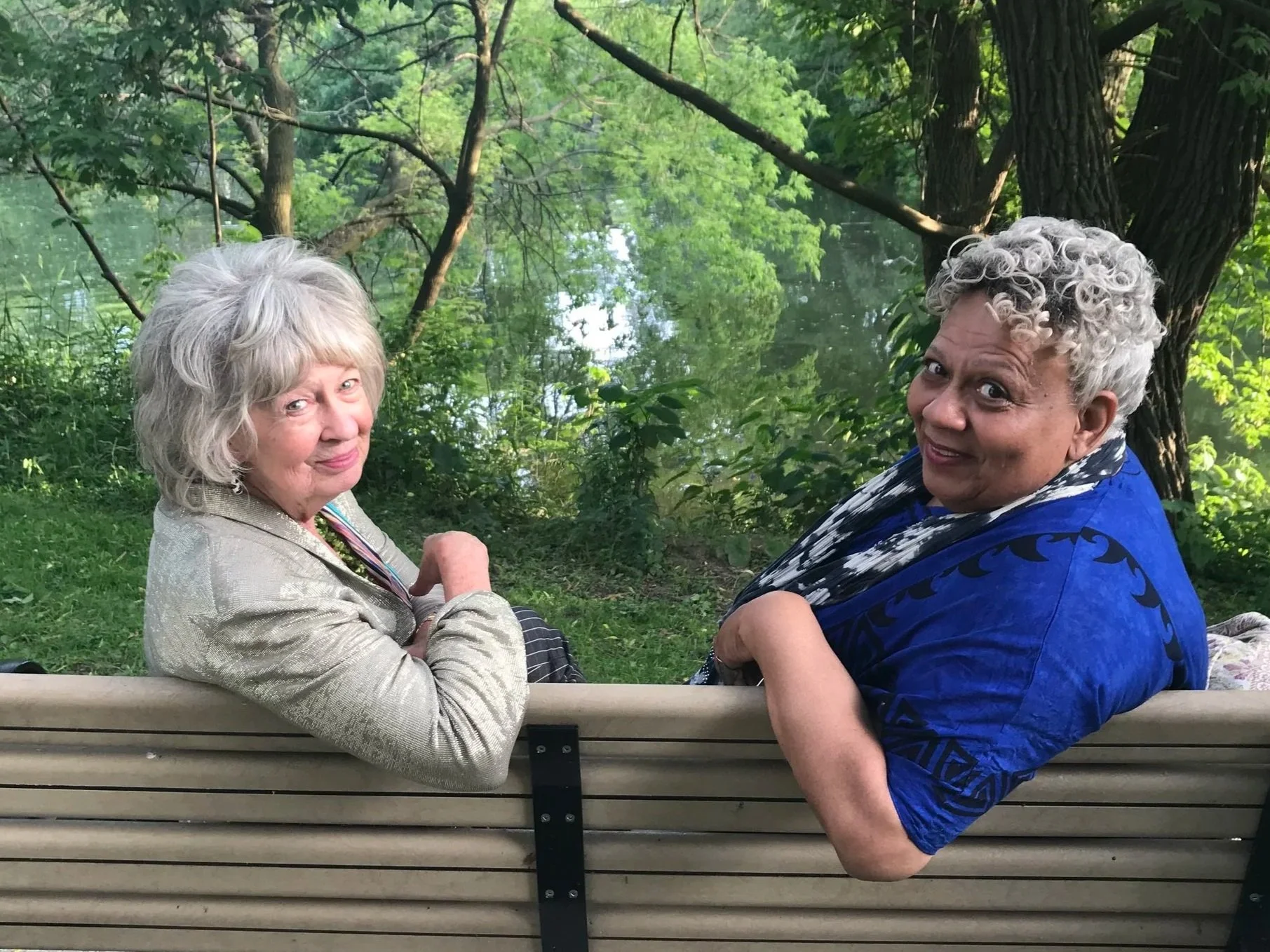
Jackie Richardson (r) & Jayne Eastwood starred in the critically acclaimed CBC Gem short-form comedy series ‘Hey Lady’ (Photo contributed)
That philosophy explains Richardson’s insistence that a singer’s voice should never be buried in the sound mix. The instruments establish the setting, but the vocalist is responsible for delivering the lyrics and their message. If the audience cannot hear the words, that essential conversation is lost.
Of the historic women she has portrayed, Alberta Hunter had the most profound impact on her. In Cookin’ at the Cookery: The Music and Times of Alberta Hunter, Richardson portrayed an artist whose life exemplified perseverance, reinvention and a refusal to allow age to end her creativity.
Hunter stepped away from music to care for her ailing mother and later became a nurse, reportedly changing her age to obtain the position. Years later, Mercer heard her perform and brought her to the attention of club owner Barney Josephson. Hunter eventually returned to the stage at Josephson’s Greenwich Village club, The Cookery, in her eighties and continued performing almost until her death at age 89.
“Alberta Hunter’s story gave me a deeper understanding of the hardships and triumphs of women who simply refused to give up,” said Richardson, whom the Toronto Star named in 2014 as one of 180 people who helped shape the city during its first 180 years. “She embodied perseverance and, vocally, had not missed a step.”
Richardson’s performance earned her the 2004 Dora Mavor Moore Award for Outstanding Female Performance in a Principal Role in a Musical. It also demonstrated how seamlessly she could combine singing, acting and a commitment to preserving Black history.
Breaking into film and television required a different kind of persistence.
Despite her extensive theatre experience and appearances on CBC variety programs, casting personnel continued to view her primarily as a singer. Whenever she updated her acting résumé in the CBC talent bank, she recalled, it somehow ended up back in the music department.
That perception began to change when Richardson was cast as the inmate Dunc in Turning to Stone, a television drama inspired by the experiences of incarcerated women. The role marked her first major screen opportunity and placed her alongside accomplished professionals, including producer John Kastner, director Eric Till, Shirley Douglas and Nicky Guadagni.
She entered an unfamiliar environment but quickly discovered that her ideas were valued. When she tentatively offered suggestions, Till listened and was willing to try them.

Jackie Richardson (r), Ron Small (l), Marlon Brand & Deborah Cox starred in the musical docu-drama, 'Sing Out Freedom Train' (Photo contributed)
The role earned Richardson her first Gemini Award nomination and gave her confidence that she could build a career on screen.
“It was a huge step,” she said. “It told me, ‘Get your feet in there and keep working’. If you try, you can do something with this.”
Years later, The Gospel According to the Blues brought that journey full circle.
Richardson won the Gemini Award for best performance by an actress in a leading role in a dramatic program or miniseries for her portrayal of Momma-Lou Steele, a mother fighting to protect her family and community from the devastation caused by poverty, drugs and despair.
The victory was deeply personal because it confirmed that the industry finally recognized the actor she had always known herself to be.

Classical Cabaret presented Ron Small (l), Jackie Richardson, Topaze Hasfel-Schou & Lloyd Adams 'But I Was Cool' by Oscar Brown Jr. in February 1993 (Photo by David Whitely)
Her artistic legacy also continues through her daughter, Kim Richardson, an award-winning singer and actor with a similarly broad musical range.
“As a young child, Kim would put Miles Davis records on the family console and harmonize with his trumpet solos,” Richardson said. “As she grew older, she embraced rock music and pushed her voice in ways that initially worried me. I warned her that she might damage it, but its power and range continued to grow. She is a sponge who immerses herself in every genre and understands its history. She can walk into any recording session with a genuine feel for the music’s roots.”

Jackie Richardson (r) and her daughter Kim performed a duet at the Children’s Aid Foundation fundraiser in May 2012 (Photo by Ron Fanfair)
Performing with her daughter has been among the most rewarding experiences of Richardson’s life. She also admires Kim’s talents beyond singing, including assembling performers, arranging vocals, selecting music, developing concepts and costumes, and producing complete shows.
“It is everything,” Richardson said of the artistic journey they share.
The generosity she shows her daughter also extends to emerging artists and members of her community. Through her long involvement in Regent Park, she has witnessed young people develop their talents in music, spoken word, film and documentary production.
Richardson does not believe mentorship should follow a single model.
“Established artists should pay attention to the individual before them and respond to what that person needs, whether it is artistic guidance, practical advice or help managing everyday challenges,” she said. Wherever you are, if you see raw talent and a need they have, you offer whatever you can offer. I see many of my fellows doing that, and I am really happy about it.”
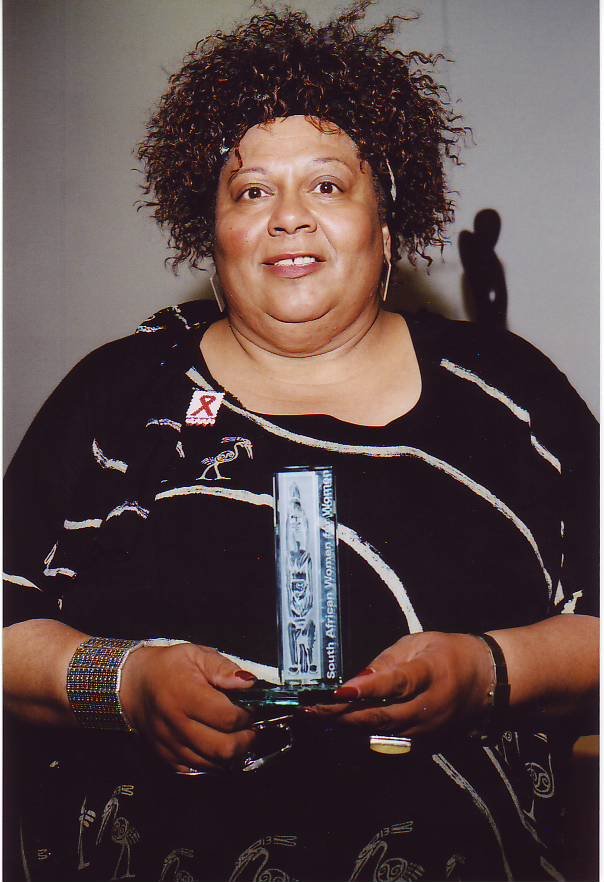
Jackie Richardson received a Friendship Award at the South Africa Women for Women celebration in Toronto in August 2004 (Photo by Ron Fanfair)
Richardson’s approach is rooted in acts of kindness she has never forgotten.
During a two-and-a-half-year engagement at the Bel Air Café, she often missed the last subway home to Richmond Hill after performing six nights a week and staying afterward to say goodbye to guests.
Two waiters who lived downtown refused to let her take the night bus. Instead, they drove her to Richmond Hill before returning to the city.
Their kindness taught Richardson a lesson she has carried throughout her life.
“From there on, anybody who needs a ride gets a ride from Jackie,” she said. “Sometimes you do not know the circumstances or what they are coming from or going to. I just say, ‘This one is on me’.
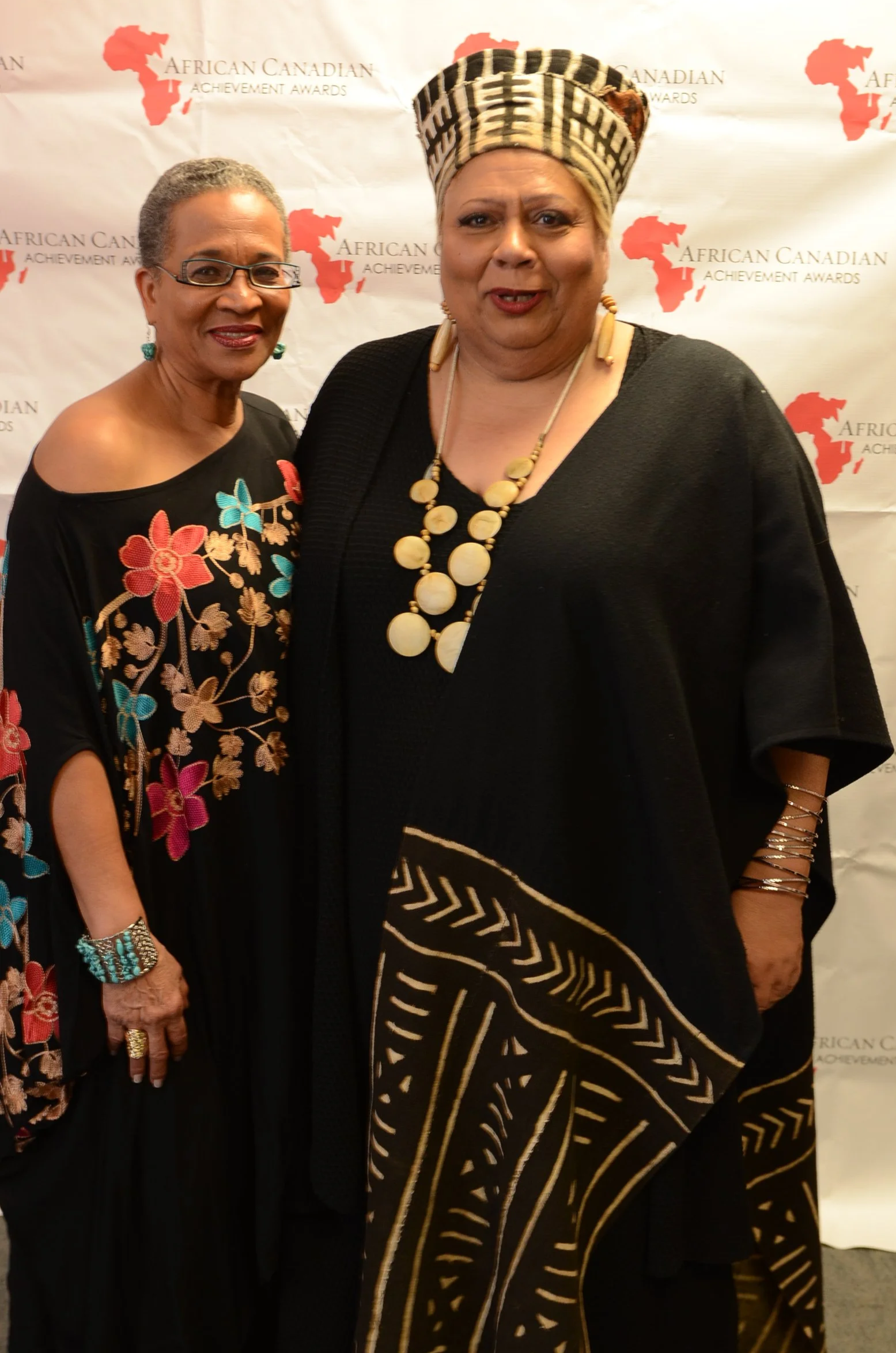
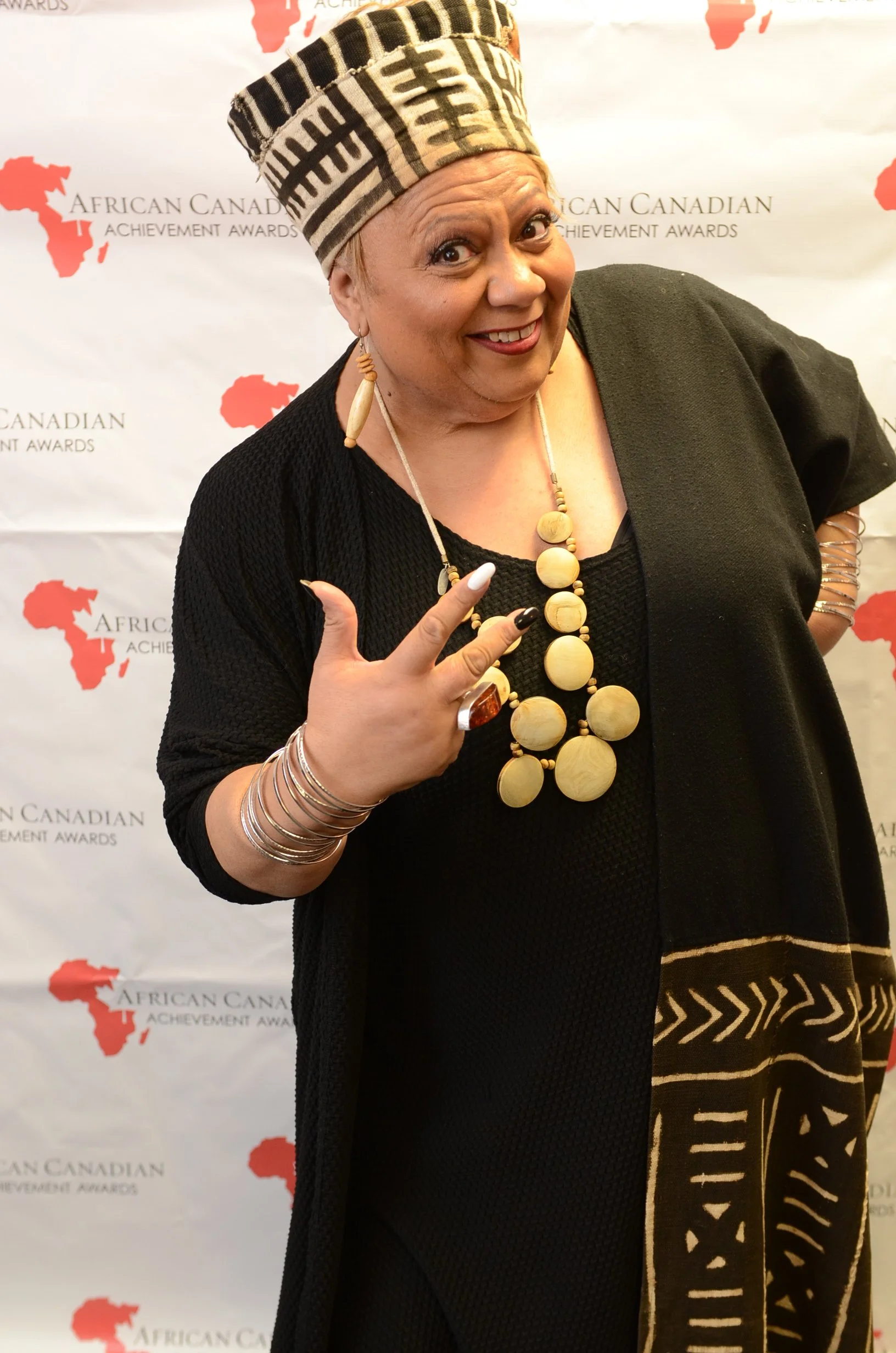
Jackie Richardson (r) and event planner Joan Pierre at the 2015 African Canadian Achievement Awards (Photo by Ron Fanfair)
The gesture reflects Richardson’s guiding principle throughout her wide-ranging career of receiving the gift, nurturing it and passing it forward.
She does not define her legacy by awards or artistic categories.
Instead, Richardson measures it by the joy the arts have brought her, the history she has helped preserve, the audiences she has moved and the people she has encouraged to find their own creative outlets.
She believes the arts broaden the mind and reveal new possibilities. They allow people to examine their interests, disappointments, relationships and sense of self. Even for those whose primary careers lie elsewhere, singing, theatre or visual art can satisfy an emotional and creative need.
“I have had so much joy in my life, and I am so grateful for it,” she said. “The arts give you insight into yourself, what you like, what you dislike and how you want people to treat you. People in the arts taught me a long time ago to pass it forward.”
That is why the Jean Augustine Excellence Award feels like more than another addition to an already distinguished résumé. It recognizes the shared purpose connecting two women who have helped make Black Canadians more visible and created opportunities for others.
Augustine pursued that mission through education, advocacy and public office. Richardson, on the other hand, has done much the same through her commanding voice, dramatic authenticity and generosity.
One came to Canada from Grenada and the other from the United States. Both found opportunity here, overcame barriers and widened the path for those who followed.