Sir Garfield Sobers was the standard by which cricket greatness is measured
July 17, 2026
Sir Garfield Sobers, the Barbadian cricket legend widely regarded as the greatest all-rounder in the history of the game, died earlier today at the age of 89.
For more than two decades, he stood as the standard by which cricket's greatest players were measured. Equally accomplished as a batsman, fast bowler, spin bowler and fielder, he possessed a rare versatility that transformed the game and inspired generations across the Caribbean and throughout the cricketing world.
As news of his passing spread, tributes poured in from political leaders, former teammates, broadcasters and admirers, all remembering not only an extraordinary cricketer but also a warm, humble and generous man whose influence extended far beyond the boundary.
Leading the tributes was Barbados Prime Minister Mia Mottley, who said the nation, the Caribbean and the wider sporting world were mourning one of their greatest sons.
“Across Barbados and across the world, we hold him with gratitude, with reverence and with a tender sorrow that comes when a people have to say farewell to one of their greatest sons,” she said.
Tracing his remarkable journey from humble beginnings to global acclaim, Mottley said Sobers ‘travelled from Bayland to Kensington, from Kensington to Sabina Park and onto the world stage, carrying his country, Barbados, carrying the West Indies and carrying the Caribbean as a whole with distinction’.
She said Sobers earned his place among cricket's immortals not simply because of his astonishing achievements, but because ‘he became the standard by which greatness would forever be measured’.
Sobers' legacy, Mottley added, belongs not only to Barbados but to the entire Caribbean and the wider sporting world.
“The finer things do not end in silence,” she pointed out. “They end with the whole ground rising and with a grateful people saying, ‘Thank you,’ and, ‘Yes, we love you’. Barbados stands for you, the West Indies stands for you and the world stands for you. For an innings that was so well played, Sir Garry, we will always love you.”
For generations of cricketers and fans, Sobers represented the complete player -- a batsman capable of breathtaking stroke play, a bowler equally dangerous with pace or spin, and a brilliant fielder whose athleticism helped redefine excellence on the cricket field.
Although his influence reached far beyond statistics, the numbers remain extraordinary.
In 93 Test matches, including 87 consecutive appearances, Sobers scored 8,032 runs at an average of 57.78, captured 235 wickets at 34.03, took 110 catches and captained the West Indies from 1965 to 1973, leading a side that helped shape the identity, confidence and pride of Caribbean cricket.
His defining innings came 68 years ago at Sabina Park in Kingston, Jamaica.
Before the third Test against Pakistan in March 1958, questions had begun to emerge about whether Sobers’ immense talent would ever translate into the major innings expected of him.
“I don't mind admitting I was becoming a little anxious about it, not so much on my own account but because there were those who kept wondering if I really would fulfil my potential as a batsman at the Test level,” Sobers later recalled in Gary Sobers' Most Memorable Matches, written by the late Tony Cozier.
He answered those doubts spectacularly.
Batting at No. 3 after Pakistan were dismissed for 328, the 21-year-old produced one of cricket's greatest innings, scoring an unbeaten 365 in 674 minutes with 38 boundaries. The knock surpassed Len Hutton’s world-record 364 against Australia and made Sobers both the youngest player to score a Test triple-century and the first West Indian to achieve the feat.
His partnership of 446 with the late Conrad Hunte for the second wicket narrowly missed the world-record partnership then held by Australia’s Don Bradman and Bill Ponsford.
As Sobers closed in on history, Pakistan's Hanif Mohammad, whose own 337 had recently become the longest innings in Test history, decided to bowl.
When Sobers reached 364, Hanif switched to left-arm bowling.
“You can bowl with both hands if you like,” Sobers told him.
The next delivery was worked into the covers for a single, bringing up one of cricket's most celebrated records.
“In a split second, the place was pure bedlam,” Sobers remembered. “The crowd streamed across the ground and lifted me in the air, and, for a time, I was on cloud nine.”
The celebrations became so exuberant that spectators damaged the pitch and play was abandoned early.
That innings transformed Sobers from a gifted young cricketer into an international sporting icon.
He later became the first cricketer to score 8,000 Test runs, further cementing his place among the game's greatest batsmen.
Sobers was also a member of the West Indies team that played in cricket’s first tied Test against Australia in Brisbane in 1960, one of the sport's most celebrated matches.
In 1968, while captaining Nottinghamshire against Glamorgan in Swansea, he became the first batsman to hit six sixes in a single over in first-class cricket, launching Malcolm Nash into cricket folklore.
Sobers’ versatility extended beyond the international game. During the 1963-64 Australian domestic season with South Australia, he became the first player to complete the rare double of scoring 1,000 runs and taking 50 wickets in a single first-class season, a feat that underscored why he remains the benchmark for all-round excellence.
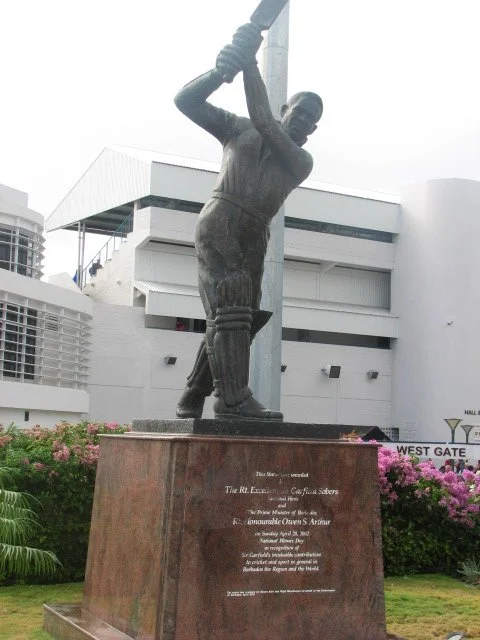
Garry Sobers' greatness is immortalized in a statue outside Kensington Oval in Barbados (Photo by Ron Fanfair)
Yet perhaps the ultimate measure of Sobers' brilliance came from Sir Donald Bradman, whose Test batting average of 99.94 remains one of sport's most extraordinary records.
Widely regarded as the greatest batsman in cricket history, he considered Sobers' majestic 254 for the Rest of the World XI against Australia at the Melbourne Cricket Ground in 1972 the finest innings he had seen on Australian soil.
“It was an incredible innings, full of the most savage power, the most brilliant shots, the most delicate placements,” Bradman, who died in 2001, said. “Some of his footwork was absolutely perfect. At other times, even when his feet were not absolutely in the right place, the ball still sped off the bat to the boundary with such speed that it left the fieldsmen standing like stone.
“He hit 33 fours and two sixes in an exhibition which nobody who saw it will ever forget. I count myself privileged to have been there and to have had the opportunity of commenting on this innings, which will live in the minds of all who saw it as long as life shall last.”
Teammates and journalists who spent decades around Sobers said the statistics told only part of the story. They remembered a man whose humility matched his extraordinary talent.
Former West Indies captain Clive Lloyd, who played alongside Sobers, said the Barbadian icon combined unparalleled talent with extraordinary humanity.
“Garry was one of the nicest people you could meet,” said the newly-appointed Lancashire Cricket Club president. “His generosity, leadership and willingness to encourage younger players also stood out.”
Lloyd's own Test career began in 1966 under memorable circumstances when Seymour Nurse was injured shortly before a match, thrusting the young Guyanese into the side.

Garry Sobers (left) congratulates Clive Lloyd after Lloyd scored 104 in 70 minutes with six sixes and 12 fours for the West Indies Masters against a Rest of the World XI in a limited-overs match at Toronto's Exhibition Stadium in August 1990 (Photo by Ron Fanfair)
Batting alongside Sobers, he scored 82 and an unbeaten 78 on debut, sharing two important partnerships with the man he had admired from afar.
“We always admired him,” Lloyd recalled. "He had that special walk to the wicket."
For him, there has never been any doubt who was the sport’s greatest all-rounder.
It was Sir Garry without question,” he said.
Such was Sobers' passion for horse racing that, during Lloyd's debut Test, he was keen for play to finish early so he could get to the nearby racecourse armed with a hot tip from his friend and trainer Josh Gifford.
Former West Indies fast-bowling great Sir Wesley Hall, who first met Sobers when the future legend was about eight years old and later shared a dressing room with him for many years, said he had lost not only one of cricket's greatest players but also a lifelong friend and mentor.
“Garry was such a great player that everybody would like to be in his company,” he pointed out. “I was lucky enough to play with him for a very long time, and he was always there for me, telling me how to do it because, at the beginning, I did not know very much.”
Hall said Sobers' kindness and generosity matched his remarkable talent.
“Garry was the type of person that would give his shirt to them, and he was very good to other people who wanted to know something about him,” he said.
Reflecting on another of Sobers' passions, Hall said the cricket legend was ‘a very good golfer’, laughing as he recalled how Sobers jokingly told him never to return to the course after repeatedly watching him miss the ball.
Veteran Caribbean sports personality Joseph ‘Reds’ Perreira first noticed Sobers long before he came to know him personally.
“I remember him walking onto the ground at Bourda alongside Seymour Nurse, impeccably dressed in matching blazers and wearing his trademark confident smile,” he said. “What was very catchy was the way he walked. The body language said so much.”
Years later, Perreira covered many of Sobers' greatest innings and developed a close friendship with him while broadcasting World Series Cricket in Australia. Their travel schedules often revolved around Sobers' love of golf, as he always wanted to arrive at a venue early enough to fit in a few rounds before the cricket began.
Although he witnessed countless memorable performances, he said it was Sobers’ humility that remained with him most.
“He was a great man,” Perreira said. “But he didn't allow his greatness to go to his head. He was a down-to-earth guy.”
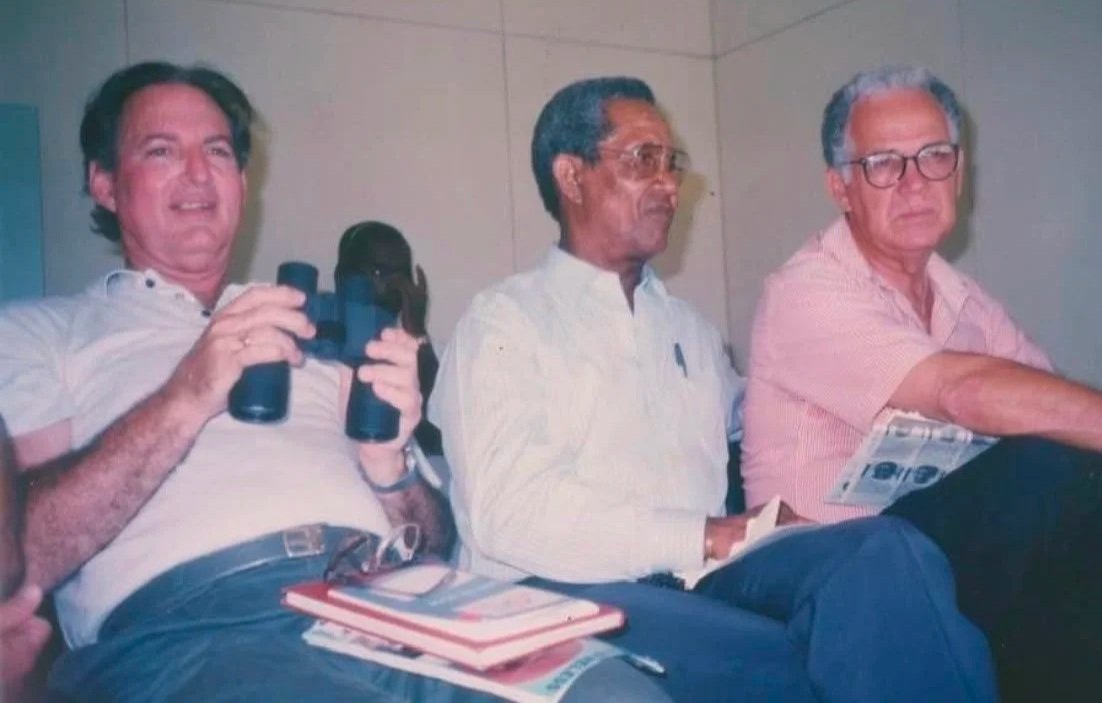
Sir Garfield Sobers (c) with Joseph ‘Reds’ Perreira & the late Tony Cozier (Photo contributed)
While Perreira came to know Sobers as a close friend during decades covering international cricket, former Ontario Cricket Association president Errol Townsend admired the Barbadian icon from the moment he burst onto the Test stage as a teenager.
He said his admiration for Sobers began with a youthful argument that proved just how wrong first impressions can be.
Townsend vividly recalls missing the opening day of Sobers’ Test debut at Sabina Park in March 1954 because he was attending his school's sports day in Jamaica.
When his father excitedly described the 17-year-old as a future batting star, the retired lawyer and sportswriter dismissed the suggestion, insisting Sobers had been selected only as a left-arm spinner to replace the injured Alf Valentine.
“I told my dad that as soon as Valentine got better, that would be the end of Sobers’ Test career,” Townsend recalled with a laugh. “How wrong I was.”
The following day, he watched the teenage Barbadian bowl for the first time and was immediately captivated.
“He got Trevor Bailey with his fourth ball, caught behind by Clifford McWatt, and you could already see that, although he batted at No. 9, he possessed the skills to become a top-order batsman,” noted Townsend who co-authored Herb McKenley: Olympic Star. “It was the beginning of something extraordinary."
For him, Sobers’ greatness was built as much on supreme self-belief as on his remarkable talent.
He often recalls a story from Sobers' teenage years when someone suggested the young all-rounder should be patient if he failed to make the national team.
“Sobers slammed the dominoes on the table,” Townsend recounted. “Then he said, ‘I made runs and I got wickets in the trial. If they don't pick me, I'll sell my boots and retire’. Imagine a 17-year-old saying that. That was the kind of self-confidence he possessed, and, in large part, it was what made him the greatest all-rounder of all time.”
Despite becoming one of cricket's most celebrated figures, Townsend said Sobers never lost the humility that endeared him to generations of players and admirers.
“I met him on a couple of occasions, and he was always the same person,” he said. “Even after achieving worldwide fame, he remained down to earth. You could stop and talk to him about cricket or anything else, and he would always give you an honest opinion. Cricket has lost a once-in-a lifetime figure.”
That combination of supreme confidence and genuine humility also left a lasting impression on cricket followers far beyond the Caribbean.
Among them was Franklin ‘Dickie’ Martin, the Jamaica-born cricket enthusiast whose animated conversations at grounds throughout the Greater Toronto Area kept the game's rich history alive until his passing in 2001.
He never missed an opportunity to remind anyone willing to listen that Sobers stood alone in cricket history.
In Martin’s view, only two men deserved to wear all-white attire wherever they went -- Sobers and Colonel Harland Sanders, founder of Kentucky Fried Chicken, whose trademark white suit became part of his public image.
For him, Sobers was simply cricket royalty.
I was able to experience Sobers’ wit, confidence and candour firsthand during his 1992 visit to Toronto for the Ontario Cricket Association's inaugural awards ceremony.
By then, helmets, arm guards and other protective equipment had become commonplace. Asked whether modern batsmen had become too dependent on protection, he did not hesitate.
“I believe that a cricketer should be good enough to use his bat to protect himself,” Sobers told me.
The conversation turned to one of the most controversial decisions of his captaincy, the fourth Test against England at Port of Spain in 1968.
With victory still possible, Sobers declared the West Indies innings closed, setting England an ambitious target of 215 runs in 165 minutes. England accepted the challenge and completed a remarkable chase, prompting years of criticism from those who believed Sobers had gambled away the match.
More than two decades later, he remained convinced he had made the right decision.
“I would do it again,” he said. “Many of the so-called experts failed to consider many facts. Wicketkeeper Deryck Murray dropped John Edrich off the second ball I bowled in the second innings. Had that catch been taken, I am convinced England would not have gone after the target. Secondly, England bowled just 12 overs an hour during the series, mainly with their spinners. In the Port-of-Spain Test, we bowled 16 overs an hour and lost with about three balls remaining. If I wanted to play for a draw, I could have slowed the over-rate down.”
Sobers was equally candid when asked how he had maintained such remarkable consistency throughout a career while enjoying what many described as an active social life.
"I never understood why my private life was so closely monitored," he said. “I was never a person who could go to bed early. Once I started playing cricket, it became even more difficult for me to sleep after a match. If I did that, I would go out and fail the next day. Late nights motivated me."
Sobers’ answers reflected the fearless approach that characterized both his cricket and his life. He trusted his instincts, embraced challenges and never felt compelled to justify the decisions that made him one of the game's most compelling competitors.
Former Windward Islands wicketkeeper and Canadian captain Bryan Mauricette remembered a side of Sobers that few saw, recalling his generosity and extraordinary memory.
As a young cricketer in the early 1970s, he was asked to drive Sobers from his hotel to the cricket ground during a Combined Islands match in Saint Lucia.
Years later, while watching a match at Kensington Oval in Barbados, Mauricette was astonished when Sobers spotted him in the crowd, greeted him by name and stopped to chat. It was a simple gesture, but one he never forgot.
When Sobers later travelled to Toronto for a charity cricket match, Mauricette proudly posed for photographs with him alongside members of his family.
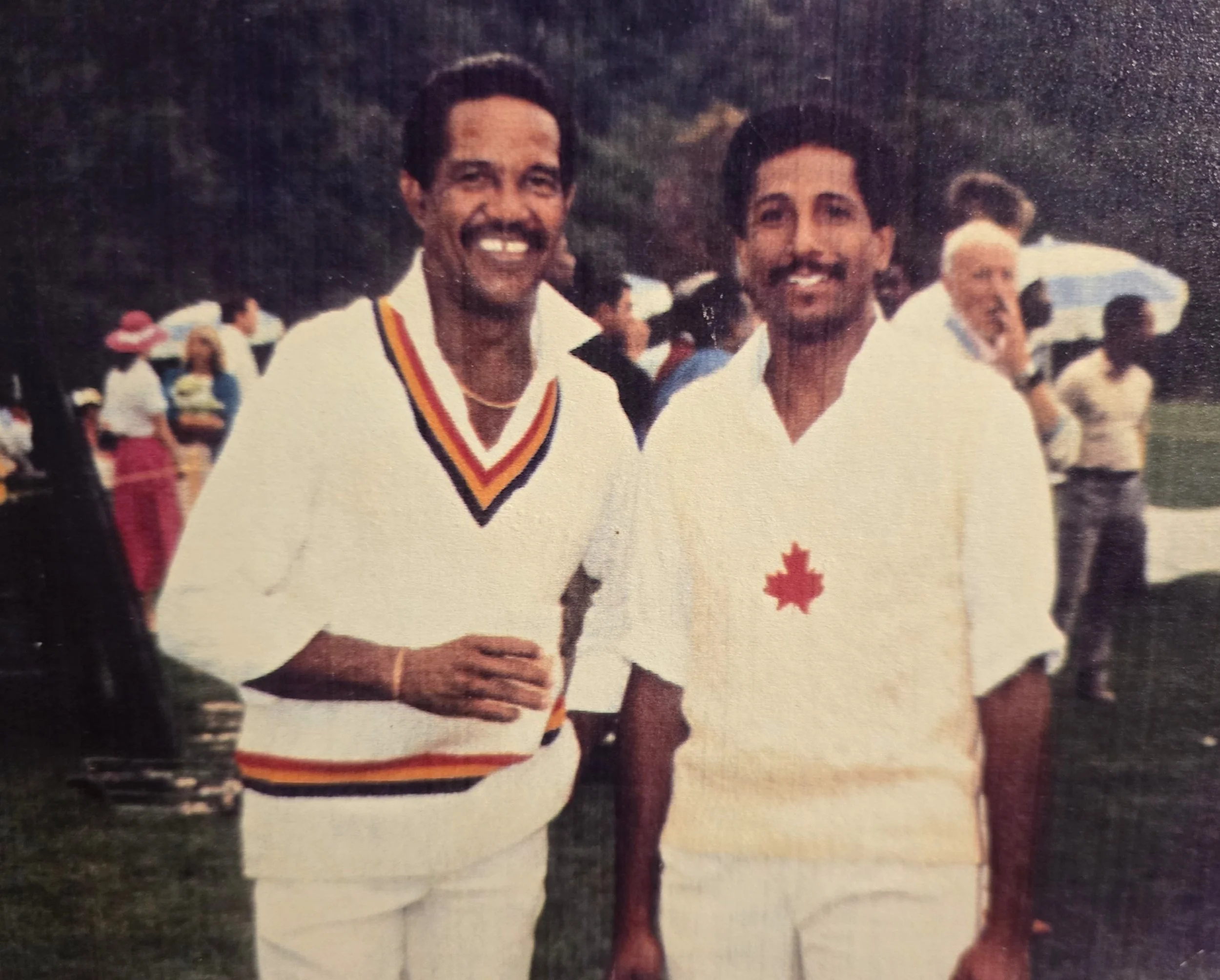
Garry Sobers (l) with Bryan Mauricette in Toronto in the late 1980s (Photo contributed)
Taken together, the memories reveal a remarkable consistency. Whether they played beside him, reported on his exploits, interviewed him or admired him from afar, they remembered not only the greatest all-round cricketer of his generation, but also a man whose warmth, humility and generosity elevated him even further.
Indian cricket historian and journalist Boria Majumdar first met Sobers in 2010 when Majumdar delivered the Frank Worrell Memorial Lecture in London.
Like countless admirers around the world, he said Sobers’ death leaves an irreplaceable void in the game.
“World cricket is poorer without Sir Garry,” Majumdar said. “Some people are irreplaceable, and Sir Garry was one of them. For anyone who follows the history of the game, this is one of those days when you feel a profound sense of loss. The greatest is no more, and cricket has lost one of its most devoted servants.”
Yet those closest to Sobers believed his greatness was shaped not only by extraordinary talent, but also by profound personal loss.
Tom Dewdney, who now lives in a long-term care facility in Scarborough, Ontario, after suffering a stroke in 2011, was travelling with Sobers and Collie Smith from Manchester to London for a charity match when the car, driven by Sobers, was involved in a devastating crash. Smith died three days later from his injuries, while Sobers and Dewdney survived.
Reflecting on the tragedy during an interview, Dewdney said he always believed Sobers was deeply haunted by the loss of one of his closest friends. In his view, the Barbadian great dedicated the remainder of his extraordinary career to both himself and Smith, using the grief and guilt he carried as the inspiration to become the finest all-rounder the game has ever known.
The renowned Trinidadian historian and cricket writer C.L.R. James perhaps captured Sobers' broader significance best, describing him as ‘the living embodiment of centuries of tortured history’.
To James, the Barbadian genius represented far more than sporting excellence.
“He symbolized the aspirations and achievements of the Caribbean people,” he wrote.
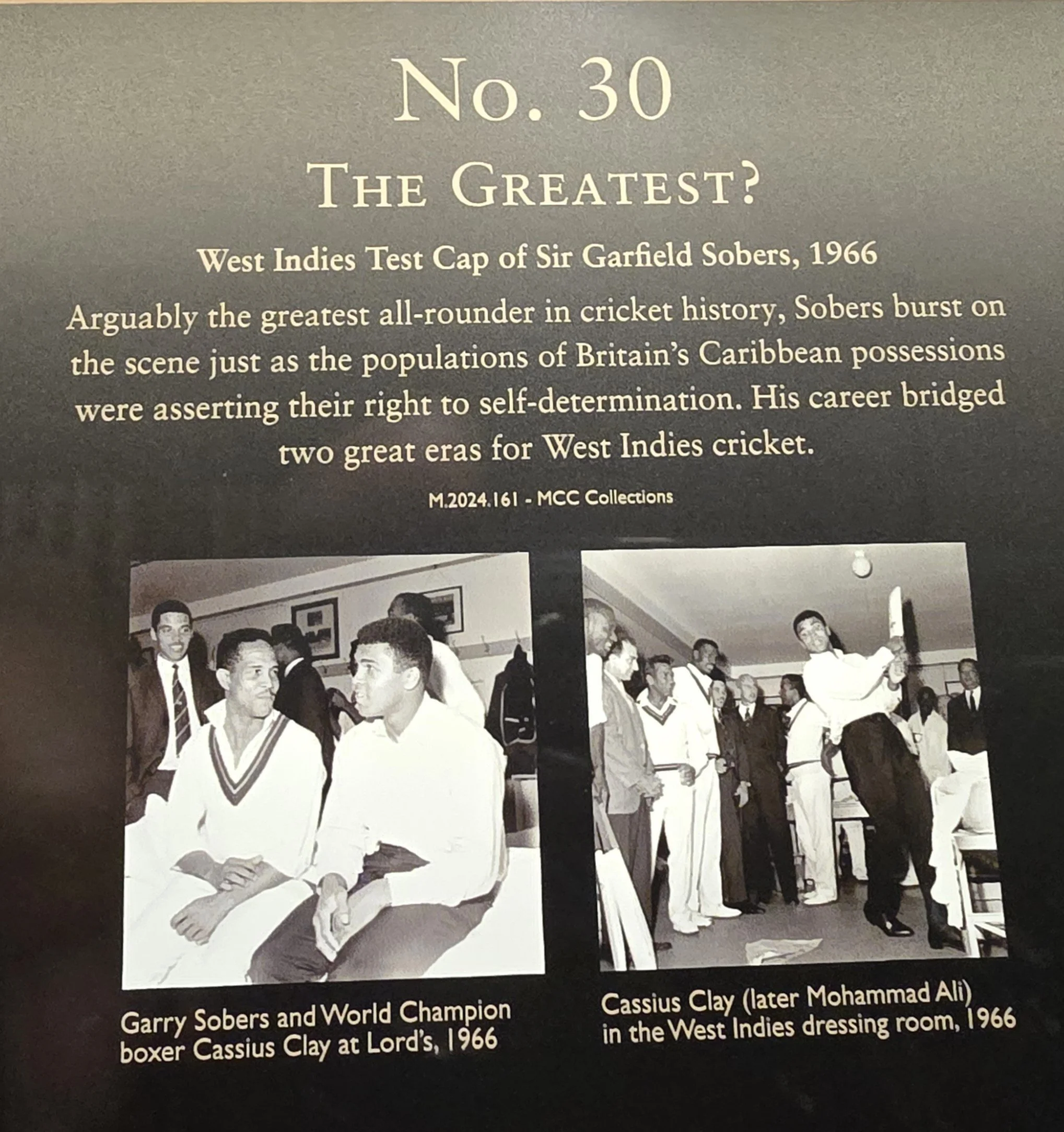
Garry Sobers shares a memorable moment with late boxing legend Muhammad Ali at Lord's Cricket Ground in London in 1966. The meeting brought together two of the greatest sporting icons of the 20th century, each destined to leave an indelible mark on his respective sport
Fittingly, Sobers died while the 40th Sir Garfield Sobers International Schools Cricket Tournament was being played in Barbados.
Established in 1986 with his support and carrying his name, the annual youth competition has, for four decades, helped develop generations of young cricketers, ensuring that his influence continues to shape the game's future.