Nathan Redmon's legacy finally takes its place in a Canadian museum
April 22, 2026
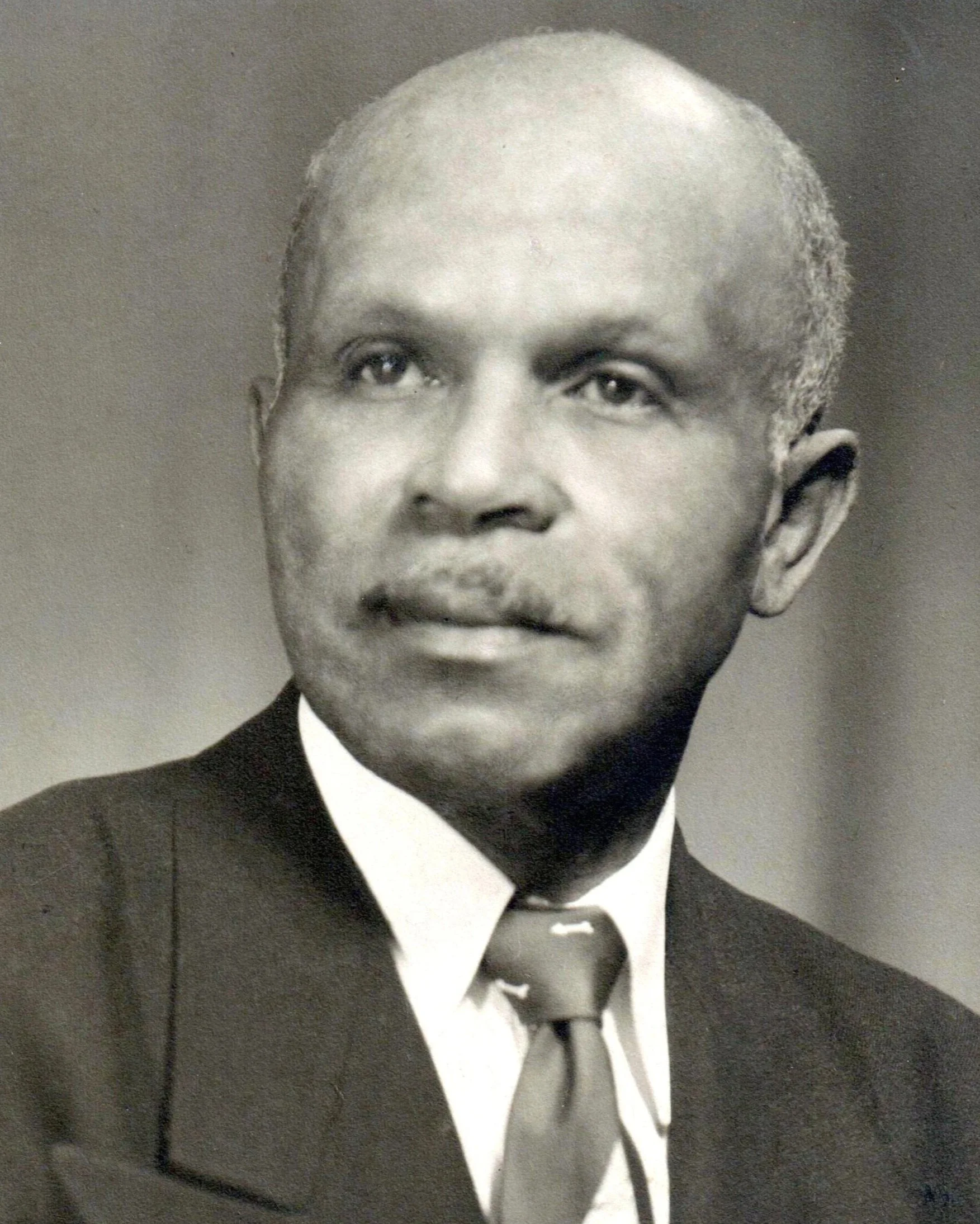
Long before conversations about equity and representation reached museum walls, Nathan Redmon was quietly reshaping Toronto’s economic landscape, one load at a time.
Arriving in 1913 from Chicago, he started as a railroad porter and, with grit, vision and entrepreneurial instinct, built the city’s first Black-owned haulage company. Major developers trusted his 12-truck operation to transport bricks and lumber that helped build a growing metropolis.
That legacy has now come full circle. For the first time in its history, the Canadian Automotive Museum has placed a Black figure at the centre of its storytelling. It is an overdue recognition not only of Redmon’s enterprise, but also of the foundational role Black builders have played in shaping the city itself.
For his maternal granddaughter, Bernice Carnegie, the recognition brings renewed attention to a story rooted in resilience, determination and vision.
“I am struck by his foresight and belief that he could break the limitations that were put on Black people during this era,” she said. “He knew he could be more than a doorman, cab driver and train porter, and his vision for wanting to do better for his family was the carrot that kept him going. I think the other amazing factor is how he used his many creative talents to pull it off. I am not aware that he was schooled in the trades, but he was able to do everything from building homes to converting cars and trucks for his cartage business, with flatbeds that could haul 10 tons of goods.”
Redmon Haulage played a significant role in building Toronto, hauling bricks and lumber for major developers. Yet, like many family legacies, the full weight of that contribution was not always immediately understood, a realization that came to Carnegie over time.
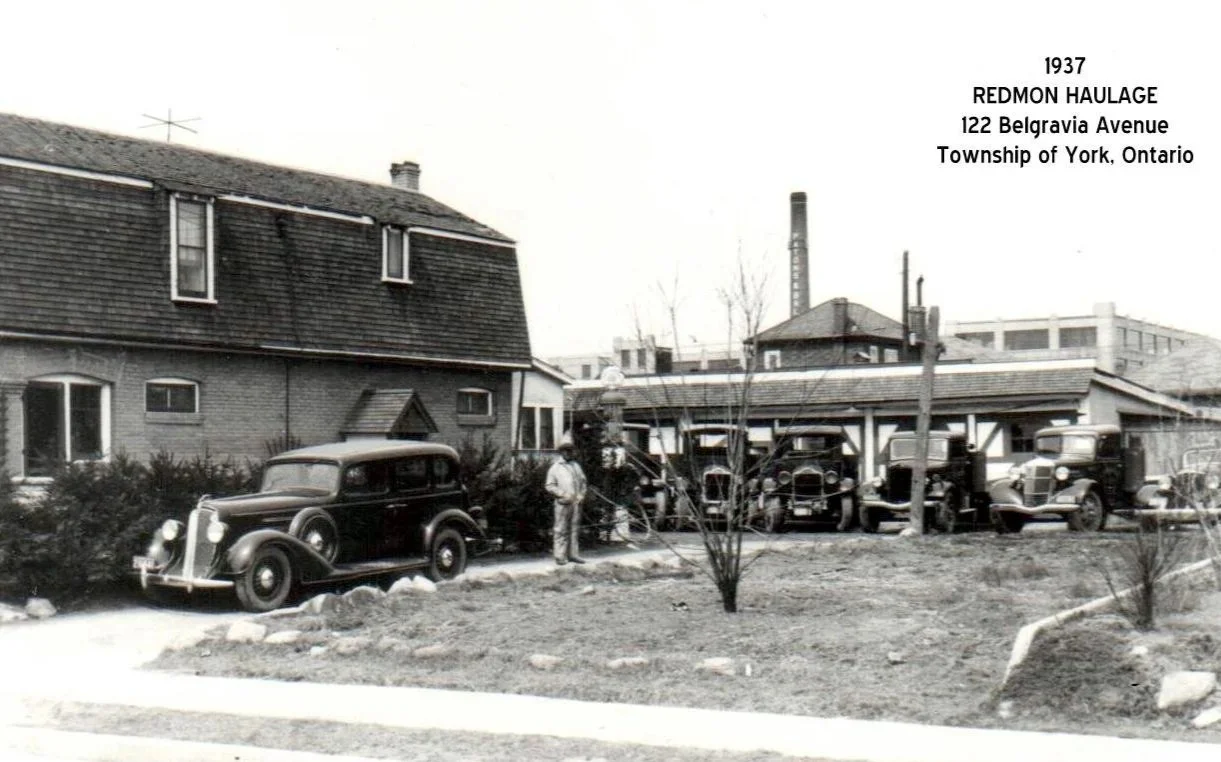
Redmon Haulage was the first Black-owned haulage company in Toronto (Photo contributed by the Carnegie family)
“Like most young people, we are so preoccupied with our lives that by the time we recognize the contributions of our elders, we miss the window for appreciating them when they are alive,” she said. “It was as an adult that I truly understood the impact of his contribution. His journey was one of courage and sacrifice.”
Now, with his story preserved in a museum setting, that understanding takes on deeper meaning not only for Carnegie’s family, but for the broader public.
“I am thrilled that my grandfather’s story is being recognized publicly in this way and that his journey will have a place in history for generations to come,” she noted. “There is so much to know in our world, and museums give us a chance to broaden our understanding of who and what brought us to this place and time.”
Beyond recognition, Redmon’s legacy continues to influence future generations, shaping perspectives on leadership, ambition and possibility.
“Someone must be first, and I do not think we appreciate what that takes,” said Carnegie, the daughter of Herb Carnegie who was posthumously inducted into the Hockey Hall of Fame in the Builder category in 2022. “I know my grandfather played a significant role at the time in being a respected leader in the Black community. Possibly, there were those who used that knowledge to propel them forward. But until now, his story has largely been hidden. Because of what the museum is doing, I hope the revival of his story will ignite others to fulfill their own passions.”
That reflection naturally extends to the present, particularly when considering the ongoing realities faced by Black entrepreneurs in Canada.
“When it comes to comparing the hurdles faced by my grandfather and Black entrepreneurs today, of course some progress has been made,” Carnegie pointed out. “At least now, agencies have been established to help confront unfair treatment. However, it saddens me to know systemic racism and old attitudes continue to plague our communities. This is a never-ending struggle. Humans are fickle, and we will always need to foster environments of fairness and inclusivity.”
Carnegie played an important role in helping bring her grandfather’s story to life, providing the museum with historical details and photographs that helped shape the exhibit’s depth and authenticity.
“In the early 1900s, a Black person owning a car was rare,” she said. “My grandparents were an anomaly to have the foresight to start a business that required such capital. Hopefully, that achievement in the business world, at a time when conditions were not ideal or favourable for Black entrepreneurs to succeed, will encourage others to believe they can achieve their vision. Hopefully, they will latch on to the essence of this story’s importance and recognize that each of us is responsible for navigating obstacles to find our place of belonging, which ultimately allows us to fulfill our destiny.”
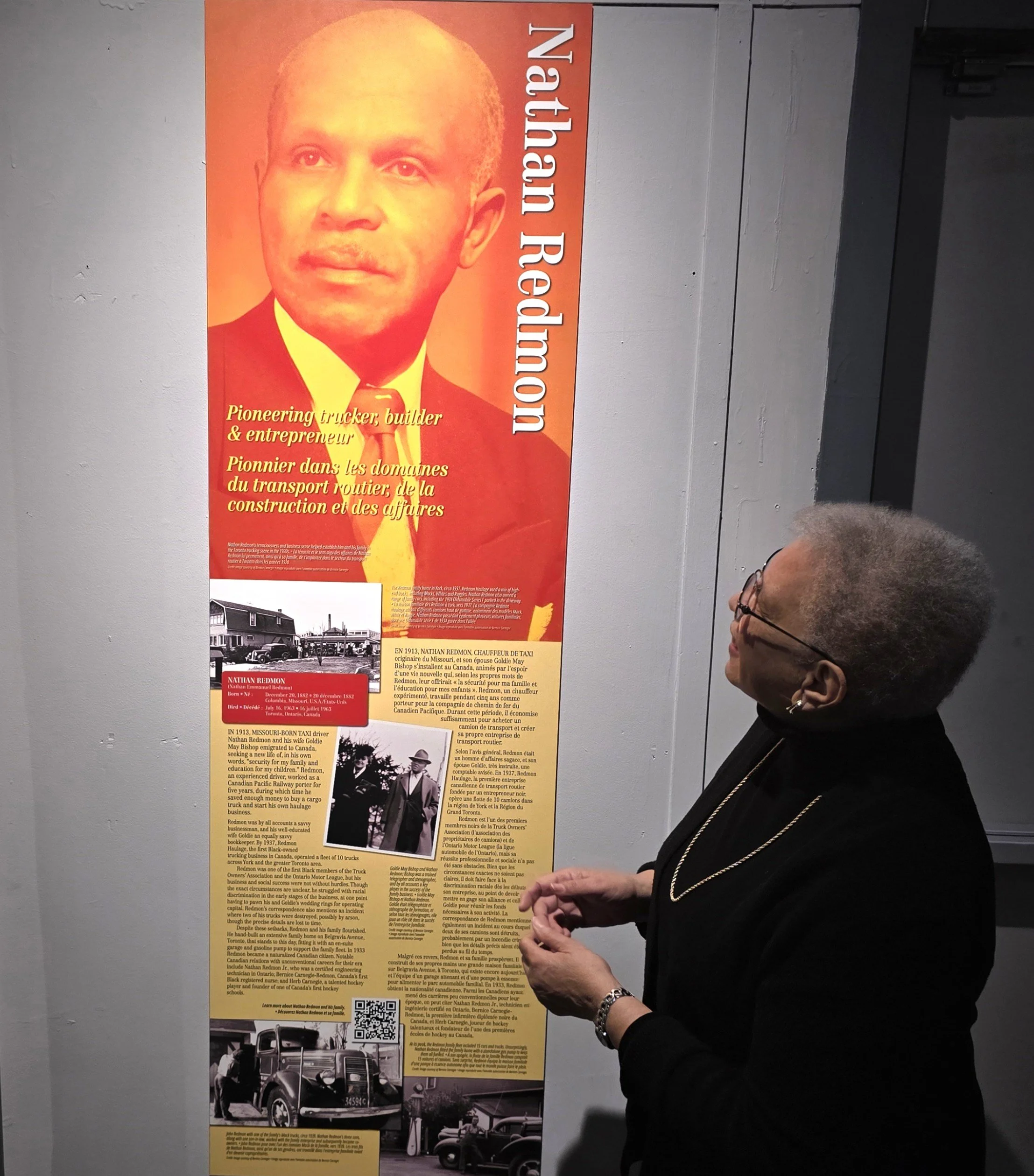
Bernice Carnegie views the panel exhibit of her grandfather Nathan Redmon (Photo by Ron Fanfair)
Alexandra Miller-Gerrard, the museum’s executive director and curator, said the decision to centre an exhibition on Nathan Redmon reflects a broader shift in how history is being told and who is being recognized within it.
“While this is the first exhibition centred on a Black figure, it’s not the first time the museum has explored Black history,” she explained. “We have previously shared stories of Black Canadians in our exhibit Oshawa’s Automotive Community where there was already a strong base of oral history from Black employees in the city’s automotive sector. The challenge has always been finding these stories, as they are often under-documented in traditional archives.”
That reality has led to a more intentional curatorial approach aimed at addressing those gaps.
“Now feels like the right time because there’s both a public appetite and an institutional responsibility to revisit those gaps,” Miller-Gerrard said. “We are in a moment where audiences are asking deeper questions about who built our cities and industries. This exhibition is part of acknowledging that history is richer and more complex than previously presented, and that we have a duty to reflect that.”
Since around 2019, she noted, the shift has become more deliberate, moving the museum beyond long-standing narratives centred on large corporations and well-known figures.
“We have been actively working to move beyond those familiar stories and bring forward ones like Nathan Redmon’s,” said Miller-Gerrard who is also president of Architectural Conservancy Ontario. “These are stories that highlight individuals, communities and contributions that have always been part of Canada’s industrial growth but haven’t been given the same visibility.”
In reframing transportation history, the exhibit highlights the role of entrepreneurs, builders and community leaders whose impact has often gone unrecognized.
Central to that effort was close collaboration with Redmon’s family, particularly Carnegie, whose involvement grounded the exhibit in lived experience.
“We truly could not have done this without the family,” Miller-Gerrard said. “This is very much their project, and our role was to help bring it to a wider audience. She confirmed which photographs were selected, reviewed exhibit text and suggested wording, contributing significantly to the final narrative. Her edits and insights were exceptionally strong, frankly stronger than what we typically receive through standard review processes. It was a genuine collaboration and conversation.”
That partnership ensured both historical accuracy and emotional depth.
“Details like his ingenuity in making concrete blocks or the presence of a gas pump on his property become much more meaningful when grounded in family memory,” she said. “This isn’t the museum telling someone else’s story in isolation. It’s a story being shared in partnership.”
The result is an exhibition that reshapes how visitors understand the role of Black Canadians in building the country’s economic and industrial foundations.
“This exhibition helps broaden public understanding of Black history beyond a narrow set of narratives,” Miller-Gerrard said. “Visitors may come expecting automotive history, but they leave with a deeper appreciation for the people, like Redmon, whose labour and entrepreneurship made that history possible.”
In that sense, the exhibit positions Black history as central rather than peripheral.
“We want people to see that their stories belong in museums too,” she added. “These are not side stories. Instead, they are central to Canada’s economic and industrial development.”
The approach is part of an ongoing shift in how the museum curates and presents its stories.
“Since 2019, we’ve been moving away from traditional, over-told narratives and toward stories that reflect a broader and more accurate history,” Miller-Gerrard said. “This is not a one-time effort. It’s an ongoing shift in how we approach storytelling.”
At its core, the exhibit bridges industrial history and human experience, making it accessible even to those who may not initially connect with automotive themes.
“Transportation history is about the movement of people, goods and opportunity,” Miller-Gerrard said. “Redmon’s story makes that tangible.”
Rather than focusing solely on machinery, the exhibit centres on the life behind it.
“We could have created an exhibit about his trucks, but that would have been far less engaging than telling his story,” she said. “He was a self-made entrepreneur, a builder of homes and community, and a family man whose legacy continues through future generations.”
It is that human dimension, Miller-Gerrard added, that ultimately resonates.
“Visitors don’t just learn about trucks, but they understand what those trucks mean in someone’s life,” she added. “The connection to transportation becomes secondary to the human impact, and that’s what makes the history truly meaningful.”
In reclaiming Nathan Redmon’s story, the exhibit does more than honour one man’s ingenuity. It restores a missing chapter of Toronto’s foundation and reframes who gets remembered as a builder of the city.
What was once a largely hidden legacy now stands in full view, not simply as history, but as a call to recognize the vision, courage and quiet determination that have long shaped communities from the margins.
In bringing that story forward, the museum is not just preserving the past. It is expanding the future, ensuring that those who walk through its doors leave with a deeper understanding of whose hands built the world around them, and whose stories remain to be told.
The museum is located at 99 Simcoe Street South in Oshawa and is open Tuesday through Sunday, from 10 a.m. to 4 p.m.