Building futures through the National Junior Golf Academy
March 24, 2026
Shanice Viner’s introduction to golf came through her godmother, an avid golfer who sparked the early interest in the sport.
Recognizing that growing passion, her mother later enrolled her and her brother, Shaka, in the newly established National Junior Golf Academy (NJGA), a program designed to provide young people from underserved communities with access to the game and opportunities for personal development.
Like many newcomers, Viner initially found golf frustrating.
“It was very hard for me to hit the ball at first,” she recalled. “What really drew me to the sport was the constant challenge. No matter how good you become, there is always something to improve. I stuck with it, and over time, I grew to love the game.”
Viner, who played for two years at the University of Waterloo before transferring to Toronto Metropolitan University, said the sport taught her the value of commitment, showing up week after week for practice and putting in the effort to improve.
The program also created opportunities for the siblings to meet professional golfers, including Calvin Peete, whose presence offered inspiration and a real-life example of what was possible in the game.
Now holding an undergraduate degree in geographic analysis, Viner works as a research project co-ordinator at George Brown Polytechnic.

Siblings Shanice and Shaka Viner with the late Calvin Peete in 2007 (Photo by Ron Fanfair)
Kingsley Rowe’s vision for the NJGA, established in 1998, extended far beyond teaching young people how to swing a club. It was about opening doors in communities where such opportunities were rarely accessible.
By introducing golf as a vehicle for discipline, confidence and exposure, the program helped reshape the trajectories of participants like Viner and many others. It created a structured environment where young people could develop life skills, build meaningful relationships and begin to see possibilities beyond their immediate surroundings.
That impact extended to others, including Dominique Claxton, who, through the NJGA, had the opportunity to meet Tiger Woods, widely considered one of the greatest golfers of all time.
When Woods burst onto the global stage in 1997, becoming the first Black golfer to win a major championship, he did more than claim a title. He reshaped what young Black boys believed was possible in a sport that had long excluded them.
Seeing someone who looked like them dominate golf’s biggest stages gave many the confidence to pick up a club for the first time, challenging both barriers to access and long-held perceptions.
In Canada, that ripple effect reached players like Claxton, who not only embraced the game but also had the rare opportunity to meet Woods in Alabama. In April 2001, he was one of three Canadians selected among 20 young golfers from across North America to attend Tiger Woods’ Golf Clinic in Birmingham.
“That was big,” he recalled. “Tiger was one of the main reasons I got into the sport, and to be in his company was amazing. He spent a few minutes with each of us, watching our swing and giving us some great tips. While talking to the kid next to me, I hit a beautiful shot that he saw, and he said, ‘Great shot, Dominique’. You think someone like him would spend some time with you and forget your name after 30 seconds. He did not, and I felt good about that.”
Claxton’s early interest in golf was sparked by watching his father and uncle hit balls in the backyard. His formal introduction to the sport came in the fall of 1999 when he joined the NJGA and began developing his skills and understanding of the game.
“The club was heavy, and it was frustrating at first,” he said. “My hand-eye coordination was not there, so even making solid contact with the ball was very difficult. Once I started hitting the ball and picking up tips, I felt good and became addicted to the sport.”
Living near Shoreham Drive and Jane Street at the time, Claxton spent about five years with the academy.
“I played soccer and basketball, but golf was a different sport than what I was used to,” he said. “I have made so many friends through the sport to the point where I get phone calls to come out and join some of them on a course. It all started with the academy.”
Rowe said the experience of meeting Woods transformed Claxton.
“Dominique came back as a different person,” he recounted. “He learnt so much in the week and came back as a very positive person. Before the trip, he was timid and unsure of where he was going. He was at the top of his class in his next school report. It was like night and day.”
Though Rowe was introduced to golf by his father, who had spent time in the United States, he initially had little interest in the sport.
“It was too slow,” he said. “At the time, I preferred playing cricket and soccer.”
That perspective shifted at age 13, following a defining moment that would reshape not only his relationship with the game but also his broader sense of purpose. His desire to help others, particularly those in underserved and marginalized communities, was deeply influenced by his great-aunt, Leila James Tomlinson, Jamaica’s first female scholar in 1912.
After completing her studies in England, she returned home three years later and was appointed a sub-examiner with the Department of Education, a role traditionally held by a man. Five years later, her position was made redundant.
Although a Commission of Inquiry determined James Tomlinson had been unfairly dismissed, she was not reinstated. Undeterred, she continued her work overseas, serving in Costa Rica, Bermuda and parts of Africa before returning to Jamaica in 1941.
Her public service career, marked by both achievement and injustice, reflected an unwavering commitment to education and social development, while also exposing the systemic gender barriers of the time.
That legacy left a lasting impression on Rowe and helped shape the values that would later guide his life and work.
“Growing up, I thought about how I could help others,” he said. “Although I came from a middle-class background, that was always at the back of my mind. She provided me with that roadmap as to how I could help others.”
After leaving a successful business career, Rowe moved to Canada in 1976. More than two decades later, he founded the NJGA in Toronto’s Jane and Finch community after discussions with friends about how he could give back.
“In my view, many young people in that community were not always exposed to the same opportunities,” he said. “I believed the game of golf, which had given me so much, could be a meaningful way to open doors, broaden their horizons and provide life skills and a sense of direction.”
Golf has not traditionally been accessible to many Black and low-income communities.
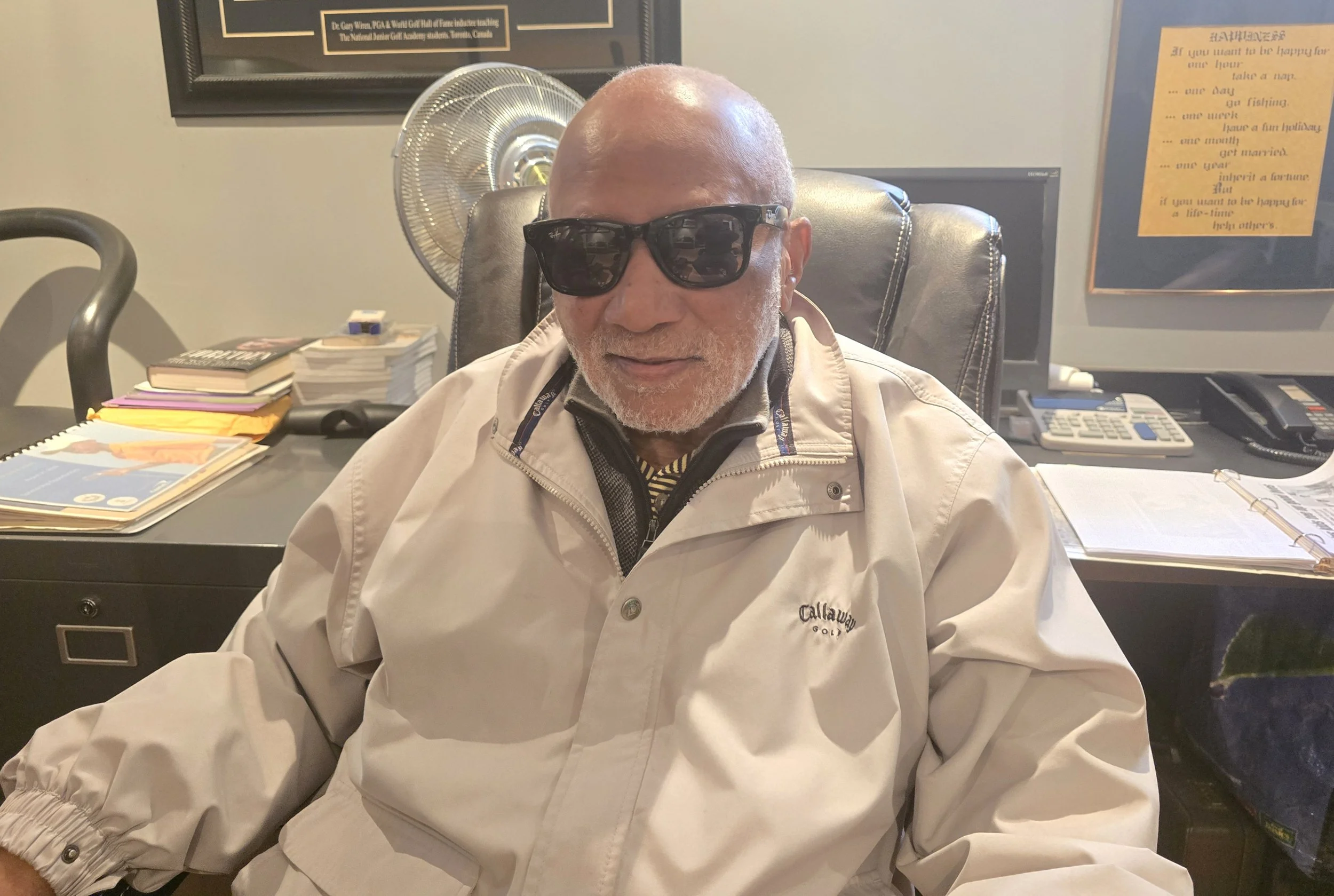
Kingsley Rowe (Photo by Ron Fanfair)
Rowe said he recognized the sport’s potential as a tool for social change even before coming to Canada.
“I was a member at the Half Moon Golf and Country Club in Montego Bay,” he said. “My father told me that if I was going into business with someone, I should take them onto the golf course because it reveals a person’s character. He believed you could quickly tell if someone was honest or not. That stayed with me, along with the values of the game itself. There is no referee in golf. You are expected to be truthful and hold yourself accountable. Those are the principles I wanted to pass on to young people.”
Launching a golf program in the Jane and Finch community was not easy. The sport is often perceived as expensive and inaccessible, far removed from the realities many families face.
Convincing young people and their parents to consider golf required overcoming financial barriers, limited exposure and long-standing perceptions.
Securing corporate support presented another challenge, as equipment, course access and instruction come at a cost. It required persistence and a clear vision to demonstrate how investing in the program could create meaningful opportunities, using golf as a vehicle for personal growth, discipline and long-term success.
“It was hard,” Rowe admitted. “But we got some help from golfers I played with. In my 22 years in the Greater Toronto Area, I have also established good relationships.”
To broaden exposure, he connected participants with some of the sport’s most accomplished figures, including Peete and Lee Elder. Their presence at events across the city gave young people rare, firsthand insight into what was possible.
Elder made history in 1975 as the first Black golfer to compete in the Masters Tournament, while Peete was, prior to Tiger Woods, the most successful African-American golfer on the PGA Tour.
“I knew these individuals through golf and business, and I believed their presence, and the chance for them to speak, would inspire the kids,” Rowe said. “These are people whose imprint on the sport is truly impactful.”
The academy’s credibility was further strengthened by the involvement of PGA Master Professional Dr. Gary Wiren, who served as Honourary Chairman and was a frequent guest at its events.
In 2005, the Canadian Professional Golf Tour also announced its support, providing role models, assisting with clinics and creating opportunities for participants to attend tour events and volunteer.
Beyond the game, the NJGA invested in education. In 2008, it launched a scholarship program to support youth facing financial barriers to post-secondary studies.
Without that support, Ellen Konadu said she is uncertain when she would have completed her Humber College criminal justice program.
“I would have been struggling to pay for post-secondary education, and it certainly would have taken me longer to complete the program,” she said at a fundraising tournament in 2014. “The biggest thing this has done for me is allow me to fully concentrate on my schoolwork without worrying about where the money is coming from for the next semester. In my first semester, my average was 72 percent. Now it is 80 percent and climbing.”

Raymond Ang (l), Thanish Munas, Ellen Konadu, Tony Tran, Derek Ang and Taylor Barrett won NJGA scholarships in 2014 (Photo by Ron Fanfair)
Konadu was among 16 young people who each received $4,000 annually to complete college or university education.
Funding was raised through an annual invitational golf tournament, reinforcing the academy’s commitment to creating pathways not only onto the golf course, but into classrooms and careers.

Steve Nehlawi (l), Share newspaper publisher Arnold Auguste and his son Hollingsworth Auguste and Michael Annett took part in the NJGA fundraising golf tournament in September 2014 (Photo by Ron Fanfair)
The academy’s broader impact was also reflected in initiatives like the 2004 Scarborough–Indianapolis Peace Games, which brought youth together through sport, mentorship and cultural exchange.
At Tam O’Shanter Golf Course, participants were introduced to golf through the NJGA, using the game to teach discipline, integrity and life skills. For many, it was their first experience on a golf course, offering not just instruction, but exposure to new possibilities and a wider world.
The NJGA closed in 2017 due to Rowe’s declining health. He is blind.
For the nearly 3,000 young people who passed through the academy, the lessons extended far beyond the fairways. It was never just about learning how to play the game, but about understanding character, opportunity and self-belief.
Through the vision of Rowe, golf became a bridge, connecting young people to possibilities they might not have otherwise imagined, and leaving a lasting imprint on lives that continue to reflect the program’s purpose long after the final swing