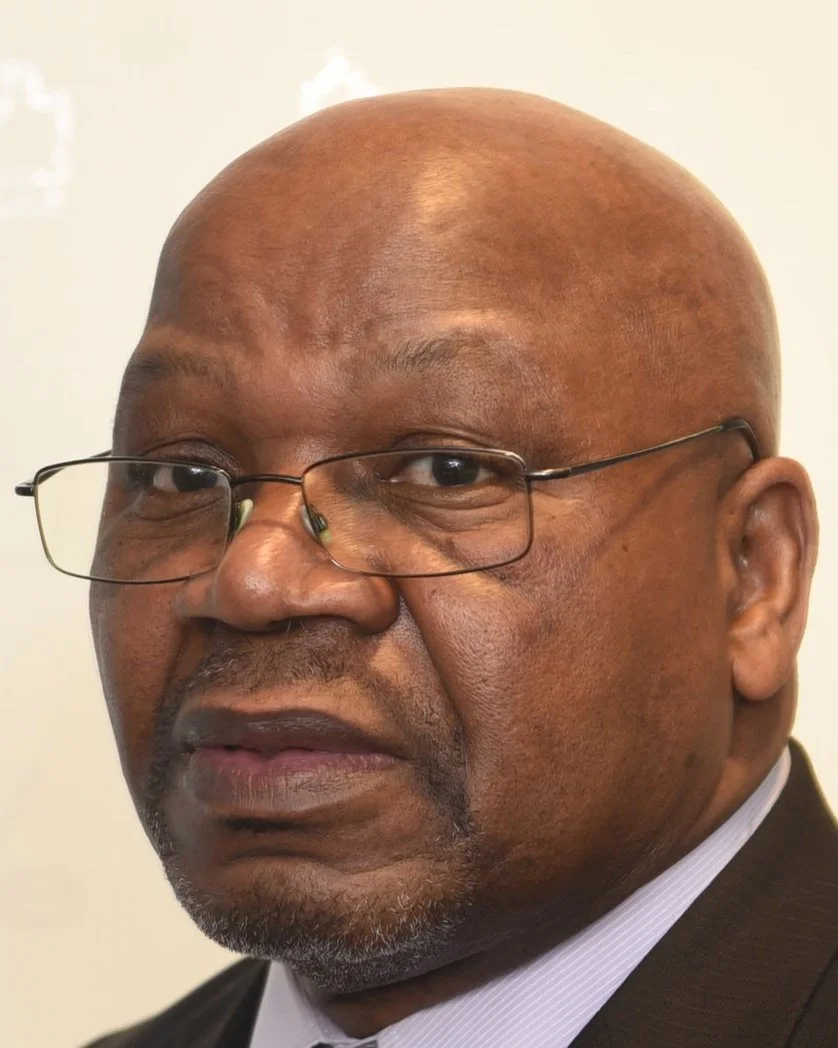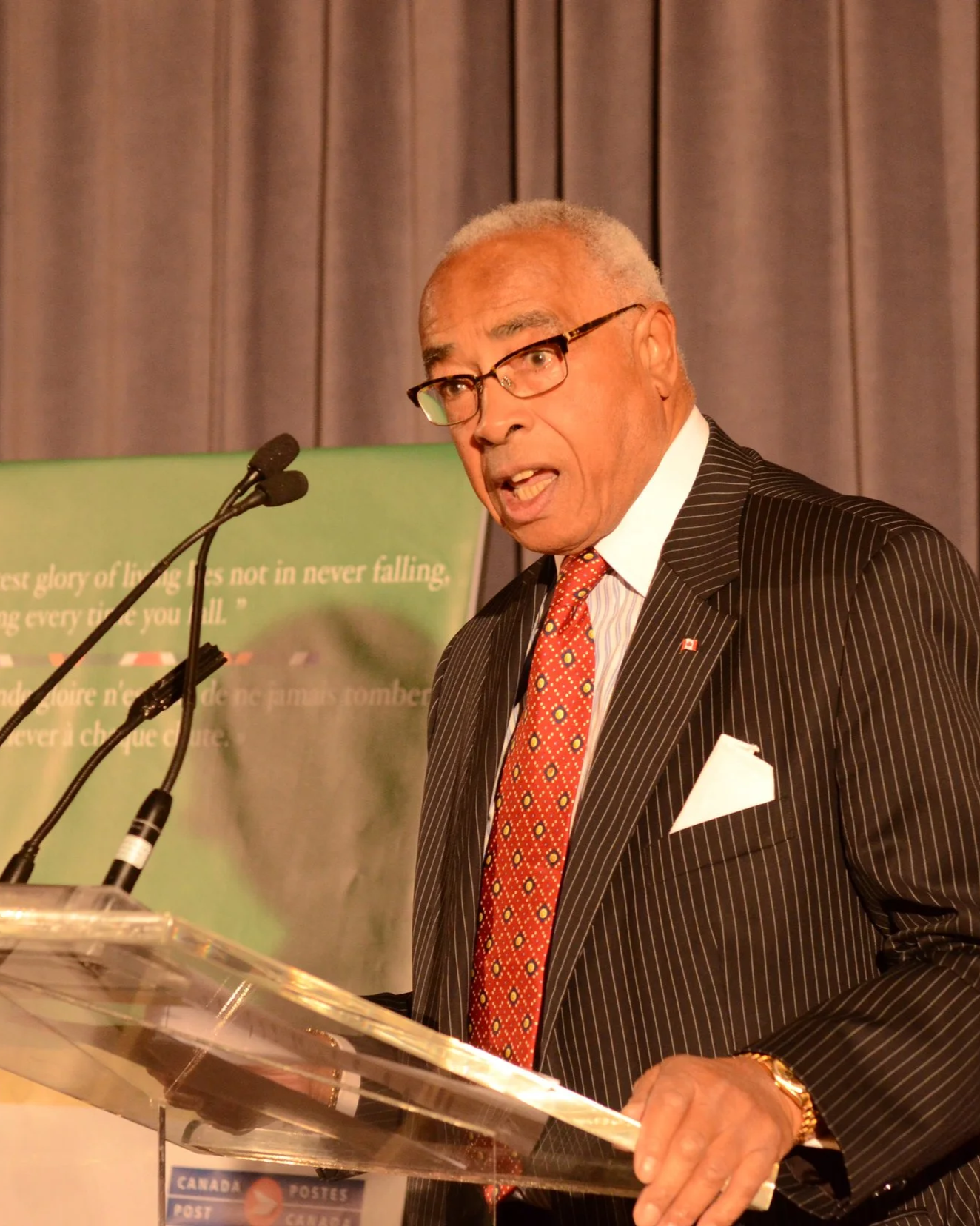
Donald Oliver's life marked by service, advocacy and breaking barriers
September 18, 2025
Given six months to live after being diagnosed in 2015 with a rare heart disease, Donald Oliver did not accept that as a death sentence.
Instead, he lived 10 more years, continuing to serve with purpose and grace.
Canada’s first Black male senator died in Nova Scotia on September 17 at age 86.
“He proudly represented Nova Scotia for over two decades with grace, wisdom and a relentless commitment to inclusion and justice,” said the province’s Premier Tim Houston. “His work focused on championing issues of diversity, equity, human rights and economic empowerment. Nova Scotia was lucky to have someone of Mr. Oliver’s calibre and integrity representing us on the national stage.”
In 2008, Oliver introduced the Senate motion that led to Parliament’s formal recognition of Black History Month.
“This landmark achievement reflects his tireless commitment to ensuring that the contributions and legacies of Black Canadians are recognized and honoured across the country,” the African Canadian Senate Group, led by Rosemary Moodie, said in a statement. “He was a trailblazer and dedicated champion for equality whose contributions to Canada will endure for generations to come. He served with commitment, compassion and humility. He leaves behind an important legacy of leadership and perseverance. As Senators of African-Canadian descent, we walk along the path he forged, and his legacy continues to inspire our work in the Senate today.”
Jean Augustine, who introduced the motion in the House of Commons 30 years ago to recognize February as Black History Month in Canada, became the first Black woman elected to Canada’s Parliament two years after Oliver entered the Senate.
“I respected the work he was doing that revolved around equity and inclusion because those values are very important to me,” she said. “Though we were not in the same political caucus, we had mutual respect and supported one another.”
When oral historian and cultural strategist Delvina Bernard was growing up, Oliver was spoken in her household with deep admiration and respect.
“His trailblazing achievements as a distinguished lawyer, pioneering senator and unwavering social justice advocate — I even treasure his cookbook — profoundly inspired many of us and embodied the spirit of Black excellence long before that phrase entered common use,” the doctoral candidate said. “He was a consummate elder statesman whose vision, integrity and courage have left us an enduring and transformative legacy."
Oliver had cardiac amyloidosis which is caused by abnormal protein deposits in the heart tissue.
Although there is no cure in Canada, the octogenarian participated in clinical trials at the Mayo Clinic in Minnesota, testing experimental treatments.
Despite the challenges of his illness, he remained active and engaged in his community.
“This showed that he was a fighter who refused to go down easily,” said his cousin, Anthony Sherwood. “What I will remember most is how active he was in the community.”
A shared passion for theatre was one of the things that connected them.
“When I was associated with Obsidian Theatre in Toronto, he came to many productions,” said Sherwood who is an award-winning documentary filmmaker. “He was the first president of the Neptune Theatre Foundation in Halifax.”
Oliver was one of five children, born into a family shaped by both faith and music.
His grandfather was a Baptist minister and his mother a concert pianist. He played the trumpet in his youth and even owned a jazz band.
Sheila White, another cousin who was an aide to late Mayor Mel Lastman, described Oliver as a man who carried himself with grace and deep compassion.
“He lived a life marked by a lifetime of meaningful accomplishments,” she added.
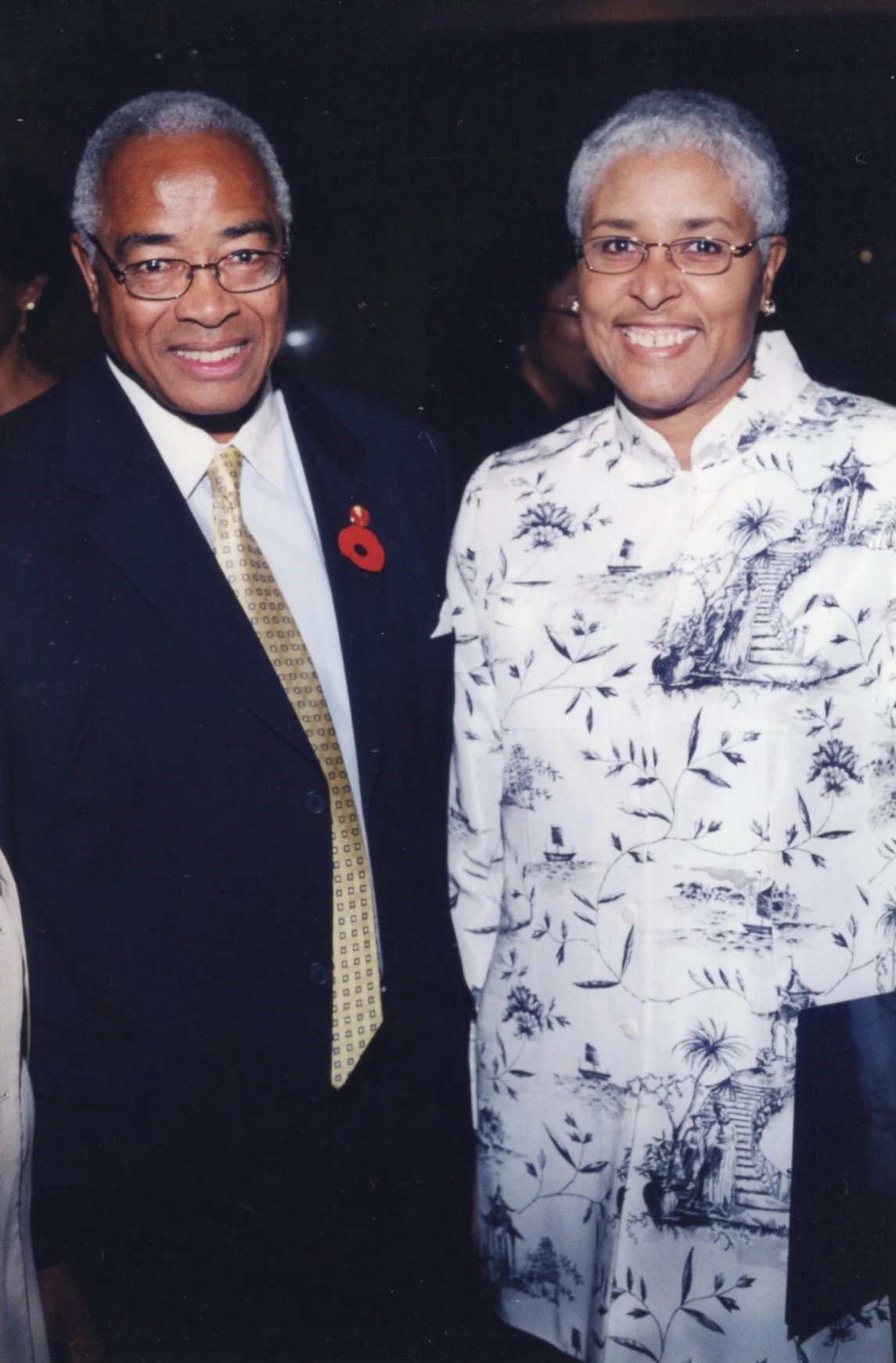
Donald Oliver & then Scotiabank Senior VP Mary Anne Chambers were the keynote speakers at the Urban Financial Services Coalition gala in October 2002 (Photo by Ron Fanfair)
Called to the Nova Scotia Bar in 1965 after graduating with a Law degree from Dalhousie University, Oliver served as director of the Nova Scotia Law Foundation and was active in several community organizations in his home province before his appointment to the Senate in September 1990.
He was a major force behind the establishment of the James R. Johnston Chair in Black Canadian Studies at Dalhousie University where Senator Wanda Thomas Bernard was the first Black Canadian to have an academic tenure position, and one of the architects of the Black United Front, the Black Cultural Centre for Nova Scotia and the defunct National Black Coalition of Canada.
“His contributions to each of these organizations are invisible to many, but highly impactful,” she pointed out. “As one of the mentors who was visible and available to me during my formative years, I will be forever grateful for his effective leadership.”
Through the Black Cultural Centre established in 1983, Oliver’s vision and leadership helped ensure that the stories, struggles and triumphs of African Nova Scotians would have a permanent home.
“Senator Donald Oliver was a true pioneer, not only in his groundbreaking service to Canada’s Senate, but also in his dedication to our community here in Nova Scotia,” said Russell Grosse, CEO of the Black Cultural Centre. “As a founder of the Centre, his contributions will forever be part of our foundation, and his legacy will inspire us to continue the vital work of preserving and sharing our history.”
Tony Ince expressed deep gratitude for Oliver’s foundational work that paved the way for others like him.
Appointed to the Senate last March, he learnt of Oliver’s death while at a dinner for Dr. Lynn Jones who was appointed to the Order of Canada.
“The first message I saw on my phone after being off of it for about two hours was from one of my staff members, saying Donald Oliver died,” he recalled. “The emotion I felt was overwhelming sadness because he laid the foundation for me to be where I am at.”

Donald Oliver was presented with an African Canadian Achievement Award in 2004 (Photo by Ron Fanfair)
Oliver was Canada’s second Black Senator after Anne Cools who was appointed in 1984.
His maiden speech in the Senate in 1991 set the tone for his political career, showcasing his vision, passion and commitment.
“I believe I can represent Black Nova Scotians and visible minorities throughout the country…I understand the need to combat racism whenever it appears and to provide equal opportunities to all regardless of the colour of their skin.”
Oliver used the position to support diversity and was a powerful advocate for visible minorities during his 23-year career in the Red Chamber.
In 2005, he raised $500,000 to lead the first-ever national study conducted in Canada that definitively proves the business case for diversity. The Conference Board of Canada's employer’s guide provides concrete strategies and tools that can be used by leaders, human resource managers and line managers to create inclusive workplaces that respect, value and promote visible minority talent.
The ground-breaking practical guide has been impactful.
“Several senior public servants have told me that there is no report that’s more instrumental in moving the four target groups (visible minorities, Aboriginals, people with disabilities and women),” he said shortly after retiring from the Upper Chamber. “Because that report suggested things that should be done by senior managers to be more inclusive, a lot of those recommendations were taken into consideration and changes were made. That more people from the four target groups have been hired and promoted in both the public and private sectors, I think, is a direct result of the recommendations and findings of that report.”
After the study was initiated, Oliver travelled to several countries around the world to talk about the urgency of fostering diverse and inclusive organizational cultures.
The recipient of five honourary degrees from Canadian universities, he singled out the work done on Private Members’ Bills to amend sections of the criminal code about stalking and one that addressed spam and related online threats as the highlights of his tenure in the Senate.

York University Chancellor and Vice-President Mamdouh Shoukri (r) and Chancellor Roy McMurtry (l) presented an honourary degree to Donald Oliver in 2012 (Photo by Ron Fanfair)
“From a public policy point of view, I saw a problem with the criminal code and the number of Canadians of all colour that were being stalked and the law was not able to protect them,” said Oliver who enjoyed cooking and making jams, relishes and pickles. “So I drew up a Bill that passed in the House of Commons and became the law of the land. Spam, at one stage was costing Canadians more than $9 billion in lost productivity. I brought in two Private Members’ Bills to try and correct that problem. Portions of those bills ultimately became law so that’s two things that are part of my legislative career that I will always remember.”
Another high point of his Senate career was meeting United States President Barack Obama in Washington in 2009. Former Prime Minister Stephen Harper invited him on the trip.
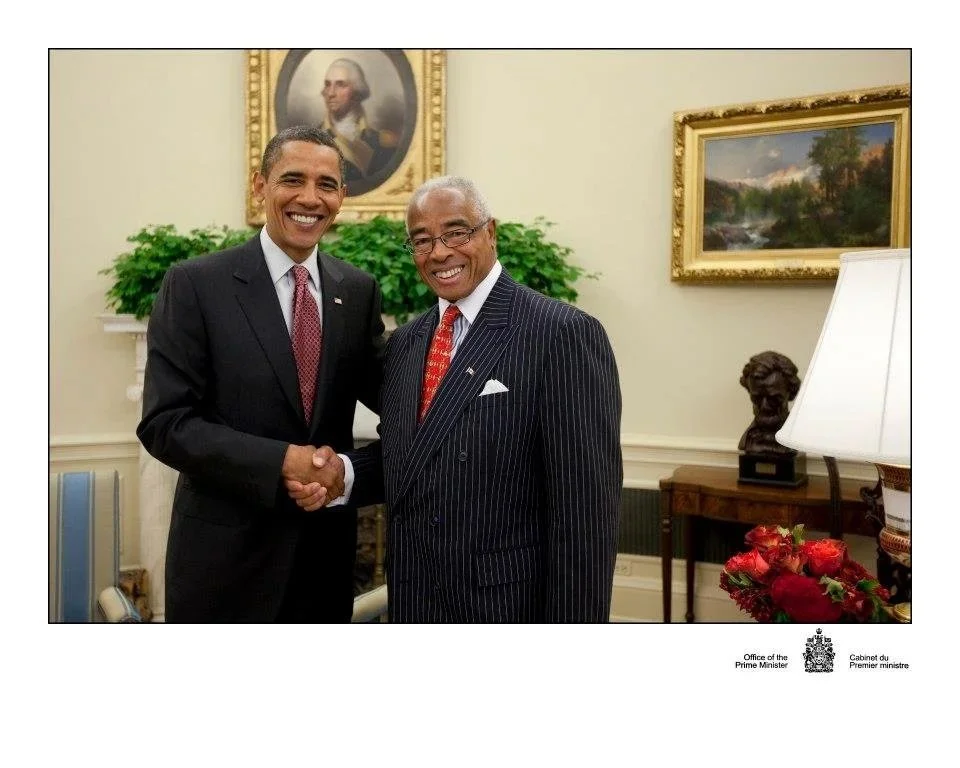
Donald Oliver and Barack Obama (Photo contributed)
“We went to the White House and had a meeting in the Oval office in preparation for the G-20 summit in Pittsburgh,” Oliver, the first Black to hold the post of Deputy Speaker, recalled. “When that meeting was over, I had a one-on-one with Obama. It was an incredibly exciting moment for me because he had been briefed by our PM about a lot of the work I have done in the Afro-Caribbean community for almost 50 years. The U.S president congratulated and praised me for that work and some of the good things that have come from that work and then we talked about our joint history.
“I explained that I was the first Black man in Canadian history to be summoned to the Senate even though, on both sides of my family, I am a descendant of slaves in America. I said I had a lot to be proud of. He was the first Black man to become president of the U.S, so we both had a lot in common to be proud of. We shook hands and took a photo. That was very moving for me.”
In 2020, Oliver was appointed to the Order of Canada.
A descendant of slaves from Maryland and Virginia, he was the third member of his family to be selected for Canada’s second-highest honour for merit.
His half-brother, William Oliver – the only African Canadian chaplain during the Second World War – and uncle, Bill White who was the first Black Canadian to run for federal office in Canada, were invested in 1985 and 1971 respectively.
“Fleeing slavery, my family made their way to Nova Scotia and have been doing humanitarian and other kinds of work for generations,” Oliver said at the time. “It’s quite a tradition and history. When I received the call that I was selected for the Order of Canada, I was speechless.”
At the BlackNorth Initiative inaugural gala in 2023, Oliver was bestowed with a Lifetime Achievement Award.
“Some leaders deserve a crown,” said founder Wes Hall who is the University of Toronto Chancellor. “He deserves a crown, a throne and a chapter carved permanently in Canada’s history. When I reflect on his life, I don’t just see a man who achieved titles. I see a man who carried the weight of being the first and transformed that into a legacy that will outlive us all.”
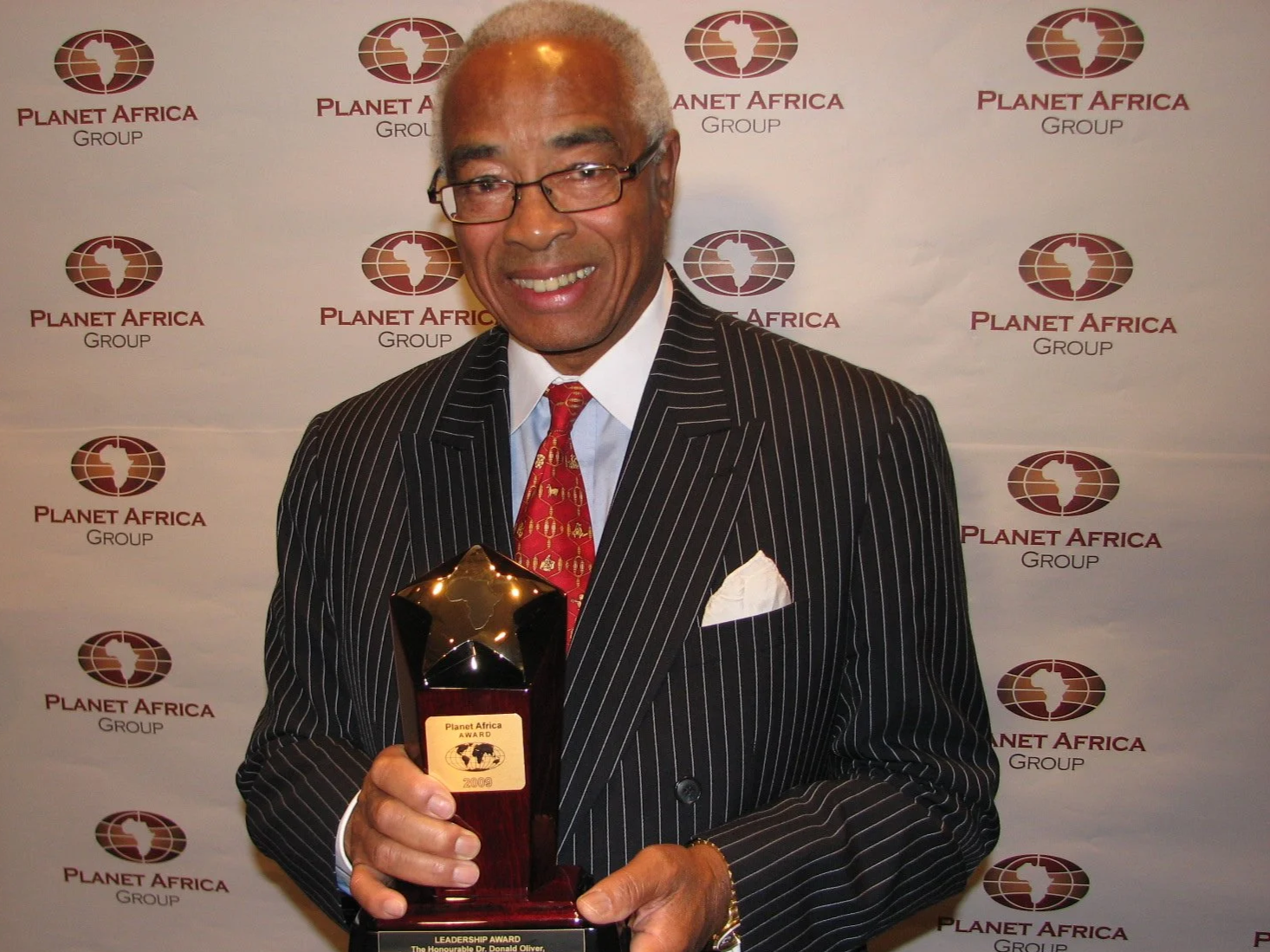
Donald Oliver was the recipient of a Planet Africa Award in 2009 (Photo by Ron Fanfair)
Dalhousie University Chancellor Rustum Southwell said Oliver was a titan in Canada’s Black community.
“He worked diligently for a prominent place for Black Canadians in all aspects of society,” the Black Business Initiative founding Chief Executive Officer pointed out. “And he did this without fanfare in his own inimitable way.”
Two years ago, the Donald Oliver scholarship was launched at the university.
Created with a $1 million gift from close friend Wade Dawe, it provides financial support and access to mentoring for African Nova Scotian students.
“He was just a distinguished gentleman, an exceptional person and a friend to many, including me,” noted the entrepreneur and investor. “Spending time and travelling together created a bond between us that felt meaningful.”
A memorial service to celebrate Oliver’s life will take place on September 27 at New Horizons Baptist Church in Halifax.