Saukrates brings a lifetime of work to a global moment
May 7, 2026
For Canadian hip-hop pioneer Saukrates, even his stage name carries a deeper story about influence, intention and identity.
Born Amani Wailoo, he didn’t take the name from the ancient Greek philosopher. Instead, he was inspired by the late Sócrates, the legendary Brazilian soccer midfielder remembered for his intelligence and artistry on the pitch.
By reshaping the spelling to ‘Saukrates’, the multidimensional artist created a distinct identity that avoids confusion while signalling admiration. The name bridges sport, intellect and culture, much like the layered depth found in his music.
Over the years, he has consistently woven athletics into his artistry, performing at the Canadian Football League (CFL) Grey Cup halftime show in 2006 alongside Nelly Furtado, creating promotional campaigns for the Toronto Raptors and Toronto Blue Jays, recording a single celebrating the rise of P. K. Subban to the National Hockey League and releasing a track sampling National Basketball Association Hall-of-Famer Allen Iverson’s now-infamous ‘Practice’ press conference.
That long-standing fusion of music and sport has now come full circle as he steps onto one of the world's biggest cultural stages through his involvement in the upcoming FIFA World Cup 2026.
For the first time in his career, Saukrates shared his music directly with his parents, sending them the very song he created for Canada’s role in the World Cup. Canada is co-hosting the event with the United States and Mexico.
It is a quiet but powerful moment that sits alongside a series of long-awaited achievements.
Three decades after earning his first Juno nomination, Saukrates has secured his first Juno Award for Rap Single of the Year, Who’s Driving You?, with TOBI and Jully Black.
The recognition speaks not only to longevity, but to his role as a foundational voice in Canadian hip-hop, shaping its sound long before it commanded national attention.
That sense of timing and perseverance has now come full circle as Saukrates steps onto a global stage once again.
As a writer and producer contributing to a song tied to the upcoming FIFA World Cup, he is aligning his craft with one of the world’s biggest sporting events. It marks a fitting convergence of music, sport and legacy, echoing the very inspiration behind his name.
The project began with a simple but ambitious idea.
Two years ago, former Canadian soccer player Dwayne De Rosario, a prominent ambassador for the FIFA tournament, reached out to create a song to represent Canada on the global stage.
The vision was rooted in unity, inspired by the collaborative spirit of We Are the World, bringing together multiple voices to deliver a message that could resonate across borders.
At first, Saukrates questioned whether something of that scale was even possible. But within about 15 minutes of their conversation, the idea began to take shape as he envisioned how it could come together musically. That early spark quickly evolved into a creative blueprint.
“I composed this sonnet to represent Canada on my Lucida piano, imagining myself to be Oscar Peterson,” the Capitol Hill Music co-founder said. “It was just piano and pulse for about two minutes, and we chose to go with a world music tempo rather than club or pop that comes and goes.”
From there, the project expanded both musically and culturally, deepening its sense of purpose.
At De Rosario’s request, Saukrates ensured Indigenous voices were meaningfully included.
“I did my research and had the lyrics blessed by an Elder in ceremony and then given to a singer to perform the intro and outro in Ojibwe,” he said. “Dwayne also recommended a Spanish artist that we brought into the project.”
The song ultimately took shape as a multilingual collaboration, featuring five lead artists performing in five languages -- Ojibwe, English, French, Spanish and Punjabi -- reflecting both the diversity of Canada and the global nature of the World Cup.
That scale required a new level of coordination.
Drawing on his experience touring with 10-time Juno Award winner Nelly Furtado, Saukrates developed a deeper understanding of how to assemble and manage a large group of musicians. It is the first time he has worked with as many as 18 artists on a single track, serving as composer, producer and writer at the centre of the project.
The song and its accompanying video are scheduled for release on May 29.
For Saukrates, a former recreational soccer player and lifelong fan, the moment carries added meaning.
“This song is my route of excitement to be part of the World Cup,” he said. “Normally, I watch the games at home with my flags on the wall, depending on which country is playing. This year, I get to enjoy soccer’s biggest showcase from home and put out a song. I’m not leaning toward going to any of the matches in the city. I don’t need a ticket. I am already part of the World Cup in a big way.”
That perspective reflects a broader sense of fulfillment that extends beyond the global stage. Now, with a Juno finally in hand and his voice part of a worldwide anthem, Saukrates finds himself at a powerful intersection of recognition, purpose and legacy.
Three decades after first entering the Juno conversation, he now stands on the winning side.
For Saukrates, it is a moment that feels less like vindication and more like quiet affirmation.
Rather than framing the journey through what may have been overlooked, he embraces the recognition with gratitude, reflecting on a career defined not by bitterness, but by persistence, influence and an enduring commitment to the craft.
“Through mentorship, I learned early how the business works,” Saukrates said. “When I began operating professionally at age 16, my manager, Chase Parsons, showed me and my crew the world. Toronto, albeit, felt like a planet hard to escape as a hip-hop artist. We pressed vinyl and put it in New York. All of a sudden, Canada was no longer an anxiety, and there was no reason to think for any moment that we would not be recognized at home. It was like, ‘We are going to be back.’ We tucked Canada in the back pocket and never burned bridges. But we had to leave then.
Reflecting on what the recognition means at this stage of his career, he said the moment represents both longevity and continued growth.
“For those of us who have been around since the 1990s, it means we have not quit,” said Saukrates. “It represents growth for me and shows that there is still more to come. It’s the result of combining quality with quantity and committing to sharing my music with people. Even putting something out that you have given your best to, or simply being nominated, is already a win.”
He had been nominated three times before his eventual win. His debut hit, Still Caught Up and Money or Love, the third track on The Underground Tapes, earned Juno Award nominations for Best Rap Recording in 1996 and 2000, respectively. His fourth release, Amani -- a four-track EP co-produced by Rich Kidd and Snaz with a guest appearance by SonReal -- was also nominated for Rap Recording of the Year in 2015.
Looking back, it is the simplicity and self-reliance of his early years that continue to resonate most.
“I can create songs, regardless of the genre, entirely on my own,” said Saukrates who writes most of his material. “The way I make music today is the same way I did when I was a teenager. I have always had a machine. First, it was the ASR-10 sampler and keyboard, along with an Akai MPC drum machine. Now I use the Akai MPC 61, a standalone synthesizer keyboard. I can plug it in, start playing, find some sounds and rock a crowd like I’m 15 or 16 all over again.”
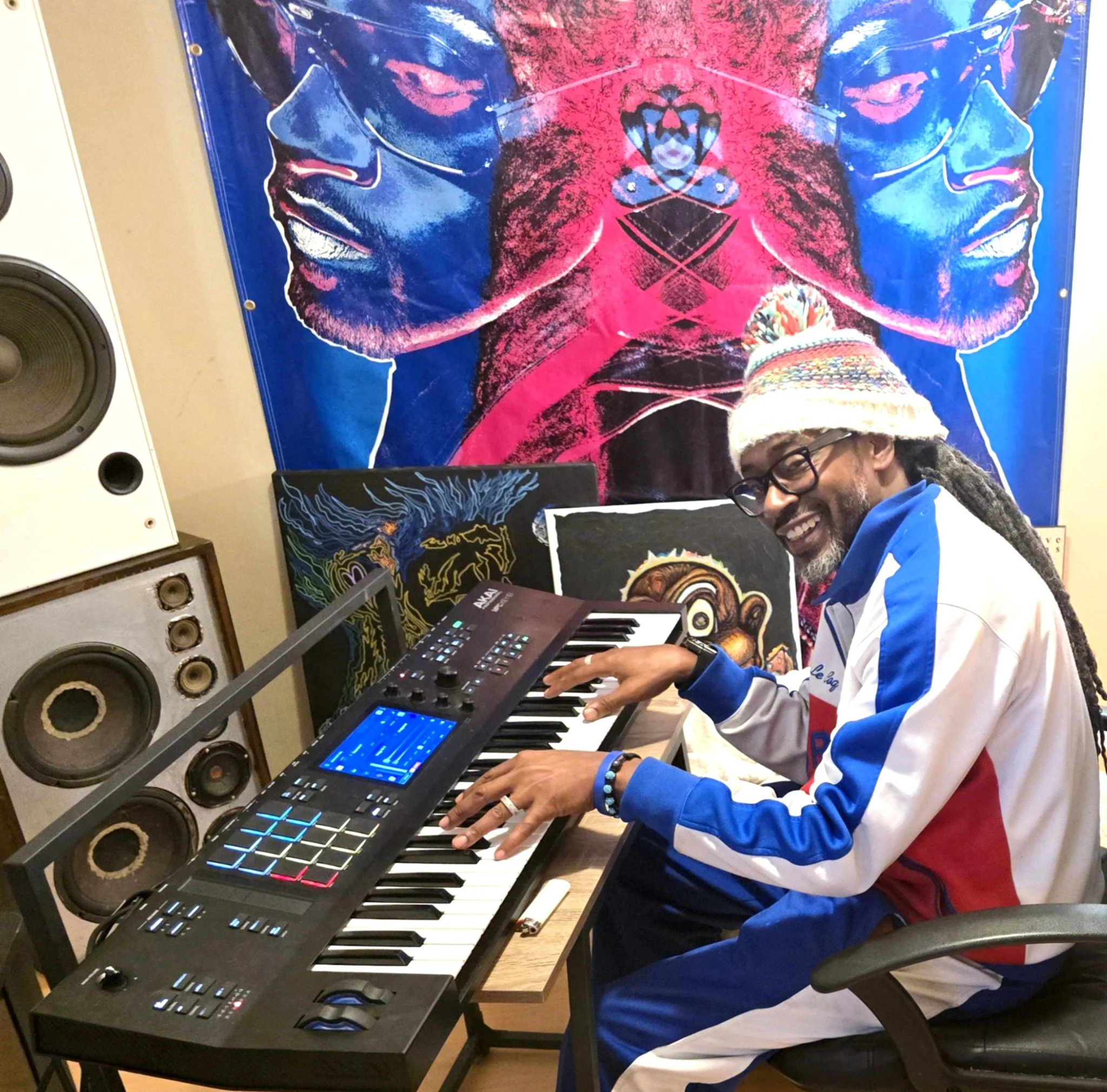
Saukrates finds comfort and inspiration in his basement where he spends hours creating music and painting (Photo by Ron Fanfair)
That independence, he noted, was shaped early by the environment he grew up in, offering insight into how his musical identity first took root.
“It starts with my Guyanese-born parents (Oscar & Zephine Wailoo) playing music in the house,” he said. “It began with Black music and expanded into soulful rock and roll. You had The Beatles, the mastery of Crosby, Stills & Nash, and Kenny Loggins before he went pop in the early ’80s. The collection in our home was eclectic. From there, they encouraged me to play an instrument in a genre that wasn’t necessarily popular with young Black kids in Canada at the time.”
The violin was his introduction to music, a decision shaped more by his parents than by choice.
“My mom said, ‘You’re going to try this one’,” he recalled. “I didn’t choose it. My parents insisted that my younger brother and I be involved in music, sports and French immersion.”
That early structure extended beyond music and into his work ethic.
“At 15, I was a part-time soccer referee in West Rouge, earning minimum wage,” he said. “I grew up playing hockey from the age of six, so I later became the security supervisor for recreational skating at Scarborough Village Arena. Because my mother was a City of Toronto recreation programmer, I also worked at Port Union and Colonel Danforth Park Community Centres.”
While fans often ask Saukrates to name a favourite song, he frames his career differently, focusing less on individual tracks and more on defining experiences.
“People always ask what my favourite song is, and I could never really put my finger on it,” he said. “What I can point to are pivotal moments in my catalogue.”
One of those defining moments was the Big Black Lincoln project, which marked a creative departure from expectations.
“That was with T.R.A.C.K.S., Agile, Ro Dolla and Shakari Nyte,” said Saukrates who, in 2024, released a special edition of his debut album, The Underground Tapes, featuring 42 tracks with a select few of his classic songs paired with narration from the artist. “We were five hip-hop artists who chose not to rap on an entire album. We sang instead, drawing from funk, soul, blues and rock. We only rapped on one track, the final song.”
The creative freedom of that project left a lasting impression.
“The beautiful thing about that recording process was that nothing got left on the cutting room floor,” added Saukrates. “We ended up with about 19 songs. It was like a double album. It gave me the chance to really sing my heart out alongside four other MCs, rappers and producers.”
At the time, however, the project didn’t align with industry expectations, forcing him to navigate competing artistic and commercial pressures.
“I was signed to Def Jam then, so those records weren’t going to fly,” he said. “They wanted me to rap in New York. This was a great escape.”
That willingness to move against the grain continues to shape how Saukrates approaches his work today, including how he structures his creative life.
“I work from home, so it is a morning siesta of brunch and conversation with my wife and our son, seeing what the day brings before I get to work around noon,” he said. “Because I have shifted my angle on the game, I own everything. So, I can make my own schedule. Though I am a few months short of my 50th birthday, I feel like I am 29.”
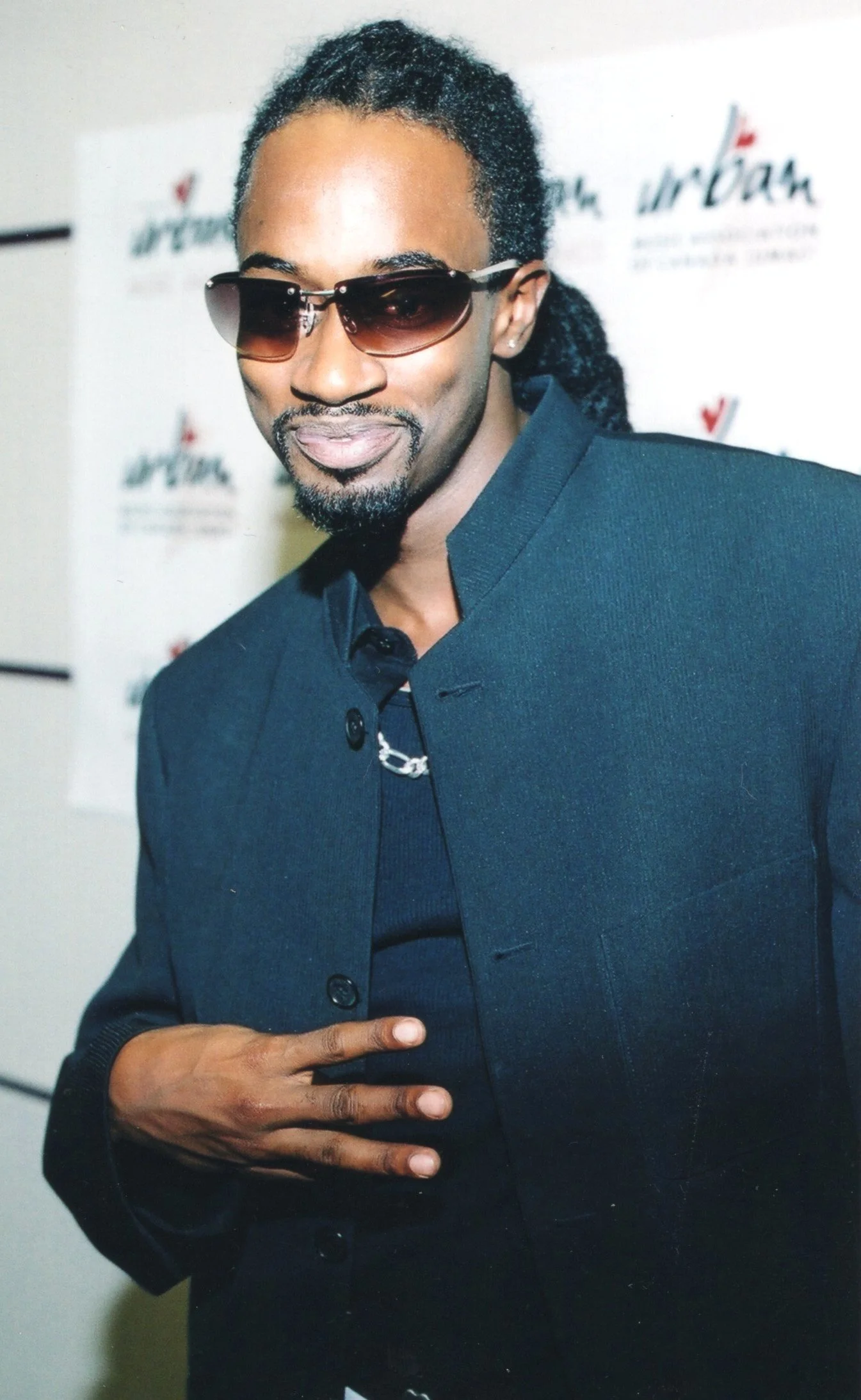
Saukrates at the 2004 Urban Music Awards (Photo by Ron Fanfair)
Having witnessed the evolution of the genre firsthand, Saukrates also reflected on the broader trajectory of Canadian hip-hop.
“All of us who dared to leave this planet we call Toronto and tasted other cities around the world saying, ‘I like your stuff,’” he said. “You learn that people have been paying attention since the ’90s, and that would have been through vinyl and moving records. Today, everything is digital, but it is still the same sentiment. Everyone from my generation who is still around and enjoying their craft had to leave. The new artists that have taken over left. It is going away to show home that the world cares. Sometimes, home can’t support our endeavours.”
That journey inevitably ties back to the role of community in shaping both opportunity and identity.
“Everything I have learned to do when it comes to arts, sports, teaching, learning and sharing outside of the professional music industry life has come from community programs and what elders built to be available,” Saukrates said. “They were character-forming, and I could not have done it without the community.”
He mentioned Fresh Arts, an artist-led mentorship program, as playing a central role in shaping that outlook.
For young artists watching Saukrates’ path, the lessons of patience and timing remain central to his message.
“Those who feel it should happen overnight feel privileged in the wrong ways,” he said. “I was privileged because of the mentorship and programs I went through. Growing up, many of my friends and I were aligned with the professional angle of this business because of the Fresh Arts program. From 14 years old, we were taken to the SOCAN office to register as writers by Wendy ‘Motion’ Brathwaite. Those programs lent stability.
“The scariest thing is that there are so many artists out there not even trying because they are uploading to streaming platforms. You have your independent distribution, and you are good to go from the luxury of your bedroom. The quality of the music I dare not judge because everybody has their thing, even if the content is a waste of my time. I am cool with that.”
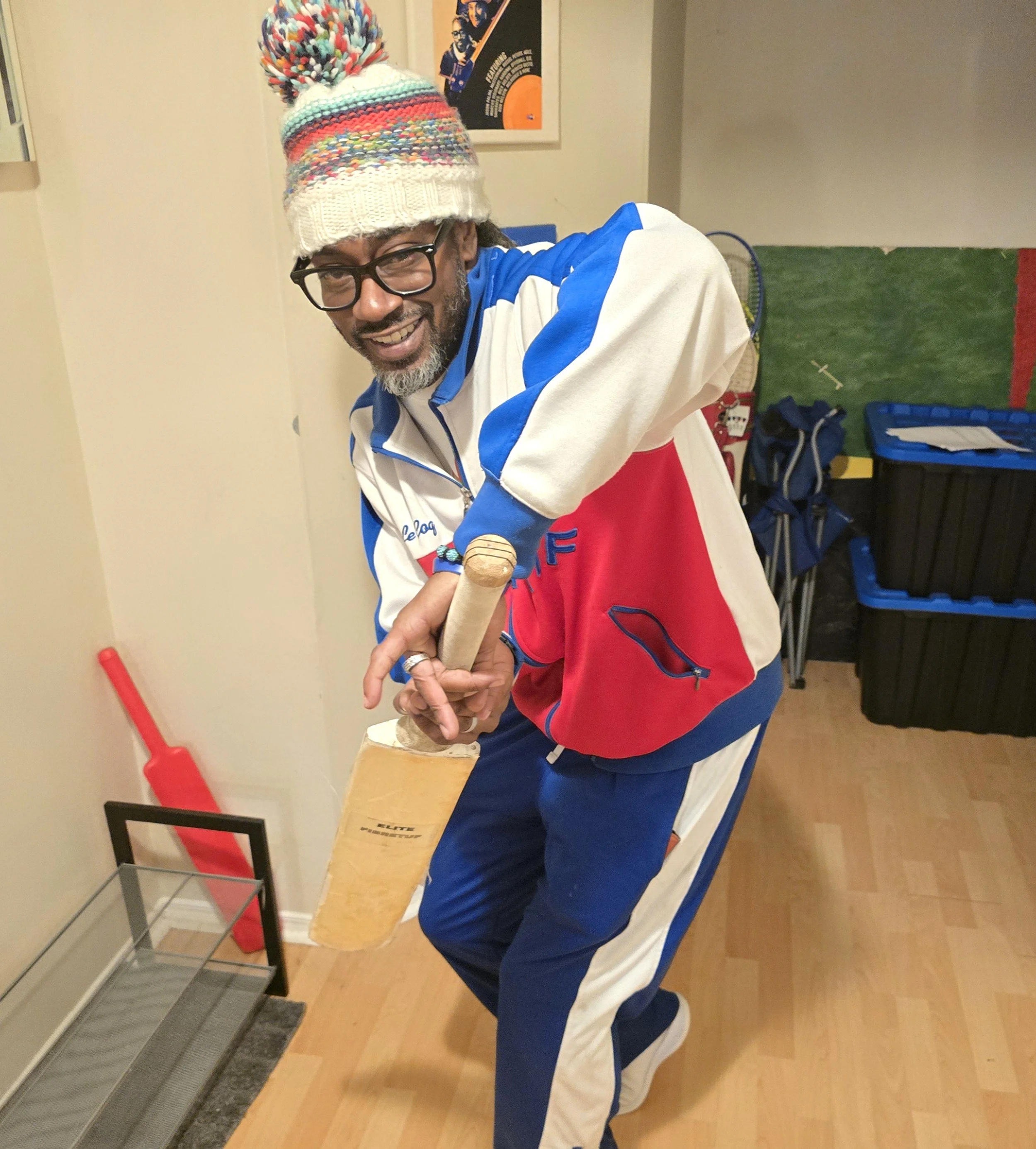
Saukrates poses with a cricket bat from his basement collection, a nod to his father’s lifelong connection to the sport in Guyana, Edmonton and Ontario (Photo by Ron Fanfair)
Away from the spotlight, it is the simplest parts of life that continue to ground and inspire him.
“Family, food, a newfound appreciation for spirituality, laughter, patience and hobbies off the beaten path,” Saukrates said. “I have a green thumb and I enjoy the garden. I have just ordered my garden supplies. I love living close to the lake. There is so much peace and wildlife. People are afraid of the swans. I feed them. We know where the nests are.”
He has lived in the West Rouge community since 1991, after spending his first two years in Ottawa and later relocating to Edmonton for seven years before returning to the Toronto area in December 1986.
With Saukrates’ voice part of a worldwide anthem and his career anchored by long-earned recognition, he stands at an intersection of meaning and momentum. It is a reminder that the most enduring journeys are not rushed, but built note by note, moment by moment, until the world is ready to listen.