Thrion Mitchell refused to let homlessness end his dream
May 21, 2026
Just when you think you have heard the full extent of the struggles many Caribbean students face while pursuing higher education, another story emerges that forces you to look even deeper.
For many young people across the region, access to university is tied to sacrifice, financial hardship and the hope that education can create a better future. Even receiving a scholarship to attend the University of the West Indies (UWI) is often seen as a life-changing opportunity.
But Thrion Mitchell’s journey takes that reality to another level.
Behind his academic achievements is a story shaped by homelessness, emotional struggles and uncertainty that few students could imagine enduring while trying to complete demanding university studies.
Yet through it all, he refused to give up.
Nearly two years ago, Mitchell entered the UWI Faculty of Social Sciences to pursue a double major in Banking and Finance & Economics. During his first year, his father provided financial support to help him through school. But when dad encountered setbacks and could no longer assist financially, his son was suddenly confronted with the harsh possibility of homelessness and being forced to abandon his studies.
His situation became even more desperate last year when campus security found him sleeping on the roof of the medical sciences building and removed him from the area, placing his belongings into two garbage bags. By then, the rooftop had already been his home for six months after he had earlier been forced to leave the roof of the science and technology building.
“When they found me there the second time, I realized I could no longer sleep anywhere on campus and might have to stay on the roadside,” Mitchell said. “One officer who knew me understood that I was not causing trouble or engaging in criminal activity. He allowed me to sleep in a hallway for one night and told me I would need to find somewhere else to stay the next day.”
Faced with nowhere else to turn, he approached the Office of Student Financing for assistance.
“I had applied for scholarships and did not hear back, so I decided to go there this time and plead my case,” Mitchell said. “They promised to help after hearing my story.”
Elizabeth Buchanan-Hind, executive director of UWI’s Institutional Advancement Division and chair of the UWI Toronto Benefit Awards Committee which raises scholarships and bursaries for Caribbean students, believed she had heard almost every kind of student hardship story.
That was until she learned of Mitchell’s case.
About 24 hours after seeking help, he received a phone call from Buchanan-Hind while wandering across campus, uncertain about what would come next.
She wanted to hear more about his story.
“After speaking with her, I sensed she genuinely cared,” Mitchell said. “It was a poignant moment for me because it was the first time I felt someone truly cared about me. Up until then, I believed people in positions of authority in Jamaica did not care about people like me.”
When Buchanan-Hind learned that Mitchell had maintained a perfect 4.0 GPA, the highest possible academic standing on a 4.0 scale, she became even more determined to help.
She promised to support him while also encouraging him to share his story to inspire others facing obstacles and considering giving up.
“Without that phone call from Ms. Elizabeth and her keeping her promise, I would not be speaking with you,” Mitchell said. “I would have been out of school and living on the street.”
He not only received a UWI scholarship but was also awarded a CB Group UWI 5K Scholarship in Jamaica.
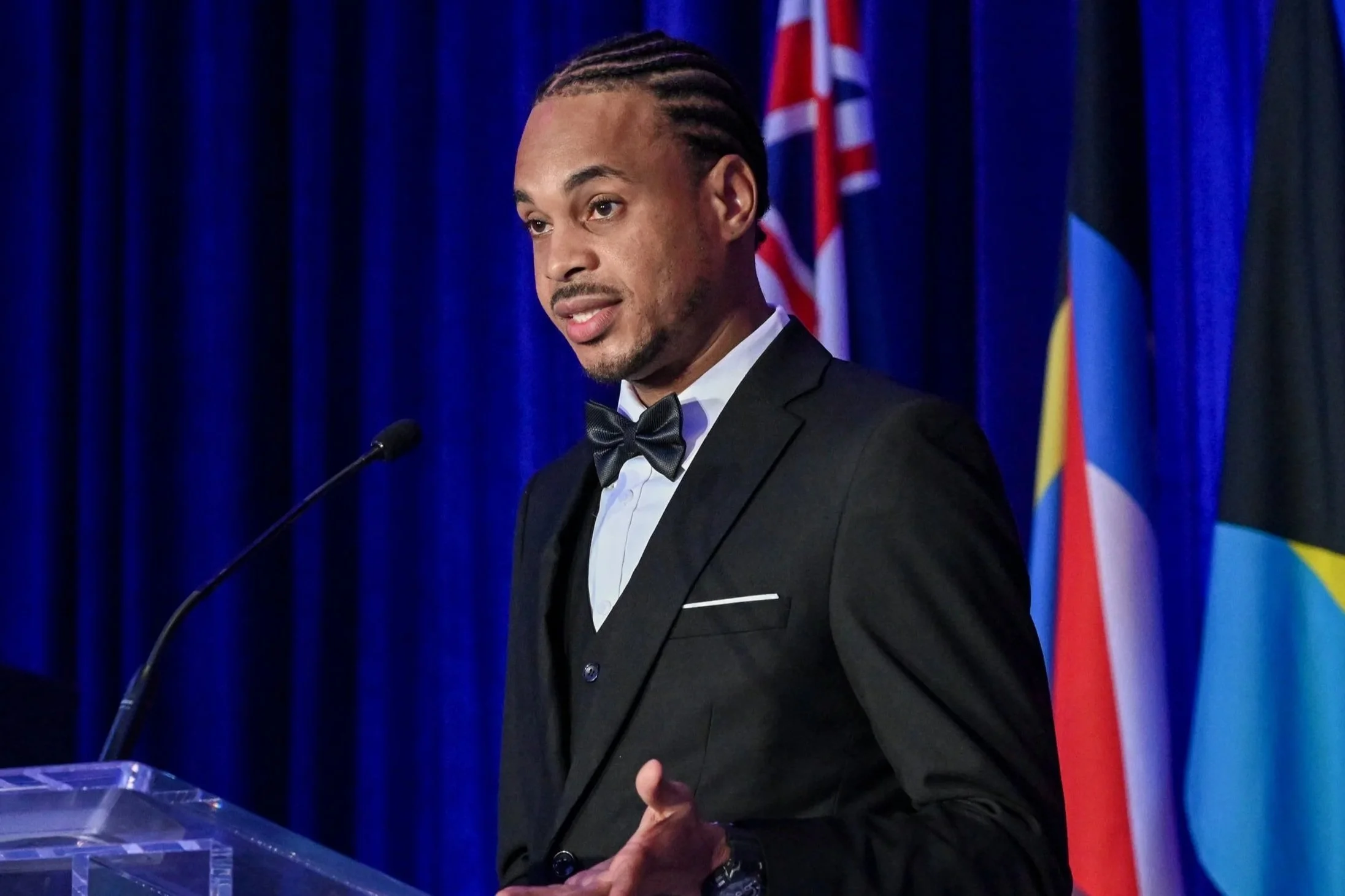
Last month marked the first time Mitchell had travelled outside Jamaica when he attended the 17th annual UWI Toronto Benefit Gala and shared his story with an audience, some of whom were moved to tears.
“Hearing students tell their stories of outstanding achievement despite unimaginable challenges is always grounding for me,” said Jamaican-born Mary Anne Chambers who is the University of Guelph chancellor. “It is truly a testament to their brilliance and determination. Brilliance clearly has no relationship to socio-economic status. Unfortunately, the absence of opportunity often goes hand in hand with poverty. If more young people were able to achieve their potential, I have absolutely no doubt that communities facing challenges would be better able to care for themselves. The world would be a much better place.”
Mitchell’s educational journey has not been straightforward.
After leaving Lionel Town in Clarendon to attend UWI in 2012, he completed his first year before eventually dropping out. Years later, he realized he needed to reclaim his future.
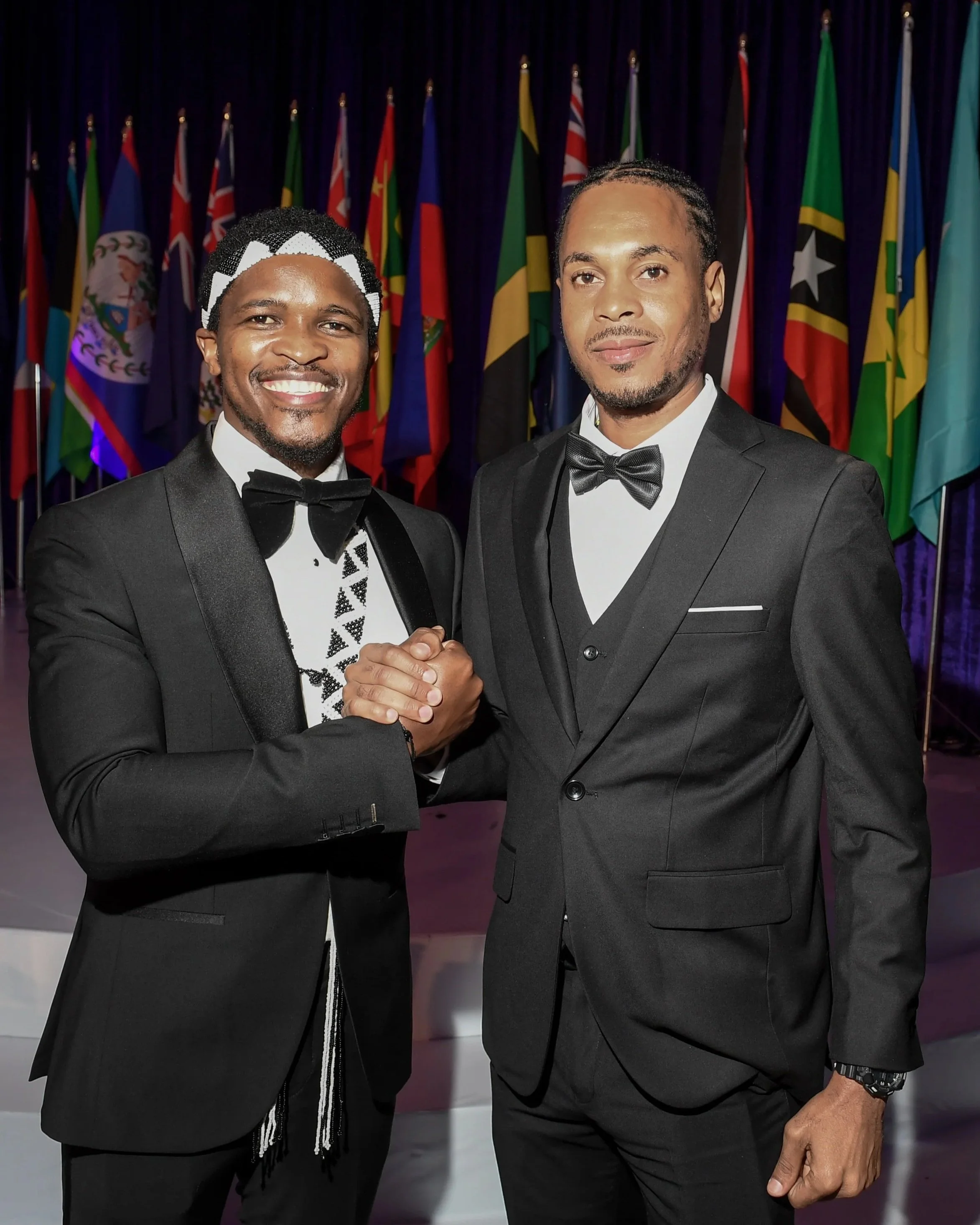
Thrion Mitchell (r) with Nelson Mandela’s grandson, Siyabulela Mandela, who was recognized with a Global Humanitarian Award at the UWI Toronto Benefit gala (George Pimentel Photography)
Mitchell points to the birth of his son in November 2021 and a candid conversation with the child’s mother as the turning point.
“She was not pleased with where I was in life and she let me know that in no uncertain terms,” he said. “She explained that the expectations she had for me drove her to a breaking point. That made me realize the life I was living might have been good enough for me, but not enough to support her and our son. At the same time, my parents are getting older, my younger siblings are growing up and I needed to put myself in a position of responsibility. I could not do that with the path I was on. It was enough to sustain me, but not enough for the man I was required to be.”
Conversations with family members, along with seeing where many of his peers were in life, convinced Mitchell that he needed to return to the classroom.
After his then-partner became pregnant, she travelled to the United States to give birth to their son. She later returned to Jamaica for several months before moving back to New York in the summer of 2023 with the child, where they now reside.
Mitchell has not seen his son since.
“Although the relationship between my son’s mother and me has deteriorated, I have spoken to him a few times,” he said. “I hope to go and see him later this year.”
Fatherhood has transformed the way Mitchell views life, responsibility and success.
“My son was born when I was 28 and up until then I was living my life for myself,” he admitted. “I was just doing enough to get by. I thought I was okay until my son came into the world and I realized that was not the case. I realized that, in addition to him needing me to fulfil my potential, my family members and community were also depending on me to use my potential to the fullest. I was being selfish instead of selfless. That sense of purpose was born in me when my son came into my life and it gave me the drive to want to do well.”
For Mitchell, success is about fulfilling responsibilities, being dependable and not becoming a burden to others.
Despite the hardships of homelessness and sleeping on stairwells and rooftops, he says those experiences strengthened rather than defeated him.
“To be honest, they didn’t break me because I come from the ghetto in Clarendon and grew up struggling,” Mitchell said. “It was not the first time I was sleeping outside and barely getting by. When I returned to Kingston to re-enter university, I knew what the circumstances were. If anything, it motivated me to do well. It made me more determined and increased my effort beyond what it would have been if I were in a more comfortable situation.”
That determination was reflected in the classroom, where he maintained a perfect 4.0 GPA and became one of the top performers in the Faculty of Social Sciences.
“I attended all my classes and paid close attention to everything the lecturers presented,” Mitchell said. “I built strong communication with classmates so we could help each other understand the material. I reviewed my notes daily and began preparing for final exams from the first week. I also asked a lot of questions in class. I loved what I was studying, which is very important if you want to succeed at anything. In essence, it was about using my time wisely and being intentional with how I spent it.”
His father also played a major role in shaping his outlook on life.
“He didn’t speak a lot, but when he spoke, his words carried weight,” Mitchell said. “He always told me to control my emotions and not give my power to others. He reminded me there would always be challenges in life, but I had to know who I was and how to respond to unfavourable situations. Otherwise, I would lose control of the outcome. He also taught me to be selfless. Being valuable to other people is a good thing, and it also brings value to you.”
Despite everything he has endured, he remains focused on using education to help others. As a student pursuing Banking and Finance & Economics at UWI, his long-term goal is to improve financial literacy in Jamaica and across the Caribbean.
“I am very passionate about educating my people to become more financially literate,” Mitchell said. “Growing up, I was not educated about money and finance. It was through networking with people while I was away from school that I learned about investing, stocks and how the economy works.
“Seeing how far people around me progressed because they had that knowledge made me realize how much people can improve socially and economically through financial education. I believe it can help reduce crime, poverty and some of the dysfunction associated with poverty. My aim is to contribute to Jamaica’s financial and economic landscape by helping people become more financially literate.”
He also hopes to become an entrepreneur and create agencies that would work alongside Jamaica’s Ministry of Finance and Ministry of Education to strengthen financial education initiatives across the country.
As part of a summer work and cultural exchange program, Mitchell is currently employed in customer service at Angel Fire year-round mountain destination in New Mexico until September 1 before returning to Jamaica to begin his third and final year at UWI.
The program allows university students from countries such as Jamaica to spend part of their summer working temporary jobs in the United States while experiencing American culture. Most placements are in the tourism and hospitality sectors, including resorts, hotels, restaurants and recreational destinations.
Located more than 8,000 feet above sea level, Angel Fire has presented an entirely new environment for Mitchell. Accustomed to Jamaica’s tropical climate, he struggled with colder temperatures, dry air and strong winds, which left him ill and dealing with severely chapped lips.
Still, after everything he has already overcome, he views this as simply another hurdle to conquer.
Mitchell’s story is not only about academic excellence. It is about resilience, redemption and discovering purpose through adversity.
It also raises broader questions about whether universities have a greater responsibility to strengthen support systems for students facing financial hardship, mental health struggles and housing insecurity before they reach a crisis point.