Canadian voices help lead Princeton’s new women in hip-hop curriculum
March 13, 2026
The launch of Miss-Education: The Women of Hip-Hop at Princeton University marks a significant moment in both academic and cultural history.
Housed at the Lewis Center for the Arts, the pioneering spring course places women at the centre of hip-hop’s story, recognizing female rappers as foundational architects of the genre rather than peripheral figures.
Adding to its significance, two of the course’s three instructors are women from Canada, underscoring the growing influence of Canadian scholars in shaping global conversations about hip-hop, culture and gender within one of the world’s leading Ivy League institutions.
Dr. Francesca D’Amico-Cuthbert, whose postdoctoral research examines Toronto rap music’s relationship to commerce, anti-Black market segmentation and access to state revenue streams and marketplace exposure, joined Ottawa-born rapper and scholar Eternia whose work explores gender equity in rap.
Together, they collaborated with American beatboxer and hip-hop studies academic Chesney Snow to develop the groundbreaking curriculum for the course.
D’Amico-Cuthbert said the decision by an Ivy League institution to embrace a course centred on women in hip-hop is especially meaningful.
“It signals a broader academic acknowledgment that many of the figures who built hip-hop culture are influential public intellectuals whose creative and intellectual interventions have shaped cultural expression and opened pathways for critical conversations about race, power, community and global culture,” said the cultural historian whose work focuses on hip-hop, Black cultural expression and contemporary art. “It is also important that these developments are happening at Ivy League institutions because of the global respect they command as centres of higher learning and critical thought.
“Hip-hop studies have been part of university classrooms for several decades, with early courses in the late 1980s and 1990s gradually evolving into full academic programs at institutions across North America and beyond. The growing presence of the field reflects recognition that hip-hop is more than music. It is a cultural movement shaped by artists, writers and thinkers whose work engages questions of identity, politics, economics and social change. We are helping expand the way hip-hop is understood by bringing a deeper cultural understanding of the form into the university space.”
Hip-hop has always been rooted in community and lived experience.
Snow, who conceived the idea for the course, explained how he, along with D’Amico-Cuthbert and Eternia, worked to translate the culture’s energy into an academic curriculum without losing the authenticity that defines it.
“I think the first thing we sought to do was to listen to the students -- what they were listening to and what their experiences within hip-hop culture were,” said Princeton University’s first full-time music theatre faculty member. “We wanted to understand where they were coming from and open a space where they could explore hip-hop while learning about its socio-political roots and artistic development. From there, we built a curriculum grounded in a social, political and historical exploration of the conditions that gave birth to the culture.”

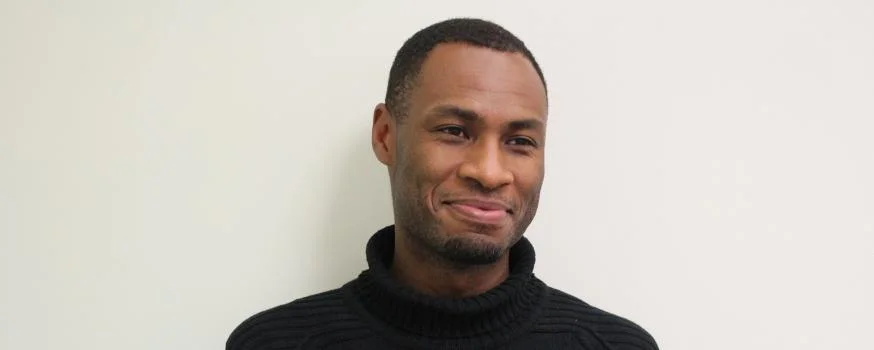
Chesney Snow (Photo contributed)
Snow noted that some people view institutions like Princeton as elite spaces that can appear disconnected from the lived realities of broader society, particularly working-class communities.
“While that perception may not be entirely inaccurate, one of the central ideas I share with my students is that hip-hop is fundamentally a knowledge movement,” he said. “When you frame hip-hop in that context, it aligns naturally with the mission of a place devoted to deep listening, inquiry and intellectual exploration. Hip-hop, at its core, is also a system of inquiry, a way of examining power, identity and resistance through creativity. Our goal was to design a curriculum that honours that intellectual depth without sanitizing the culture.”
Considered a pioneering figure in American beatbox culture, Snow views vocal expression as central to storytelling through the human body, one of hip-hop’s core elements.
“Sound and vocal percussion can be a form of healing that moves through the physical body while also telling a story,” he pointed out. “In many ways, it is similar to how Michael Winslow recreates soundscapes that are both narrative and musical, blending the two to create a kind of theatrical experience that immerses audiences in the wonder of human capacity. Exploring sound and performance in that way allows students to engage with the satirical and layered storytelling found in hip-hop. It opens the door to examining the sociological, archival and spiritual dimensions embodied within the culture.”
The course, Snow noted, was intentionally designed to bring students into direct contact with both practitioners and scholars who embody the culture.
“It was important to me that students learn directly from artists and scholars who are living embodiments of hip-hop,” said the three-time artist in residence at Harvard University Office of the Arts. “I have known Eternia for about 20 years through her work in New York City. She brings the perspective of a working artist who has lived the realities of the culture in nearly every way and continues to carry the torch for it.
“Francesca brings an extraordinary depth of scholarly cultural criticism and analysis. Frankly, I believe she is one of the leading scholars in the field globally. Having her voice as a historian was essential. She helps us interrogate the structures that shape how hip-hop is consumed, how we understand it and how it is represented.”

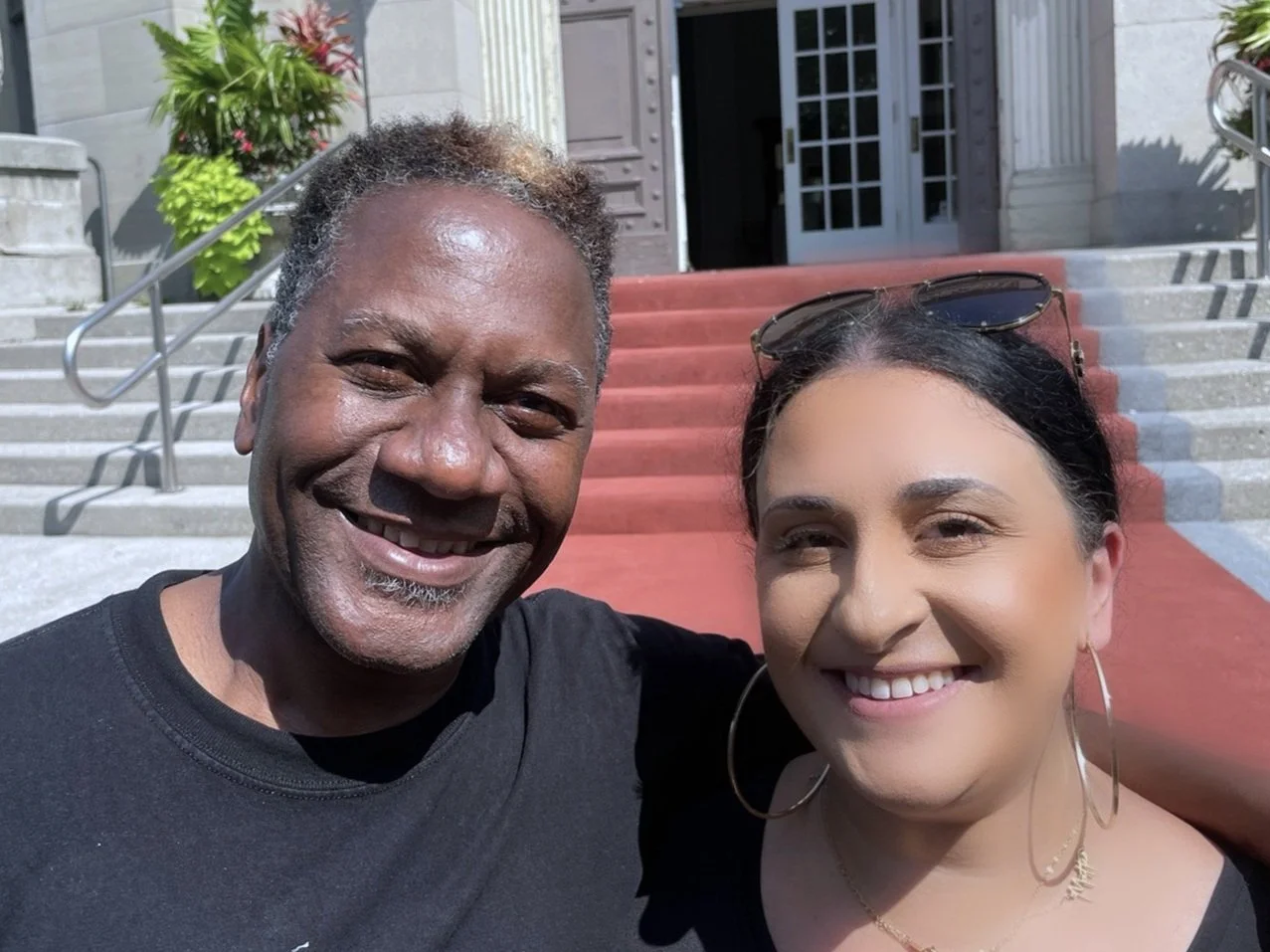
Two-time Juno-nominated Eternia (Photo contributed)
The pilot course deliberately emphasizes centring women’s voices, contributions and intellectual influence within hip-hop’s history and evolution.
Women, D’Amico-Cuthbert pointed out, have not always received full recognition for their central role in shaping hip-hop culture.
“For those of us who research women in hip-hop, the challenge is not only documenting how women have contributed to the culture,” she said. “It is also about demonstrating how crucial they have been to its development, even when their contributions have not always been fully acknowledged.
“When a university decides to revisit what we think we know about hip-hop and tell a story that centres the lives and work of women, it creates space to ask important questions. It allows us to examine why the culture has been understood in certain ways and how including women’s stories can deepen and broaden our understanding of what we know, and what we have yet to fully recognize about hip-hop.”
She emphasized the importance of institutionalizing the study of women emcees within academia rather than allowing that scholarship to exist only within cultural spaces.
“They are public intellectuals,” D’Amico-Cuthbert said. “I do not see Lauryn Hill or Queen Latifah any differently than I would see Cornel West, because so much of hip-hop is political in nature and engages with ideas. It is not only about taking positions on social issues, but also about how knowledge itself is produced and understood. Practitioners within hip-hop recognize that knowledge is politicized, and there is a deep awareness of that within the culture.
“To see emcees as anything less than thought leaders does not reflect their true role. They are not simply people putting words together in rhythm and rhyme. They are generating new ideas, offering new ways of looking at the world, engaging in public critique and often proposing solutions to the problems they see around them.”
In shaping the curriculum, D’Amico-Cuthbert said she and the other instructors gave careful thought to building a framework that reflects the diversity of women’s contributions to hip-hop.
“The goal was not only to recognize the pioneers who helped shape the culture, but also to connect those foundational voices with the perspectives of a younger generation of students whose cultural touchpoints may differ,” she said. “With hip-hop now more than 50 years old, that balance became central to the course design. We wanted to ensure students understand the historical significance of trailblazers such as Roxanne Shanté and MC Lyte while also creating space to acknowledge the artists and voices that resonate with today’s generation.”
The multimedia course is divided into three parts.
The first section introduces students to the origins of hip-hop and examines the role of women within the culture. It explores the experiences of women in hip-hop through major themes and interventions, with particular attention to feminism.
“Students examine how women in hip-hop responded to earlier feminist movements while also developing their own feminist perspectives and approaches,” said D’Amico-Cuthbert who is the Learning and Community Program Associate for Hart House Hip Hop Education at the University of Toronto. “We want them to think about the origin narratives of hip-hop and how those narratives are shaped by broader social, political, historical and economic forces, including the post-industrial crisis. These forces help create a particular landscape of gender and gender performance. By setting that context, we show students the power of who gets to shape the story and why the way it is told is deeply gendered.”
The second part focuses on inquiry and archiving.
“Students are encouraged to study and research the theory of hip-hop while also embodying that knowledge through creative and critical engagement,” said D’Amico-Cuthbert who is a founding member of Roots Rhymes Collective. “This work ultimately leads to our final performance that brings together their historical research and artistic expression.”
What does she hope students and the broader culture will take away from the course five or ten years from now?
“As a historian in the class, I always want students to think about the power dimensions of history,” D’Amico-Cuthbert said. “There is a misconception that historians simply gather details and compose a story. That is not the case. I want students to understand that the world as we know it, learn it and experience it is socially constructed. History is shaped by systems of power. I want them to think about story as power, and hip-hop does that particularly well.”
For Snow, the hope is that students leave the course with a deeper understanding of hip-hop through the cultural lens of hip-hop feminism.
“This is quite different from what people often think of as feminism in a broader sense,” he said. “While participating in many of the 50th anniversary hip-hop shows and conversations around them, I spent time with many women who came up through the culture. That experience made me feel compelled to help shift the narrative about the foundational role women have played in hip-hop. I hope students begin to recognize that hip-hop is a system of knowledge, not just a form of entertainment. The culture is a source of healing, and it also reflects human ingenuity and imagination.
“I want them to walk away understanding how they can use the performance elements of hip-hop in their research practices and hopefully feel inspired to carry the torch of the culture forward, not in ways dictated by corporate entertainment structures, but in ways that reflect hip-hop’s roots as an expression of oppressed people using knowledge to pursue liberation and innovation.”
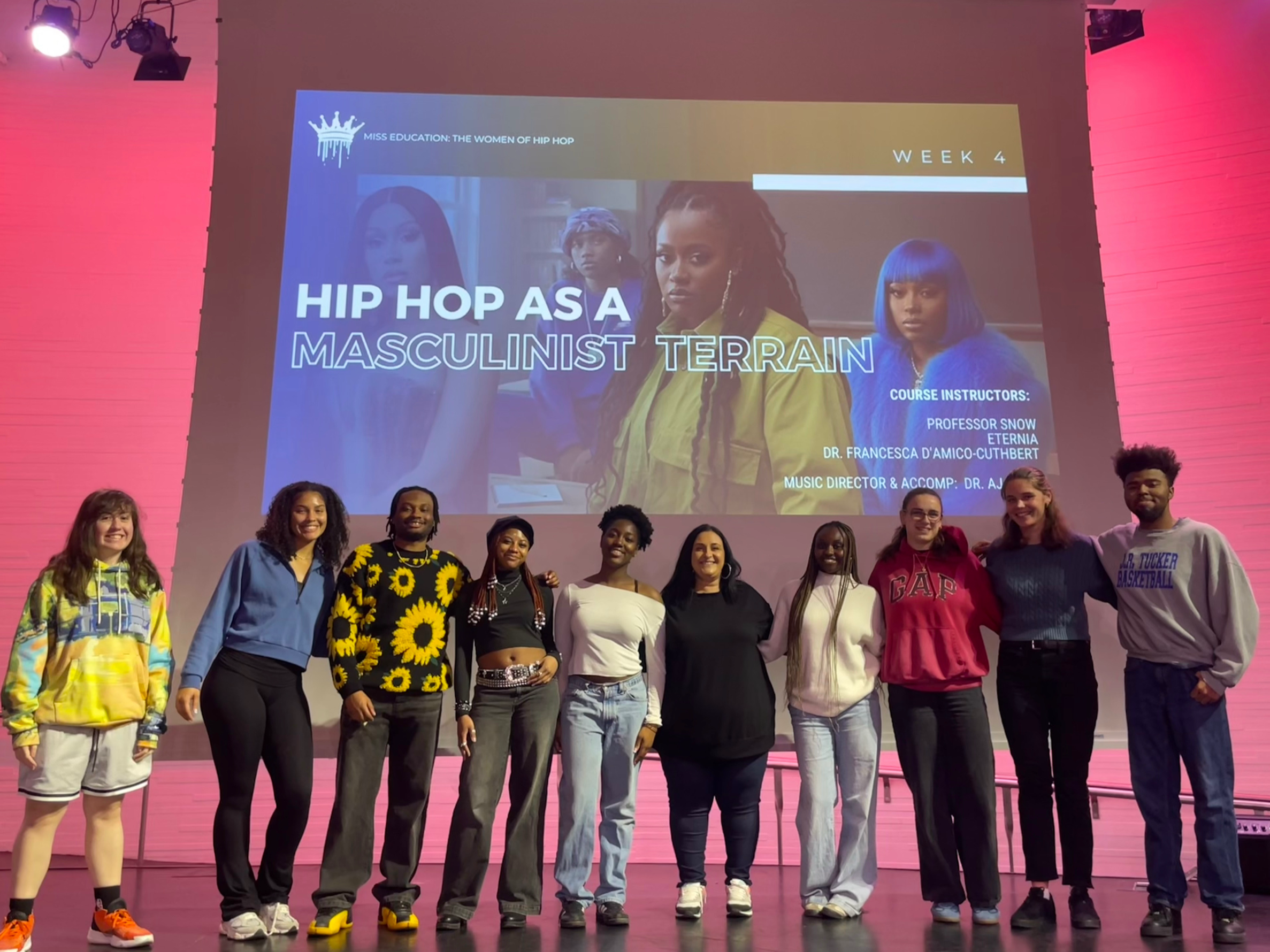
Dr. Francesca D’Amico-Cuthbert (sixth from left) with the inaugural cohort (Photo contributed)
Nine students are enrolled in the inaugural cohort, which began last month and runs through the end of April. Organizers hope the course will be offered again in future semesters and eventually become a permanent part of the curriculum.