Lillie Johnson's remarkable journey comes to a close
August 23, 2025
When you live to be a centenarian, it means you have witnessed a period of profound technological, social and cultural transformation, carried the weight of history and become a rare testament to resilience, wisdom and the enduring spirit of life.
Lillie Johnson’s 103 years were filled with a lifetime of love, fortitude and unforgettable memories.
She passed away in her sleep on August 10.
Johnson was the first Jamaican to train as a nurse at Western General Hospital where she graduated in 1954, the first Black midwife in Oxfordshire in England’s southeast in the mid-1950s and the first Black Director of Public Health in Eastern Ontario in 1961.
During her time with the Leeds, Grenville & Lanark District Health Unit, she advocated for better conditions for Caribbean farmworkers in the area.
In 1981, Johnson started the Sickle Cell Association of Ontario, initially conducting its work from her residence.

Sickle Cell Association of Ontario president Tiney Beckles (r) & Lillie Johnson in November 2016 (Photo by Ron Fanfair)
Sickle cell disease is a life-threatening and hereditary blood disorder that causes malformation of red blood cells that become distorted when they transmit oxygen through the body while thalassemia is an inherited blood disorder in which the body is unable to process normal functioning hemoglobin.
Invested into the Order of Ontario in 2011, Johnson was exposed to sickle cell disease and its effects after taking a summer course in genetics.
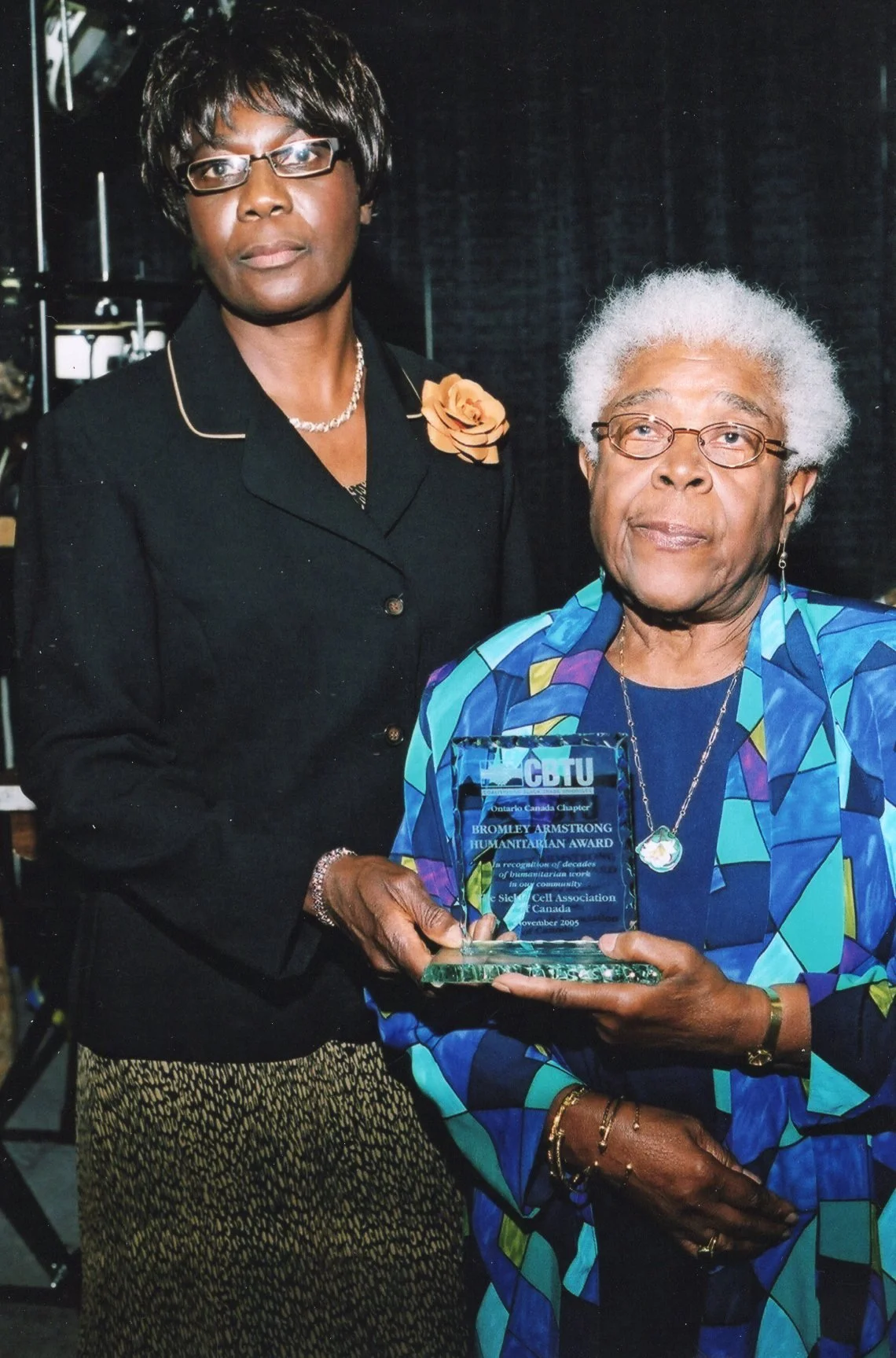
Sickle Cell Association of Ontario President Dottie Nicholas (l) presents the Bromley Armstrong Humanitarian Award to Sickle Cell Association of Ontario founding president Lillie Johnson at the Coalition of Black Trade Unionists ninth awards gala in November 2005 (Photo by Ron Fanfair)
She dedicated her life to educating sicklers and their families, health care practitioners, policy makers, educators, governments and the public about the symptoms and implications of the disease.
Johnson’s sustained passion as a sickle cell advocate resulted in the province’s Ministry of Health & Long-Term Care including sickle cell disease on the list of genetic diseases for universal newborn screening in 2005.
“Having learned from her about sickle cell disease and the significant challenges experienced by those who suffer from it, I was immensely proud as Ontario’s Minister of Children & Youth Services and the Member of Provincial Parliament for Scarborough East to announce at Centenary Hospital in Scarborough that the Ontario government would add screening for sickle cell disease to the other screening that was already being provided for newborns,” said Mary Anne Chambers. “Miss Lillie’s advocacy was relentless for many years before that change in public policy. The world is a better place because of her.”

Lillie Johnson with Joan Montgomery of the Kidney Foundation of Canada, National Council of Barbadian Associations in Canada chair Basil Blackman and Share publisher Arnold Auguste (l) who won an NCBAC raffle to Barbados. The presentation took place in January 1998 (Photo by Ron Fanfair)
Born in Westmoreland to parents who were educators, Johnson taught in elementary schools in Jamaica before going to Scotland in 1954 to pursue nursing.
“Her migration story offers a glimpse into her character,” said Dr. Karen Flynn, the Terrance & Karyn Holm Endowed Professor in the Department of Population Health Nursing Science at the University of Illinois, Chicago, College of Nursing, and director of the Midwest Nursing History Research Center. “When she decided to leave Jamaica, she invited several friends to accompany her, but they all declined. While many Caribbean people were moving to Britain, Lillie was the only one to head directly to Scotland, where there were very few Caribbean migrants.”
“Initially, she felt out of place and lonely, but she reminded herself, ‘If I want to go to the end of the world and nobody is going with me, I am still going’. She characterized herself as a superwoman who did not need anyone. While she would have preferred companionship, she was determined to live her one life fully. She told me she has one life to live and she will get on with it.”
Flynn interviewed Johnson who is on the cover of her book, ‘Moving Beyond Borders: A History of Black Canadian and Caribbean Women in the Diaspora’ which delved into the experiences of 35 postwar-era nurses who were born in Canada or who immigrated from the Caribbean either through Britain or directly to Canada.
“As we memorialize Lillie’s accomplishments, it also worth remembering the path she walked that began in Jamaica, her values, determination and courage further forged in Scotland and fully realized in Canada,” the York University doctoral graduate added.
After finishing her studies, Johnson returned to Jamaica and was at the University College of the West Indies hospital before going to New Jersey in 1958 to take up a position at Newark Beth Israel Medical Centre. She came to Canada two years later to work for the Canadian Red Cross which was looking for nurses for Ontario outposts.
Johnson was assigned to Red Lake which is nearly 100 kilometres from the Manitoba border. She later transferred to St. Joseph’s Health Care Centre in Toronto.

Lillie Johnson was a Pan Am Games torchbearer in July 2015 (Photo by Ron Fanfair)
After retirement in 1988, she volunteered with Canadian University Service Overseas (CUSO) in Jamaica for six years, providing treatment and health information to residents in disadvantaged communities. She later served on the CUSO advisory committee on her return to Canada.
Beverley Johnson, the Ontario Public Service Employees Union’s first human rights officer, was a close friend of Johnson for almost five decades.
“Lillie was a good friend who never hesitated to advise, encourage and support me and so many others,” she said. “She loved people and always saw the good and the best in them. Where she saw a need, it was not in her nature to wait for somebody else to take action. She did what she thought was appropriate and organized others into action. I will miss her infectious laughter and her mischievous and playful ways.”

Order of Ontario 2011 recipient Lillie Johnson with the province’s Lieutenant Governor David Onley who passed away in 2023 (Photo by Ron Fanfair)
Johnson co-founded TAIBU Community Health Centre in 2008 to provide quality and culturally appropriate primary health care and related services to the Black communities in the Greater Toronto Area as its priority population and Malvern residents.
She was also an active member of the Black Health Alliance, a network of community organizations, health professionals and community members working to advance the health and well-being of the Black community, Westmoreland Basic School Support and the Project for the Advancement of Childhood Education (PACE).
In March 2015, her biography, ‘My Dream’, was launched at the Jamaican Canadian Association Centre.

Lillie Johnson at her book launch in 2015 (Photo by Ron Fanfair)
“Retirement only allowed Lillie to do more,” late PACE founder Dr. Mavis Burke said in the book’s foreword. “Her clear mind and articulate expression made her a valuable member of any team, and her strenuous efforts to launch and maintain the important sickle cell society have assured her a place in history as the awards she has received from a grateful society have shown.”

Jamaica Canadian Association president Karl Fuller, who died last year in Florida, presents a JCA Special Achievement Award to Lillie Johnson in 1998 (Photo by Ron Fanfair)
Johnson was named the 2009 Public Health Champion by the City of Toronto’s Board of Health for her outstanding contributions to protecting and promoting the health of city residents.
The Lawrence Bloomberg Faculty of Nursing at the University of Toronto, where Johnson was a part-time student in the 1960s, honoured her with a Distinguished Alumnus Award in 2011 for her lifelong commitment to health care and sickle cell.
Nine years ago, the Ontario Long Term Care Association bestowed Johnson with a Lifetime Achievement Award.
She was invested into the Order of Canada last year at a special ceremony at Extendicare Rouge Valley in Scarborough where she resided.
Johnson was laid to rest on August 20.
“She was a multifaceted person who held diverse roles, including author, organist, teacher, nurse, knitter, seamstress, traveller, business owner and chief executive officer,” her nephew, Dennis Johnson, remarked in the eulogy. “Her life was a testament to sacrifice, generosity and love for others. She embodies exceptional qualities of kindness, gentleness, willingness, graciousness, etiquette, class and elegance. Her unwavering determination, hard work, family-oriented approach, dedication and ‘no excuses attitude’ stood out.”
On August 26, Ontario’s Deputy Premier Sylvia Jones will posthumously award Johnson the King Charles III Coronation Medal.